紅葉
Chinese
red; revolutionary; prosperity; bonus; popular |
leaf; page | ||
|---|---|---|---|
| trad. (紅葉) | 紅 | 葉 | |
| simp. (红叶) | 红 | 叶 | |
Pronunciation
Noun
紅葉
Japanese
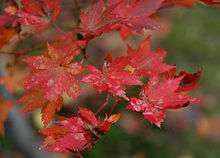
Etymology 1
| Kanji in this term | |
|---|---|
| 紅 | 葉 |
| もみ Grade: 6 |
Grade: 3 |
| Irregular | |
⟨momi1ti⟩ → /momit͡ɕi/
First attested in the Man'yōshū, spelled either in jukujikun (熟字訓) or phonetically in man'yōgana.
The 連用形 (ren'yōkei, “continuative form”) of Old Japanese verb 紅葉つ (momitsu, “of leaves, to change colors in autumn”), influenced by 紅 (momi, “silk cloth dyed crimson”) and classical verb 燃ゆ (moyu), modern 燃える (moeru, “to burn”, as the autumn colors appear like fire).
Alternative forms
- 黄葉 (usually for mostly "yellow" leaves)
Pronunciation
- (Irregular reading)
- IPA(key): [mo̞mʲit͡ɕi]
Noun
紅葉 (hiragana もみち, rōmaji momichi)
- (obsolete) the color-changing (in this case, the reddening) of leaves in autumn; also, the autumn leaves themselves
- c. 759, Man'yōshū (book 19, poem 4223), text here
- 安乎尓与之奈良比等美牟登和我世故我之米家牟毛美知都知尓於知米也毛 [Man'yōgana]
- あをによし奈良人見むと我が背子が標けむ紅葉地に落ちめやも [Modern spelling]
- c. 759, Man'yōshū (book 19, poem 4225), text here
- 足日木之山黄葉尓四頭久相而将落山道乎公之超麻久 [Man'yōgana]
- あしひきの山の紅葉にしづくあひて散らむ山道を君が越えまく [Modern spelling]
- ashi-hiki no yama no momichi ni shizuku aite chiramu yama-ji o kimi ga koemaku
- Together with the red autumn-leaves of the footdragging hills, the raindrops will be scattered on the hill-road, which my lord must cross over.[1]
- c. 759, Man'yōshū (book 19, poem 4223), text here
Etymology 2
| Kanji in this term | |
|---|---|
| 紅 | 葉 |
| もみ Grade: 6 |
Grade: 3 |
| Irregular | |
/momit͡ɕi/ → /momid͡ʑi/ → /momiʑi/
The 連用形 (ren'yōkei, “continuative form”) of classical verb 紅葉づ (momidu), modern 紅葉ず (momizu, “of leaves, to change colors in autumn”).
Appears to be a later sound change from momichi above.
Alternative forms
Pronunciation
Noun
紅葉 (hiragana もみじ, rōmaji momiji, historical hiragana もみぢ)
- the color-changing (in this case, the reddening) of leaves in autumn; also, the autumn leaves themselves
- 905, Kokin Wakashū, (book 4, poem 217; also Hyakunin Isshu, poem 5)
- Japanese maple (Acer palmatum); also, its leaves
- Synonym: 以呂波紅葉 (iroha-momiji)
- Short for 紅葉襲 (momiji-gasane).
- (colloquial) venison
- Synonym: 鹿肉 (shika-niku)
- name of a 家紋 (kamon, “family crest”), another name for 楓紋 (kaede-mon)
- (card games) the suit of cards in a hanafuda deck that show the autumn leaves, representing the month of October
Derived terms
- 紅葉に青短 (momiji ni aotan, hanafuda card)
- 紅葉に鹿 (momiji ni shika, proverb, hanafuda card)
- 紅葉の錦 (momiji no nishiki, “brocade of autumn leaves”)
- 紅葉の橋 (momiji no hashi)
- 紅葉のカス (momiji no kasu, hanafuda card)
- 紅葉葵 (momiji aoi, “Hibiscus coccineus”)
- 紅葉苺 (momiji ichigo, “Rubus palmatus var. coptophyllus”)
- 紅葉卸, 紅葉卸し (momiji-oroshi)
- 紅葉貝 (momijigai, “Astropecten scoparius”)
- 紅葉笠, 紅葉傘 (momijigasa, “Parasenecio delphiniifolius”)
- 紅葉襲 (momiji-gasane)
- 紅葉唐松 (momiji karamatsu, “false bugbane”)
- 紅葉狩, 紅葉狩り (momiji-gari, “autmumn-leaf viewing”)
- 紅葉衣 (momiji-goromo), 紅葉の衣 (momiji no koromo)
- 紅葉前線 (momiji zensen)
- 紅葉鯛 (momijidai)
- 紅葉月 (momiji-zuki, “ninth lunar month”)
- 紅葉鳥 (momijidori)
- 紅葉賀 (Momiji no Ga, chapter in The Tale of Genji)
- 紅葉 (momiji-ba, see below)
- 紅葉羽熊 (momiji haguma)
- 紅葉鮒 (momiji-buna)
- 紅葉マーク (momiji māku)
- 紅葉見 (momijimi)
- 紅葉蓆, 紅葉筵 (momiji-mushiro)
- 青紅葉 (ao momiji)
- 銀杏紅葉 (ichō-momiji)
- 以呂波紅葉 (iroha-momiji)
- 薄紅葉 (usu momiji)
- 卯月の紅葉 (Uzuki no Momiji)
- 漆紅葉 (urushi momiji)
- 大紅葉 (ō-momiji)
- 柿紅葉 (kaki-momiji)
- 草紅葉 (kusa-momiji)
- 紅紅葉 (kurenai-momiji)
- 桜紅葉 (sakura-momiji)
- 下紅葉 (shita momiji)
- 蔦紅葉 (tsuta-momiji)
- 照り紅葉 (teri-momiji)
- 櫨紅葉 (haji-momiji)
- 初紅葉 (hatsu momiji)
- 花紅葉 (hana momiji)
- 山紅葉 (yama-momiji)
- 夕紅葉 (yū-momiji)
Idioms
- 紅葉のような手 (momiji no yō na te)
- 紅葉を散らす (momiji o chirasu)
Coordinate terms
- 楓, 槭樹 (kaede, “maple tree”)
- 花札 (hanafuda) suits: 松 (matsu, “pine”), 梅 (ume, “plum blossoms”), 桜 (sakura, “sakura”), 藤 (fuji, “wisteria”), 菖蒲 (ayame, “iris”), 牡丹 (botan, “peony”), 萩 (hagi, “bush clover”), 芒 (susuki, “susuki grass”), 菊 (kiku, “chrysanthemum”), 紅葉 (momiji, “autumn leaves”), 柳 (yanagi, “willow”), 桐 (kiri, “paulownia”)
Verb
紅葉する (hiragana もみじする, rōmaji momiji suru, historical hiragana もみぢする)
Inflection
| Stem forms | ||||
|---|---|---|---|---|
| Imperfective (未然形) | 紅葉し | もみじし | momiji shi | |
| Continuative (連用形) | 紅葉し | もみじし | momiji shi | |
| Terminal (終止形) | 紅葉する | もみじする | momiji suru | |
| Attributive (連体形) | 紅葉する | もみじする | momiji suru | |
| Hypothetical (仮定形) | 紅葉すれ | もみじすれ | momiji sure | |
| Imperative (命令形) | 紅葉せよ¹ 紅葉しろ² |
もみじせよ¹ もみじしろ² |
momiji seyo¹ momiji shiro² | |
| Key constructions | ||||
| Passive | 紅葉される | もみじされる | momiji sareru | |
| Causative | 紅葉させる 紅葉さす |
もみじさせる もみじさす |
momiji saseru momiji sasu | |
| Potential | 紅葉できる | もみじできる | momiji dekiru | |
| Volitional | 紅葉しよう | もみじしよう | momiji shiyō | |
| Negative | 紅葉しない | もみじしない | momiji shinai | |
| Negative continuative | 紅葉せず | もみじせず | momiji sezu | |
| Formal | 紅葉します | もみじします | momiji shimasu | |
| Perfective | 紅葉した | もみじした | momiji shita | |
| Conjunctive | 紅葉して | もみじして | momiji shite | |
| Hypothetical conditional | 紅葉すれば | もみじすれば | momiji sureba | |
| ¹ Written imperative ² Spoken imperative | ||||
Proper noun
紅葉 (hiragana もみじ, rōmaji Momiji)
- a place name
- a surname.
- a female given name
Etymology 3
| Kanji in this term | |
|---|---|
| 紅 | 葉 |
| もみ Grade: 6 |
は > ば Grade: 3 |
| kun’yomi | |
From Old Japanese.
Compound of 紅葉 (momiji, “autumn colors”) + 葉 (ha, “leaf”). The ha changes to ba as an instance of rendaku (連濁). Also appears with the ancient pronunciation of momichi.
The momichi/momiji part is usually spelled in kana for emphasis.
Alternative forms
- (rare, found in compounds): 紅葉葉
- (usually mostly "yellow" leaves): 黄葉
Pronunciation
Noun
紅葉 (hiragana もみじば, rōmaji momiji-ba, historical hiragana もみぢば)
(alternative reading hiragana もみちば, romaji momichi-ba)
- the leaves that changed color (in this case, into red) in autumn
- the leaves of the 楓 (kaede, “Japanese maple”, Acer palmatum), also known as momiji
- c. 1005, Shūi Wakashū (book 17, poem 1128; also Hyakunin Isshu, poem 26)
Derived terms
- 紅葉の (momichi-ba no), 紅葉の (momiji-ba no, pillow word)
- 紅葉葉団扇 (momijiba uchiwa)
- 紅葉葉鈴掛の木 (momijiba-suzukake-no-ki, “London plane”)
- 紅葉葉楓 (momijibafū, “Liquidambar styraciflua”)
Etymology 4
| Kanji in this term | |
|---|---|
| 紅 | 葉 |
| こう Grade: 6 |
よう Grade: 3 |
| on’yomi | |
/kou epu/ → /koueu/ → /koːyoː/
From Middle Chinese 紅葉 (MC ɦuŋ jiᴇp̚). (Can this(+) etymology be sourced?)
Pronunciation
Noun
紅葉 (hiragana こうよう, rōmaji kōyō, historical hiragana こうえふ)
- the color-changing of leaves in autumn, usually into red; also, the red leaves themselves
- 1999 August 26, “紅葉の女王 [Queen of Autumn Leaves]”, in BOOSTER 4, Konami:
- 鮮やかな紅葉に囲まれて暮らす、緑樹の霊王のお妃。
- Azayaka na kōyō ni kakomarete kurasu, Ryokuju no Reiō no ohi.
- The consort of the Spirit King of Greenery, living within vibrant autumn leaves.
- 鮮やかな紅葉に囲まれて暮らす、緑樹の霊王のお妃。
-
Derived terms
- 紅葉前線 (kōyō zensen)
- 林間に酒を煖めて紅葉を焼く (rinkan ni sake o atatamete kōyō o yaku)
See also
- 黄葉 (kōyō, “colored (mostly yellow) autumn leaves”)
Verb
紅葉する (hiragana こうようする, rōmaji kōyō suru, historical hiragana こうえふする)
Inflection
| Stem forms | ||||
|---|---|---|---|---|
| Imperfective (未然形) | 紅葉し | こうようし | kōyō shi | |
| Continuative (連用形) | 紅葉し | こうようし | kōyō shi | |
| Terminal (終止形) | 紅葉する | こうようする | kōyō suru | |
| Attributive (連体形) | 紅葉する | こうようする | kōyō suru | |
| Hypothetical (仮定形) | 紅葉すれ | こうようすれ | kōyō sure | |
| Imperative (命令形) | 紅葉せよ¹ 紅葉しろ² |
こうようせよ¹ こうようしろ² |
kōyō seyo¹ kōyō shiro² | |
| Key constructions | ||||
| Passive | 紅葉される | こうようされる | kōyō sareru | |
| Causative | 紅葉させる 紅葉さす |
こうようさせる こうようさす |
kōyō saseru kōyō sasu | |
| Potential | 紅葉できる | こうようできる | kōyō dekiru | |
| Volitional | 紅葉しよう | こうようしよう | kōyō shiyō | |
| Negative | 紅葉しない | こうようしない | kōyō shinai | |
| Negative continuative | 紅葉せず | こうようせず | kōyō sezu | |
| Formal | 紅葉します | こうようします | kōyō shimasu | |
| Perfective | 紅葉した | こうようした | kōyō shita | |
| Conjunctive | 紅葉して | こうようして | kōyō shite | |
| Hypothetical conditional | 紅葉すれば | こうようすれば | kōyō sureba | |
| ¹ Written imperative ² Spoken imperative | ||||
Proper noun
紅葉 (hiragana こうよう, rōmaji Kōyō, historical hiragana こうえふ)
- a female given name
Etymology 5
Various nanori readings.
Proper noun
紅葉 (hiragana あかは, rōmaji Akaha, alternative reading あけは, rōmaji Akeha, alternative reading あげは, rōmaji Ageha, alternative reading いろは, rōmaji Iroha, alternative reading かえで, rōmaji Kaede, alternative reading くれは, rōmaji Kureha, alternative reading べには, rōmaji Beniha, alternative reading もみ, rōmaji Momi, alternative reading もよ, rōmaji Moyo)
- a female given name
References
- 1 2 Jan Lodewijk Pierson, Jr. (1963) The Manyôśû Translated and Annotated Book XVIII, Brill Archive
- 1 2 3 2006, 大辞林 (Daijirin), Third Edition (in Japanese), Tōkyō: Sanseidō, →ISBN
- ↑ Janet Emily Goff (2014) Noh Drama and "The Tale of the Genji": The Art of Allusion in Fifteen Classical Plays (Princeton Legacy Library), annotated edition, Princeton University Press, →ISBN, page 263
- ↑ Sasaki Sanmi; Shaun McCabe; Iwasaki Satoko (2011) Chado the Way of Tea: A Japanese Tea Master's Almanac, Tuttle Publishing, →ISBN, page 564