敦
| ||||||||
Translingual
Han character
敦 (radical 66, 攴+8, 12 strokes, cangjie input 卜木人大 (YDOK), four-corner 08440, composition ⿰享攵)
Derived characters
References
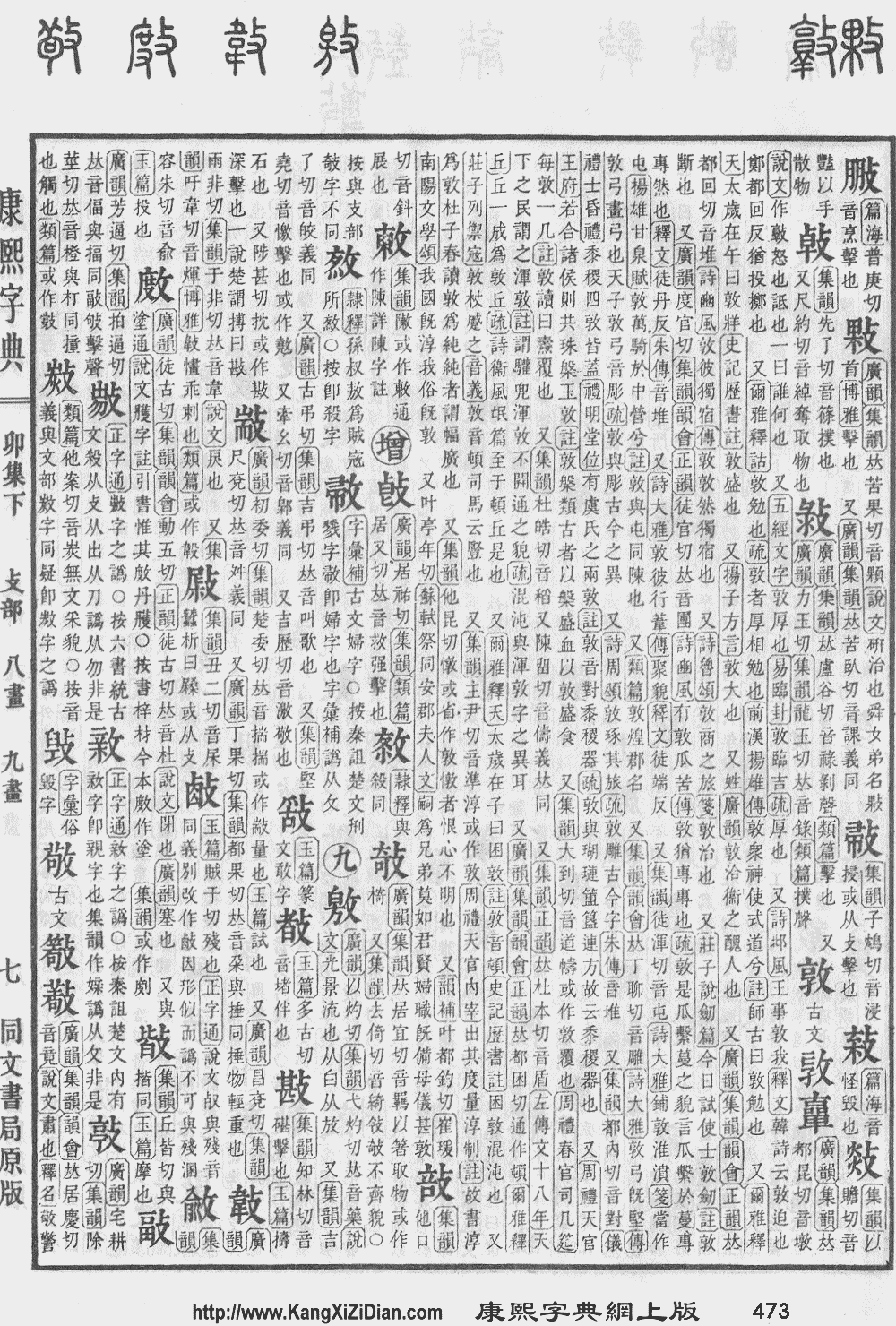
- KangXi: page 473, character 8
- Dai Kanwa Jiten: character 13276
- Dae Jaweon: page 826, character 10
- Hanyu Da Zidian: volume 2, page 1468, character 1
- Unihan data for U+6566
Chinese
| simp. and trad. |
敦 | |
|---|---|---|
Glyph origin
| Historical forms of the character 敦 | ||
|---|---|---|
| Western Zhou | Shuowen Jiezi (compiled in Han) | Liushutong (compiled in Ming) |
| Bronze inscriptions | Small seal script | Transcribed ancient scripts |
 |
 |
 |
| Characters in the same phonetic series (敦) (Zhengzhang, 2003) | |
|---|---|
| Old Chinese | |
| 弴 | *tjuː, *tuːn |
| 敦 | *tuːl, *doːn, *tuːn, *tuːns |
| 錞 | *duːlʔ, *duːls, *djun |
| 憝 | *duːls |
| 憞 | *duːls |
| 譈 | *duːls |
| 鐓 | *duːls |
| 鷻 | *doːn |
| 鶉 | *doːn, *djun |
| 惇 | *tuːn, *tjun |
| 墩 | *tuːn |
| 驐 | *tuːn |
| 燉 | *tuːns, *tʰuːn, *duːn |
| 焞 | *tʰuːn, *djun |
| 啍 | *tʰuːn, *duːn |
| 暾 | *tʰuːn |
| 噋 | *tʰuːn, *kʰʷaːɡ |
| 諄 | *tjun, *tjuns |
| 埻 | *tjunʔ, *kʷaːɡ, *kʷreːɡ |
| 稕 | *tjuns |
| 醇 | *djun |
| 淳 | *djun |
| 犉 | *njun |
Phono-semantic compound (形聲, OC *tuːl, *doːn, *tuːn, *tuːns) : phonetic 𦎫 + semantic 攴 (“hand”)
Etymology 1
- “thick; earnest; plentiful; large”
- From Proto-Sino-Tibetan *(t/d)ow-n (“thick”).
This etymology is incomplete. You can help Wiktionary by elaborating on the origins of this term.
Pronunciation
Definitions
敦
Compounds
Etymology 2
Pronunciation
Definitions
敦
Compounds
|
Etymology 3
Pronunciation
Definitions
敦
- † to administer; to manage
- 敦商之旅,克咸厥功。 [Classical Chinese, trad. and simp.]
- From: The Classic of Poetry, circa 11th – 7th centuries BCE, translated based on James Legge's version
- Duī Shāng zhī lǚ, kè xián jué gōng. [Pinyin]
- [Wu] disposed of the troops of Shang;
He and his men shared equally in the achievement.
- † solitary
- 敦彼獨宿,亦在車下。 [Classical Chinese, trad.]
- From: The Classic of Poetry, circa 11th – 7th centuries BCE, translated based on James Legge's version
- Duī bǐ dú sù, yì zài chē xià. [Pinyin]
- And quietly and solitarily did we pass the night,
Under our carriages.
敦彼独宿,亦在车下。 [Classical Chinese, simp.]
- † to throw
- † to force upon
- 王事敦我,政事一埤遺我。 [Classical Chinese, trad.]
- From: The Classic of Poetry, circa 11th – 7th centuries BCE, translated based on James Legge's version
- Wángshì duī wǒ, zhèngshì yī pí yí wǒ. [Pinyin]
- The king's business is thrown on me,
And the affairs of our government are left to me more and more.
王事敦我,政事一埤遗我。 [Classical Chinese, simp.]
Etymology 4
See 團 (OC *doːn).
Pronunciation
Definitions
敦
- † clustered
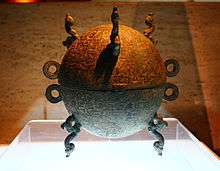
- † Alternative form of 團/团 (tuán, “round”).
- 有敦瓜苦,烝在栗薪。 [Classical Chinese, trad. and simp.]
- From: The Classic of Poetry, circa 11th – 7th centuries BCE, translated based on James Legge's version
- Yǒu tuán guā kǔ, zhēng zài lì xīn. [Pinyin]
- There were the round bitter gourds hanging,
From the branches of the chestnut trees.
Etymology 5
Pronunciation
Definitions
敦
Etymology 6
Pronunciation
Definitions
敦
- Only used in 混敦 and 敦然.
Etymology 7
Pronunciation
Definitions
敦
- Only used in 敦恨.
Etymology 8
| For pronunciation and definitions of 敦 – see 雕 (“to engrave; to inlay; to carve; etc.”). (This character, 敦, is a variant form of 雕.) |
Etymology 9
| For pronunciation and definitions of 敦 – see 燾 (“shine, illuminate; cover, envelope”). (This character, 敦, is a variant form of 燾.) |
Etymology 10
| For pronunciation and definitions of 敦 – see 淳 (“thick; honest; etc.”). (This character, 敦, is a variant form of 淳.) |
Etymology 11
| For pronunciation and definitions of 敦 – see 屯 (“Chúnliú; village, hamlet; etc.”). (This character, 敦, is a variant form of 屯.) |
Etymology 12
| For pronunciation and definitions of 敦 – see 墩 (“heap, mound; block of stone”). (This character, 敦, is the second-round simplified form of 墩.) |
Notes:
|
Etymology 13
| For pronunciation and definitions of 敦 – see 礅. (This character, 敦, is the second-round simplified form of 礅.) |
Notes:
|
Etymology 14
| For pronunciation and definitions of 敦 – see 蹾 (“to squat; to crouch”). (This character, 敦, is the second-round simplified form of 蹾.) |
Notes:
|
Etymology 15
| For pronunciation and definitions of 敦 – see 撉 (“to jolt; to thump”). (This character, 敦, is the second-round simplified form of 撉.) |
Notes:
|
Japanese
Kanji
敦
(“Jinmeiyō” kanji used for names)
Readings
Compounds
Compounds
- 敦盛 (atsumori)
- 敦賀 (Tsuruga): Tsuruga, Fukui
- 敦厚 (tonkō)
- 敦煌 (Tonkō); Dunhuang
Etymology
| Kanji in this term |
|---|
| 敦 |
| たい Jinmeiyō |
| on’yomi |
From Middle Chinese 敦 (twoj).
Pronunciation
Noun
Proper noun
敦 (hiragana あつし, rōmaji Atsushi)
- A male given name.
敦 (hiragana つとむ, rōmaji Tsutomu)
- A male given name.
References
Korean
Hanja
敦 • (don, toe) (hangeul 돈, 퇴, revised don, toe, McCune–Reischauer ton, t'oe, Yale ton, thoy)
- This term needs a translation to English. Please help out and add a translation, then remove the text
{{rfdef}}.
Vietnamese
Han character
敦 (đôn, đon, gion, ton, xôn, xun, dôn, đùn, giôn, nhật)
- This term needs a translation to English. Please help out and add a translation, then remove the text
{{rfdef}}.
This article is issued from
Wiktionary.
The text is licensed under Creative Commons - Attribution - Sharealike.
Additional terms may apply for the media files.