火鼠
Chinese
fire; angry; fierce; fiery; thriving |
rat; mouse | ||
|---|---|---|---|
| simp. and trad. (火鼠) |
火 | 鼠 | |
Pronunciation
Noun
火鼠
Japanese
FWOTD – 20 April 2014
Etymology 1
| Kanji in this term | |
|---|---|
| 火 | 鼠 |
| ひ Grade: 1 |
ねずみ Hyōgaiji |
| kun’yomi | |
Compound of Old Japanese elements 火 (hi, “fire”) + 鼠 (nezumi, “rat, mouse”).[1][2]
Pronunciation
Noun
火鼠 (hiragana ひねずみ, rōmaji hinezumi)
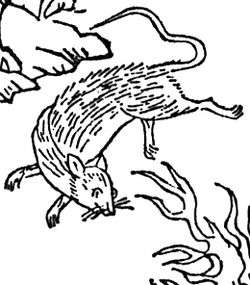
- a fire-rat: an imaginary creature of ancient China resembling a white rat, thought to live in the volcanoes of the South China Sea and to have fireproof fur
- 10th century: The Tale of the Bamboo Cutter
- 唐土にある、火鼠の裘を給へ
- もろこしにある、ひねずみのかわごろもをたまえ
- Morokoshi ni aru, hinezumi no kawagoromo o tamae
- Get me the fur robe of the fire-rat in China...
- 唐土にある、火鼠の裘を給へ
- 10th century: The Tale of the Bamboo Cutter
Derived terms
Etymology 2
| Kanji in this term | |
|---|---|
| 火 | 鼠 |
| か Grade: 1 |
そ Hyōgaiji |
| on’yomi | |
/kwaso/ → /kaso/
From Middle Chinese compound 火鼠 (*xuɑ̌ *shiǔ, literally “fire rat”). Date of borrowing unknown.
Pronunciation
Noun
火鼠 (hiragana かそ, rōmaji kaso, historical hiragana くわそ)
Usage notes
The hinezumi reading is more common.
References
This article is issued from
Wiktionary.
The text is licensed under Creative Commons - Attribution - Sharealike.
Additional terms may apply for the media files.