sino
Cebuano
Pronunciation
- Hyphenation: si‧no
Noun
sino
- a mature coconut fruit
Galician
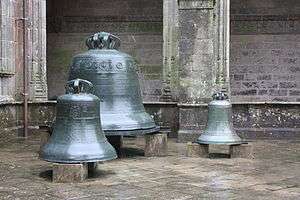
Etymology
13th century. From Old Portuguese sino, from Latin signum, from Proto-Indo-European *sek- (“to cut”) or *sekʷ- (“to follow”). Cognate with Portuguese sino.
Pronunciation
- IPA(key): /ˈsi.no̝/
Noun
sino m (plural sinos)
References
- “sino” in Dicionario de Dicionarios do galego medieval, SLI - ILGA 2006-2012.
- “sino” in Xavier Varela Barreiro & Xavier Gómez Guinovart: Corpus Xelmírez - Corpus lingüístico da Galicia medieval. SLI / Grupo TALG / ILG, 2006-2016.
- “sino” in Dicionario de Dicionarios da lingua galega, SLI - ILGA 2006-2013.
- “sino” in Santamarina, Antón (coord.): Tesouro informatizado da lingua galega. Santiago de Compostela: Instituto da Lingua Galega.
- “sino” in Álvarez, Rosario (coord.): Tesouro do léxico patrimonial galego e portugués, Santiago de Compostela: Instituto da Lingua Galega.
Inari Sami
Noun
siṇo
Inflection
| Inflection of sino | ||
|---|---|---|
| singular | plural | |
| Nominative | sino | sinoh |
| Accusative | sino | sinoid |
| Genitive | sino | sinoi |
| Illative | sinon | sinoid |
| Locative | siinoost | sinoin |
| Comitative | sinoin | sinoiguin |
| Abessive | sinottáá | sinoittáá |
| Essive | sinnoon | — |
| Partitive | sinnood | — |
Further reading
Italian
Preposition
sino
- Alternative form of fino.
Derived terms
- sin d'ora
- sin da
- sin qui
Anagrams
Latin
Etymology
From Proto-Indo-European *tḱi-né-ti, denominative present of the root *tḱey-.
Pronunciation
- (Classical) IPA(key): /ˈsi.noː/, [ˈsɪ.noː]
Verb
sinō (present infinitive sinere, perfect active sīvī, supine situm); third conjugation
Inflection
1At least one rare poetic syncopated perfect form is attested.
Derived terms
References
- sino in Charlton T. Lewis and Charles Short (1879) A Latin Dictionary, Oxford: Clarendon Press
- sino in Charlton T. Lewis (1891) An Elementary Latin Dictionary, New York: Harper & Brothers
- sino in Gaffiot, Félix (1934) Dictionnaire Illustré Latin-Français, Hachette
- Carl Meissner; Henry William Auden (1894) Latin Phrase-Book, London: Macmillan and Co.
- I cannot sleep for anxiety: curae somnum mihi adimunt, dormire me non sinunt
- (ambiguous) on good grounds; reasonably: non sine causa
- (ambiguous) without doubt, beyond all doubt: sine dubio (not sine ullo dubio)
- (ambiguous) without any hesitation; without the least scruple: sine ulla dubitatione
- (ambiguous) without delay: sine mora or nulla mora interposita
- (ambiguous) indisputably; incontestably: sine (ulla) controversia
- (ambiguous) to read a speech: de scripto orationem habere, dicere (opp. sine scripto, ex memoria)
- (ambiguous) without any disguise, frankly: sine fuco ac fallaciis (Att. 1. 1. 1)
- (ambiguous) with no moderation: sine modo; nullo modo adhibito
- (ambiguous) to lend some one money (without interest): pecuniam alicui credere (sine fenore, usuris)
- (ambiguous) to restore prisoners without ransom: captivos sine pretio reddere
- I cannot sleep for anxiety: curae somnum mihi adimunt, dormire me non sinunt
- Sihler, Andrew L. (1995) New Comparative Grammar of Greek and Latin, Oxford, New York: Oxford University Press, →ISBN
- site in The Century Dictionary, The Century Co., New York, 1911
Old Portuguese
Etymology
From Late Latin signum (“bell, ringing of a bell”), from Latin signum (“sign”), from Proto-Indo-European *sek- (“to cut”) or *sekʷ- (“to follow”). Cognate with Old Occitan senh.
Pronunciation
- IPA(key): /ˈsi.no/
Noun
sino m
- bell
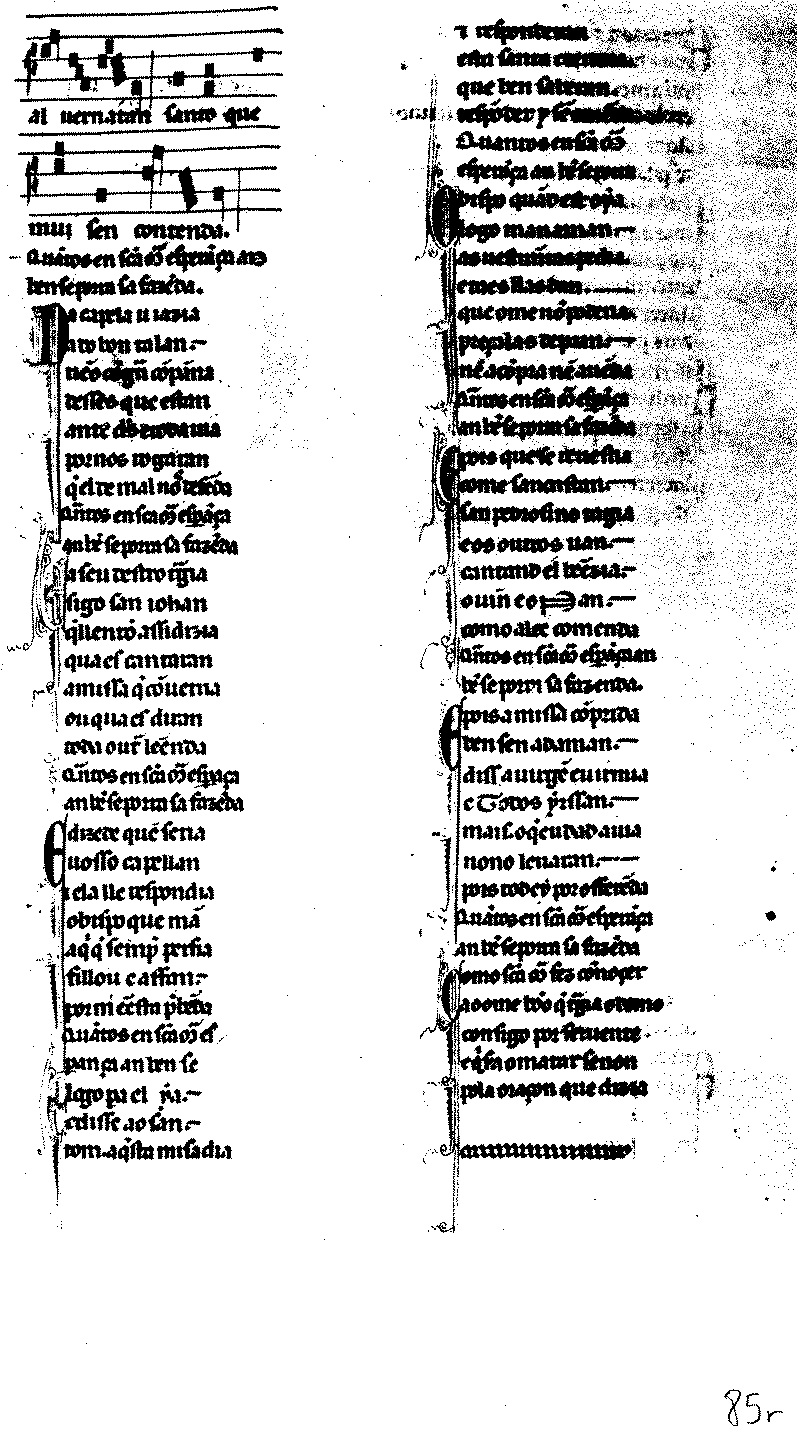
- 13th century, attributed to Alfonso X of Castile, Cantigas de Santa Maria, E codex, cantiga 66 (facsimile):
- ſan pedro ſino tagia
- Saint Peter rang the bell
- ſan pedro ſino tagia
- 13th century, attributed to Alfonso X of Castile, Cantigas de Santa Maria, E codex, cantiga 66 (facsimile):
Synonyms
Descendants
Portuguese

Etymology
From Old Portuguese sino (“bell”), from Late Latin signum (“bell, ringing of a bell”), from Latin signum (“sign”), from Proto-Indo-European *sek- (“to cut”) or *sekʷ- (“to follow”).
Cognate with Galician sino, Catalan seny and Romansch zain. Also related to French tocsin and English tocsin (both ultimately from Old Occitan senh (“bell”)).
Pronunciation
Noun
sino m (plural sinos)
- bell (percussive instrument)
- 1913, Fernando Pessoa, “Ó sino da minha aldeia”:
- Ó sino da minha aldeia, / Dolente na tarde calma, / Cada tua badalada / Soa dentro da minha alma.
- Oh bell of my village, / Lazy in this peaceful afternoon, / Each one of your tollings / Resounds in my soul.
- Ó sino da minha aldeia, / Dolente na tarde calma, / Cada tua badalada / Soa dentro da minha alma.
- 1913, Fernando Pessoa, “Ó sino da minha aldeia”:
Derived terms
Related terms
Descendants
See also
Spanish
Etymology 1
Pronunciation
- IPA(key): /ˈsino/
Noun
sino m (plural sinos)
Synonyms
Etymology 2
Latin sino-, from Sina "China" (the country).
Pronunciation
- IPA(key): /ˈsino/
Noun
sino m (plural sinos)
Etymology 3
Pronunciation
- IPA(key): /si no/
- as if two separate words
Conjunction
sino
- but (after a negative clause) (i.e., "but rather", "but only", or "but rather only")
- except, apart from
- only, solely
Tagalog
Pronoun
sino
- (interrogative) who