柄
| ||||||||
Translingual
Han character
柄 (radical 75 木+5, 9 strokes, cangjie input 木一人月 (DMOB), four-corner 41927, composition ⿰木丙)
References
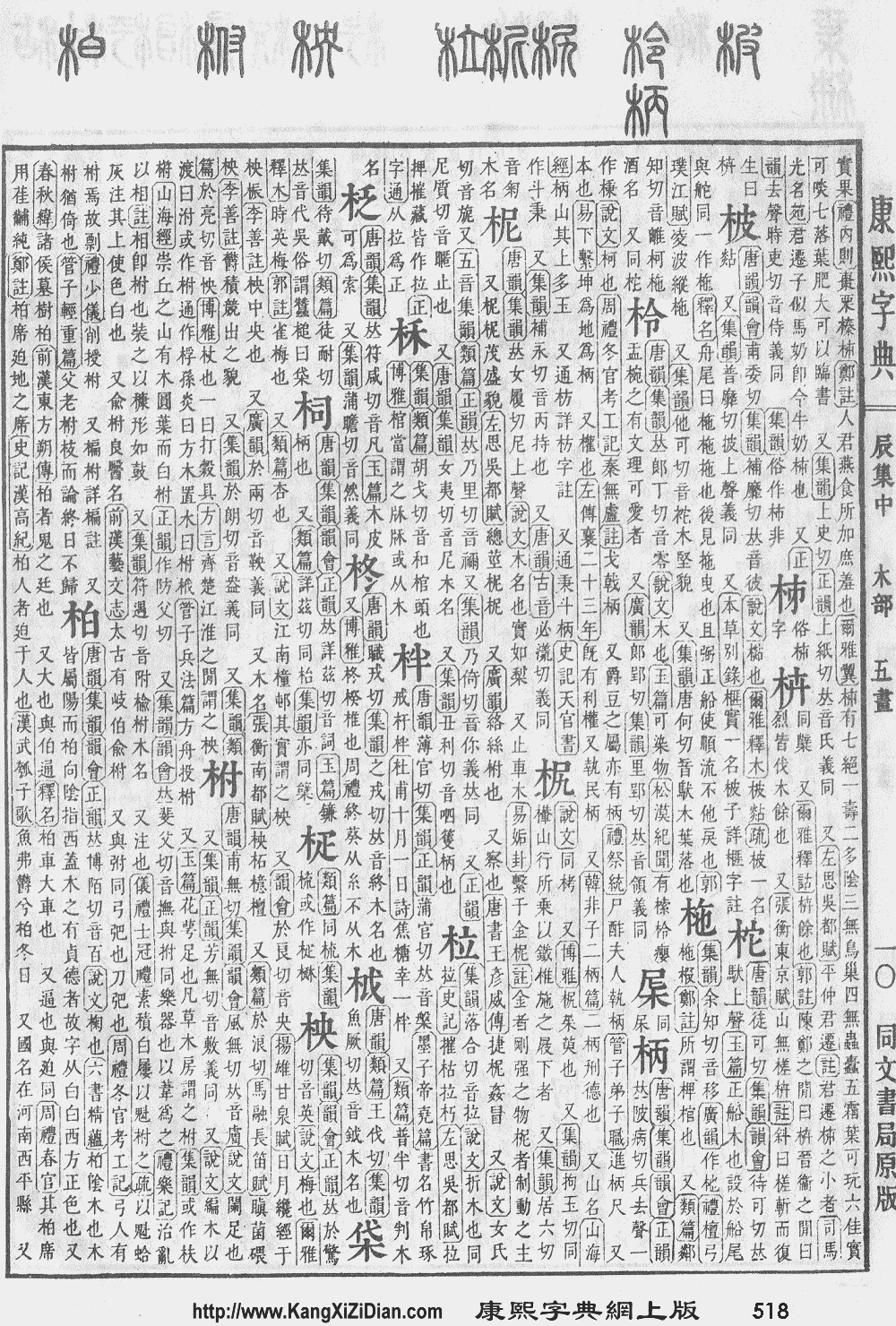
- KangXi: page 518, character 8
- Dai Kanwa Jiten: character 14603
- Dae Jaweon: page 906, character 9
- Hanyu Da Zidian: volume 2, page 1179, character 2
- Unihan data for U+67C4
Chinese
| simp. and trad. |
柄 | |
|---|---|---|
Glyph origin
| Characters in the same phonetic series (丙) (Zhengzhang, 2003) | |
|---|---|
| Old Chinese | |
| 更 | *kraːŋ, *kraːŋs |
| 粳 | *kraːŋ |
| 埂 | *kraːŋ, *kraːŋʔ |
| 浭 | *kraːŋ |
| 稉 | *kraːŋ |
| 梗 | *kraːŋʔ |
| 哽 | *kraːŋʔ |
| 綆 | *kraːŋʔ |
| 鯁 | *kraːŋʔ |
| 挭 | *kraːŋʔ |
| 骾 | *kraːŋʔ |
| 郠 | *kraːŋʔ |
| 硬 | *ŋɡraːŋs, *ŋɡraːŋs |
| 鞕 | *ŋɡraːŋs |
| 丙 | *pqraŋʔ |
| 炳 | *praŋʔ |
| 邴 | *praŋʔ, *praŋs |
| 怲 | *praŋʔ, *praŋs |
| 苪 | *praŋʔ |
| 蛃 | *praŋʔ |
| 昺 | *praŋʔ |
| 昞 | *praŋʔ |
| 窉 | *praŋʔ |
| 柄 | *praŋʔ, *praŋs |
| 鈵 | *praŋs |
| 寎 | *praŋs |
| 病 | *braŋs |
Phono-semantic compound (形聲, OC *praŋʔ, *praŋs) : semantic 木 (“wood”) + phonetic 丙 (OC *pqraŋʔ) – a wooden handle.
Pronunciation
Definitions
柄
- This term needs a translation to English. Please help out and add a translation, then remove the text
{{rfdef}}.
Compounds
References
Japanese
Kanji
Readings
Etymology 1
| Kanji in this term |
|---|
| 柄 |
| え Grade: S |
| kun’yomi |
Change in meaning from 枝 (e, historically ye, “branch, stem”).[1]
Pronunciation
Noun
Synonyms
Idioms
- 柄の無い所に柄をすげる (e no nai tokoro ni e o sugeru): “to attach a handle where there isn't one” → to strain credibility with one's words, to talk out one's ass
Etymology 2
| Kanji in this term |
|---|
| 柄 |
| かび Grade: S |
| kun’yomi |
From Old Japanese. Used in the Kojiki. Generally regarded as cognate with 黴 (kabi, “mold”), from the shared idea of sprouts or shoots. Appears to be noun stem of Old Japanese verb かぶ (kabu) (source of modern Japanese 黴る, kabiru, “to go moldy”), with probable original meaning of to sprout.[1]
Pronunciation
Alternative forms
Noun
- (archaic) a sprout
- (archaic) an ear of grain, particularly of rice
- (archaic) the handle or grip of a tool, or hilt of a blade (by extension from the idea of “a smaller portion sticking out from the main body” like a sprout)
Usage notes
Synonyms
Etymology 3
| Kanji in this term |
|---|
| 柄 |
| かい Grade: S |
| kun’yomi |
/kabi/ → /kai/
Alteration of kabi.[1]
Pronunciation
Alternative forms
Noun
柄 (hiragana かい, rōmaji kai, historical hiragana かひ)
- (archaic) see kabi above
Etymology 4
| Kanji in this term |
|---|
| 柄 |
| から Grade: S |
| kun’yomi |
From Old Japanese. Origin of particle から (kara, “from, because”).[1]
Pronunciation
Suffix
柄 (hiragana から, rōmaji -kara)
- of the same lineage
- the inherent qualities or characteristics of a thing
Usage notes
The lineage sense is often found embedded in other words, such as the first few of the following.
Derived terms
- (lineage): 同胞 (harakara): “of the (same) belly” → a sibling, more specifically a sibling from the same mother
- (lineage): 族 (yakara): “of the (same) house” → a family member
- (lineage): 親族 (ukara): “of the (same) parents/ancestors” → a blood relative
- (qualities): 神柄 (かみから, kamikara; かむから, kamukara): the true nature of a god
- (qualities): 山柄 (yamakara): the nature or characteristics of a mountain
Noun
Usage notes
Often followed by the particle に (ni). This usage evolved into the modern particle から (kara, “from, because”).[1]
Etymology 5
| Kanji in this term |
|---|
| 柄 |
| から Grade: S |
| kun’yomi |
In light of the stem sense, probably derived semantically from origin, source meanings.
Pronunciation
Alternative forms
Counter
柄 (hiragana から, rōmaji -kara)
- used to count items with shafts
Noun
Prefix
柄 (hiragana から, rōmaji kara-)
Usage notes
The shaft sense is often found embedded in other words, such as the following, which are often spelled with other kanji.
Derived terms
- 柄臼, 唐臼, 碓 (karausu): a kind of mortar and pestle with the pestle mounted on a long shaft for leverage
- 柄秤, 唐秤, 権衡 (からはかり, karahakari; からばかり, karabakari): a balance scale (as opposed to a spring scale)
- 柄楫, 唐楫 (karakaji): a tiller with a shafted handle
- 柄鋤, 唐鋤, 犂 (karasuki): a plow (literally, “a spade on a long shaft”)
Etymology 6
| Kanji in this term |
|---|
| 柄 |
| がら Grade: S |
| kun’yomi |
Alteration of kara, “qualities, characteristics”. Originally only found as a suffix. The kara changes to gara as an instance of rendaku (連濁). The rendaku pronunciation was then later used independently.[1]
Pronunciation
Suffix
柄 (hiragana がら, rōmaji -gara)
- the inherent qualities or characteristics of a thing
- a shape, pattern, or design
Derived terms
- (qualities): 国柄 (kunigara): a nation's (good) qualities; the state of a nation
- (qualities): 人柄 (hitogara): a person's character
- (qualities): 家柄 (iegara): a family's or household's station or standing in society
- (qualities): 続柄, 続き柄 (tsuzukigara): one's immediate relations, such as parents or siblings
- (qualities): 場所柄 (bashogara): the qualities of a place; that which is appropriate or suitable for a place
- (qualities): 時節柄 (jisetsugara): the qualities of a time or season; that which is appropriate or suitable for a time or season
- (shape): 花柄 (hanagara): a flower pattern
Noun
- one's physical shape or build
- 柄の大きいやつだな。
- Gara no ōkii yatsu da na.
- Wow, he's sure built big.
- 柄の大きいやつだな。
- one's character, personality, or temperament
- 柄の悪い人
- gara no warui hito
- a person with a bad character
- 柄の悪い人
- a pattern or design, such as on cloth
- あの柄は派手過ぎるよ。
- Ano gara wa hade-sugiru yo.
- That pattern is way too colorful.
- あの柄は派手過ぎるよ。
Synonyms
Idioms
- 柄にもない (gara ni mo nai): “not even in one's character” → just not in one, just not suitable for one's character or abilities
Etymology 7
| Kanji in this term |
|---|
| 柄 |
| つか Grade: S |
| kun’yomi |
Cognate with 束 (tsuka, ancient unit of length, equivalent to the amount covered from pinky to forefinger when gripping something; analogous to English hand).[1]
Both likely derive from verb 付く (tsuku, “to set to, to attach, to accompany”), particularly as seen in modern Japanese idioms such as 手を付ける (te o tsukeru, “to set one's hand to something”), 手が付く (te ga tsuku, “to start using something”, literally “one's hand sets on something”).
Pronunciation
Alternative forms
Noun
- the hilt of a sword or knife, or the grip of a bow or staff
- the portion of a brush pen held in the hand
- a penis
Idioms
- 柄を握る (tsuka o nigiru): “to hold the grip” → to stay the course in a career or trade and become an old master
- 柄を取る (tsuka o toru): “to take the grip” → to stay the course in a career or trade and become an old master
Etymology 8
| Kanji in this term |
|---|
| 柄 |
| つく Grade: S |
| kun’yomi |
Nominalization of verb 付く (tsuku, “to attach”).
Pronunciation
Alternative forms
Noun
- the nock on either end of a bow where the bowstring rests
- a bent nail or other kind of spike attached to or driven through an iron staff or a truncheon to make the weapon more dangerous
- the areas on either end of a yoke or other carrying pole where cordage or rope is attached, from which the load is carried
- the grip of a tiller, boathook, or other pole
- (as a pun on the verb sense of stick to, attach) a female entertainer's or prostitute's secret lover
Usage notes
The grip sense is not spelled using the alternative forms, and is only spelled 柄 in kanji.
Synonyms
- (secret male lover): 隠し男 (kakushi otoko), 隠男 (kakushi otoko)
Etymology 9
| Kanji in this term |
|---|
| 柄 |
| ほぞ Grade: S |
| Irregular |
Ateji or misspelling for uncommon 表外字 (hyōgaiji, “non-standard character”) kanji 枘 (hozo, “navel”, also generic term for something that protrudes slightly). Note that the right half of 柄 is 丙, with a top bar, while the right half of 枘 is 内, without a top bar.[1]
Pronunciation
Alternative forms
Noun
References
Korean
Hanja
柄 • (byeong) (hangeul 병, revised byeong, McCune–Reischauer pyŏng, Yale pyeng)
- This term needs a translation to English. Please help out and add a translation, then remove the text
{{rfdef}}.
Vietnamese
Han character
柄 (bính)
- This term needs a translation to English. Please help out and add a translation, then remove the text
{{rfdef}}.