pen
English
Pronunciation
- IPA(key): /pɛn/
- (pin–pen merger) IPA(key): /pɪn/
Audio (US) (file) Audio (US-Inland North) (file) - Rhymes: -ɛn
- Homophone: pin (pin-pen merger)
Etymology 1
From Middle English pen, penne (“enclosure for animals”), from Old English penn (“enclosure, fold, pen”) (in compounds), from Proto-Germanic *pennō, *pannijō (“pin, bolt, nail, tack”), from Proto-Indo-European *bend- (“pointed peg, nail, edge”). Akin to Old English pennian (“to close, lock, bolt”) (in compounds onpennian (“to open”)), Low German pennen (“to secure a door with a bolt”), Old English pinn (“peg, bolt”). More at pin.
Sense “prison” originally figurative extension to “enclosure for persons” (1845), later influenced by penitentiary (“prison”), being analyzed as an abbreviation (1884).[1]
Noun
pen (plural pens)
- An enclosed area used to contain domesticated animals, especially sheep or cattle.
- There are two steers in the third pen.
- A place to confine a person; a prison cell, though likelier an abbreviation of penitentiary.
- They caught him with a stolen horse, and he wound up in the pen again.
- (baseball) The bullpen.
- Two righties are up in the pen.
Translations
|
|
Verb
pen (third-person singular simple present pens, present participle penning, simple past and past participle penned or pent)
- (transitive) To enclose in a pen.
- Milton
- Watching where shepherds pen their flocks at eve.
- Milton
Translations
|
|
Etymology 2
From Middle English penne, from Anglo-Norman penne, from Old French penne, from Latin penna (“feather”), from Proto-Indo-European *péth₂r̥ ~ pth₂én- (“feather, wing”), from *peth₂- (“to rush, fly”) (from which petition). Proto-Indo-European base also root of *petra-, from which πτερόν (pterón, “wing”) (whence pterodactyl), Sanskrit पत्रम् (patram, “wing, feather”), Old Church Slavonic перо (pero, “pen”), Old Norse fjǫðr, Old English feðer (Modern English feather);[1] note the /p/ → /f/ Germanic sound change.
See feather and πέτομαι (pétomai) for more.
Noun
pen (plural pens)
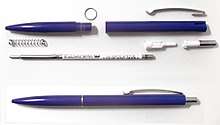
- A tool, originally made from a feather but now usually a small tubular instrument, containing ink used to write or make marks.
- He took notes with a pen.
- (figuratively) A writer, or his style.
- He has a sharp pen.
- Fuller
- those learned pens
- (colloquial) Marks of ink left by a pen.
- He's unhappy because he got pen on his new shirt.
- A light pen.
- (zoology) The internal cartilage skeleton of a squid, shaped like a pen.
- (now rare, poetic, dialectal) A feather, especially one of the flight feathers of a bird, angel etc.
- 1590, Edmund Spendser, The Faerie Queene, I.xi:
- And eke the pennes, that did his pineons bynd, / Were like mayne-yards, with flying canuas lynd, / With which whenas him list the ayre to beat […]
- 1590, Edmund Spendser, The Faerie Queene, I.xi:
- (poetic) A wing.
- (Can we find and add a quotation of Milton to this entry?)
Derived terms
|
|
Translations
|
|
|
|
Verb
pen (third-person singular simple present pens, present participle penning, simple past and past participle penned)
- (transitive) To write (an article, a book, etc.).
Translations
Etymology 3
Origin uncertain.
Noun
pen (plural pens)
- A female swan.
Translations
Etymology 4
Shortened form of penalty
Noun
pen (plural pens)
References
Anagrams
Danish
Etymology 1
From late Old Norse penni, from Latin penna (“feather”).
Pronunciation
- IPA(key): /pɛnˀ/, [pʰɛnˀ]
Noun
pen c (singular definite pennen, plural indefinite penne)
Declension
Etymology 2
Adjective
pen (neuter pent, plural and definite singular attributive pene, comparative penere, superlative (predicative) penest, superlative (attributive) peneste)
- Obsolete spelling of pæn
Dutch
Etymology
From Middle Dutch penne. This etymology is incomplete. You can help Wiktionary by elaborating on the origins of this term.
Pronunciation
- IPA(key): /pɛn/
Audio (file) - Rhymes: -ɛn
Noun
pen f (plural pennen, diminutive pennetje n)
Derived terms
- (pen): balpen, kroontjespen, vulpen
- (pin): aardingspen, scharnierpen, zadelpen
Anagrams
Haitian Creole
Etymology
Noun
pen
Japanese
Romanization
pen
Mandarin
Romanization
pen
- Nonstandard spelling of pēn.
- Nonstandard spelling of pén.
- Nonstandard spelling of pěn.
- Nonstandard spelling of pèn.
Usage notes
- English transcriptions of Mandarin speech often fail to distinguish between the critical tonal differences employed in the Mandarin language, using words such as this one without the appropriate indication of tone.
Mapudungun
Verb
pen (using Raguileo Alphabet)
- to see
Synonyms
Middle English
Etymology 1
From Anglo-Norman penne.
Noun
pen
- Alternative form of penne
Etymology 2
From Old English penn, from Proto-Germanic *pennō.
Alternative forms
Pronunciation
- IPA(key): /pɛn/
- Rhymes: -ɛn
Noun
pen
Related terms
Descendants
References
- “pen (n.)” in MED Online, Ann Arbor, Mich.: University of Michigan, 2007, retrieved 2018-04-24.
Mindiri
Noun
pen
Further reading
- Malcolm Ross, Proto Oceanic and the Austronesian Languages of Western Melanesia, Pacific Linguistics, series C-98 (1988)
Norwegian Bokmål
Etymology
Possibly from French
Adjective
pen (neuter singular pent, definite singular and plural pene, comparative penere, indefinite superlative penest, definite superlative peneste)
References
- “pen” in The Bokmål Dictionary.
Norwegian Nynorsk
Etymology
Possibly from French
Adjective
pen (neuter singular pent, definite singular and plural pene, comparative penare, indefinite superlative penast, definite superlative penaste)
References
- “pen” in The Nynorsk Dictionary.
Rade
Etymology
Noun
pen
Tok Pisin
Etymology 1
Noun
pen
Etymology 2
Noun
pen
Etymology 3
Noun
pen
- pain
- 1989, Buk Baibel long Tok Pisin, Bible Society of Papua New Guinea, Genesis 3:16 (translation here):
- Na God i tokim meri olsem, “Bai mi givim yu bikpela hevi long taim yu gat bel. Na bai yu gat bikpela pen long taim yu karim pikinini. Tasol bai yu gat bikpela laik yet long man bilong yu, na bai em i bosim yu.”
- 1989, Buk Baibel long Tok Pisin, Bible Society of Papua New Guinea, Genesis 3:16 (translation here):
Volapük
Noun
pen (plural pens)
Declension
Welsh
Etymology
From Middle Welsh penn, from Proto-Brythonic *penn, from Proto-Celtic *kʷennom.
Pronunciation
- IPA(key): /pɛn/
Noun
pen m (plural pennau)
Related terms
- penglog (“skull, cranium”)
Adjective
pen (equative penned, comparative pennach, superlative pennaf)
Mutation
| Welsh mutation | |||
|---|---|---|---|
| radical | soft | nasal | aspirate |
| pen | ben | mhen | phen |
| Note: Some of these forms may be hypothetical. Not every possible mutated form of every word actually occurs. | |||
References
- “pen”, in Geiriadur Prifysgol Cymru Online (in Welsh), University of Wales Centre for Advanced Welsh & Celtic Studies, 2014