客
| ||||||||
Translingual
| Stroke order | |||
|---|---|---|---|
 | |||
Han character
客 (radical 40, 宀+6, 9 strokes, cangjie input 十竹水口 (JHER), four-corner 30604, composition ⿱宀各)
Derived characters
References
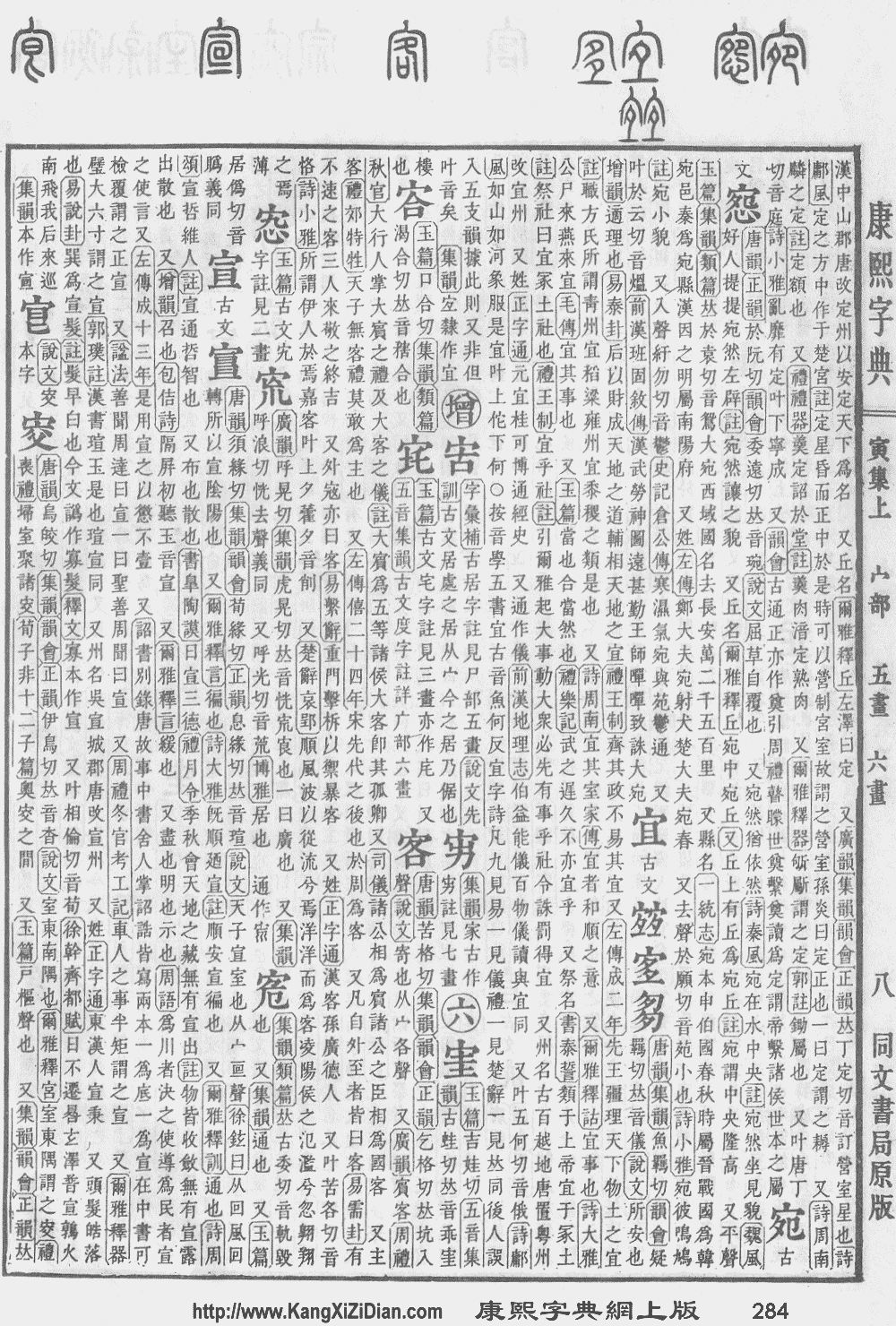
- KangXi: page 284, character 12
- Dai Kanwa Jiten: character 7128
- Dae Jaweon: page 561, character 16
- Hanyu Da Zidian: volume 2, page 927, character 13
- Unihan data for U+5BA2
Chinese
| simp. and trad. |
客 | |
|---|---|---|
Glyph origin
| Historical forms of the character 客 | ||||
|---|---|---|---|---|
| Shang | Western Zhou | Warring States | Shuowen Jiezi (compiled in Han) | Liushutong (compiled in Ming) |
| Oracle bone script | Bronze inscriptions | Chu Slip and silk script | Small seal script | Transcribed ancient scripts |
 |
 |
 |
 |
 |
| Characters in the same phonetic series (各) (Zhengzhang, 2003) | |
|---|---|
| Old Chinese | |
| 髂 | *kʰraːɡs |
| 路 | *ɡ·raːɡs |
| 輅 | *ɡ·raːɡs |
| 賂 | *ɡ·raːɡs |
| 虂 | *ɡ·raːɡs |
| 露 | *ɡ·raːɡs |
| 潞 | *raːɡs |
| 鷺 | *raːɡs |
| 璐 | *raːɡs |
| 簬 | *raːɡs |
| 簵 | *ɡ·raːɡs |
| 洛 | *ɡ·raːɡ |
| 駱 | *ɡ·raːɡ |
| 絡 | *ɡ·raːɡ |
| 酪 | *ɡ·raːɡ |
| 烙 | *ɡ·raːɡ |
| 雒 | *ɡ·raːɡ |
| 珞 | *ɡ·raːɡ |
| 硌 | *ɡ·raːɡ |
| 袼 | *ɡ·raːɡ, *klaːɡ |
| 笿 | *ɡ·raːɡ |
| 鉻 | *ɡ·raːɡ, *kraːɡ |
| 鮥 | *ɡ·raːɡ |
| 鵅 | *ɡ·raːɡ, *kraːɡ |
| 挌 | *ɡ·raːɡ, *kraːɡ |
| 落 | *ɡ·raːɡ |
| 各 | *klaːɡ |
| 胳 | *klaːɡ |
| 閣 | *klaːɡ |
| 格 | *klaːɡ, *kraːɡ |
| 擱 | *klaːɡ |
| 恪 | *kʰlaːɡ |
| 愙 | *kʰaːɡ |
| 貉 | *ɡlaːɡ, *mɡraːɡ |
| 狢 | *ɡlaːɡ |
| 佫 | *ɡlaːɡ |
| 略 | *ɡ·raɡ |
| 茖 | *kraːɡ |
| 骼 | *kraːɡ |
| 觡 | *kraːɡ |
| 蛒 | *kraːɡ |
| 敋 | *kraːɡ |
| 客 | *kʰraːɡ |
| 喀 | *kʰraːɡ |
| 揢 | *kʰraːɡ |
| 額 | *ŋɡraːɡ |
| 峉 | *ŋɡraːɡ |
| 頟 | *ŋɡraːɡ |
| 詻 | *ŋɡraːɡ |
| 垎 | *ɡraːɡ |
| 楁 | *ɡraːɡ |
Phono-semantic compound (形聲, OC *kʰraːɡ) : semantic 宀 (“roof”) + phonetic 各 (OC *klaːɡ) – a guest. Oracle bone script used 𠯆 instead of 各.
Etymology
Probably belongs to the word family of 格 (OC *klaːɡ, *kraːɡ, “to go, to come”). Starostin compares this with Proto-Altaic *kàra (“opposite, enemy”) > Turkish karak (“robber”). Schuessler (2007) cites Tibetan དགྲ (dgra, “enemy”) as a possible cognate.
Pronunciation
Definitions
客
- guest; visitor
- customer; client; consumer (Classifier: 個/个 c; 位 c)
- to treat with guest etiquette; to receive friendly
- minor; less major; less important
- Agent suffix, indicating “one that engages in ...”.
- one who sponges on a wealthy family; hanger-on; sponger
- traveller; passenger; one who lives away from home
- to live away from home; to live abroad
- (in general) people; person
- objective; beyond human consciousness
- Short for 客家 (kèjiā, “Hakka”).
- Classifier for units of food sold.
- A surname.
Compounds
|
|
|
Descendants
Others:
- → Lao: ແຂກ (khǣk, “guest”)
- → Hmong-Mien: *Khæk (“guest”)
- White Hmong: qhua (“guest”)
- → Thai: แขก (kɛ̀ɛk, “guest”)
- → Zhuang: hek (“guest; tourist”)
Japanese
Kanji
- This term needs a translation to English. Please help out and add a translation, then remove the text
{{rfdef}}.
Readings
Noun
客 (hiragana きゃく, rōmaji kyaku)
Usage notes
This is used as part of a form of address for a customer, like sir or ma'am. Because a customer is in a much higher social position, this word is used with the honorific prefix 御 (お, o-) and the honorific suffix さん (-san) or more often さま (-sama), rendering お客さん (okyakusan) or お客様 (okyakusama).
Korean
| Hanja in this term |
|---|
| 客 |
Hanja
客 • (gaek)
Vietnamese
Han character
客 (khách)
- This term needs a translation to English. Please help out and add a translation, then remove the text
{{rfdef}}.