御
| ||||||||
Translingual
Glyph origin
| Characters in the same phonetic series (午) (Zhengzhang, 2003) | |
|---|---|
| Old Chinese | |
| 卸 | *sŋjaːs |
| 汻 | *hŋaːŋʔ |
| 滸 | *hŋaːʔ |
| 午 | *ŋaːʔ |
| 仵 | *ŋaːʔ |
| 旿 | *ŋaːʔ |
| 忤 | *ŋaːs |
| 迕 | *ŋaːs |
| 杵 | *ŋ̊ʰjaʔ |
| 籞 | *ŋaʔ |
| 蘌 | *ŋaʔ |
| 篽 | *ŋaʔ |
| 禦 | *ŋaʔ, *ŋas |
| 許 | *hŋaʔ |
| 御 | *ŋas |
Han character
御 (radical 60 彳+8 in Chinese, 彳+9 in Japanese, in Chinese 11 strokes, in Japanese 12 strokes, cangjie input 竹人人一中 (HOOML), four-corner 27220, composition ⿰彳卸)
Descendants
References
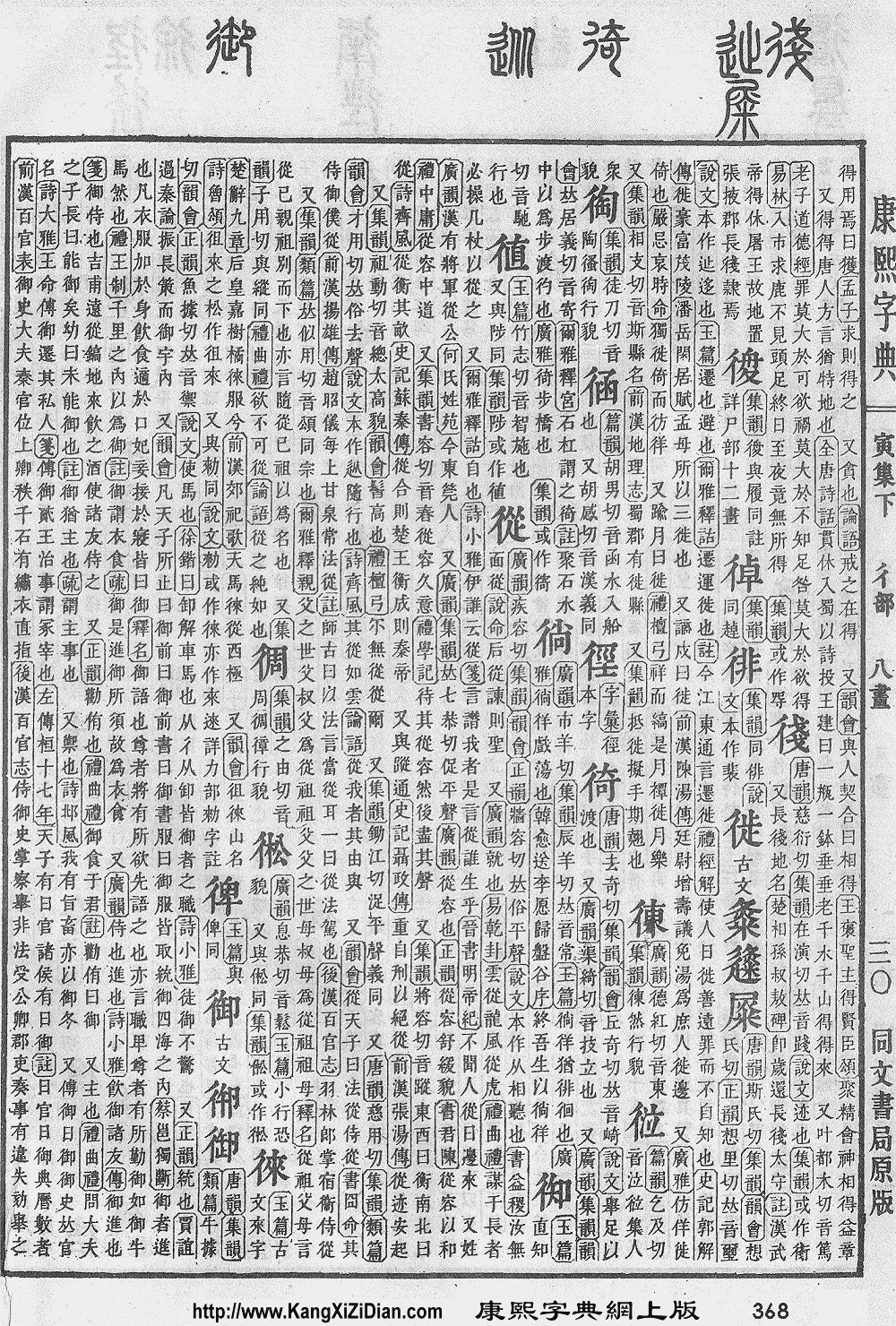
- KangXi: page 368, character 23
- Dai Kanwa Jiten: character 10157
- Dae Jaweon: page 693, character 5
- Hanyu Da Zidian: volume 2, page 832, character 16
- Unihan data for U+5FA1
Chinese
Etymology 1
| simp. and trad. |
御 | |
|---|---|---|
Pronunciation
Definitions
御
Compounds
Etymology 2
| For pronunciation and definitions of 御 – see 禦 (“to defend”). (This character, 御, is the simplified form of 禦.) |
Notes:
|
Japanese
Kanji
Readings
Compounds
See also
Etymology 1
Prefix
御 (hiragana お, rōmaji o-, alternative reading ご, rōmaji go-)
- Prefix indicating that the word is honorific. Often used to indicate that the word belongs or is related to the listener (as opposed to the speaker).
Usage notes
This prefix is frequently written in hiragana, both because it is complicated and common, and because its reading may be ambiguous if the term is unfamiliar. When the prefix is read as o- (as opposed to go-), it is almost exclusively written in hiragana.
While in general this prefix is optional, in many cases it is so commonly used that the base word can no longer be used in isolation, as in 御飯 (ごはん, gohan, rice) – the form ×飯 *han is not used alone, though it can be used as parts of compounds (such as 炊飯, suihan), and the character can be read in isolation as meshi.
Usage varies between speakers, situations, and gender – more polite speech, especially by women, features more use of this prefix, while blunt speech, especially by men, uses it less or not at all (words where the prefix has become mandatory are replaced by blunter terms that do not have the prefix). In rare cases a prefixed term has become impolite, as in 御前 (omae, “you (familiar or derogatory)”).
This character is generally read as お (o-) when it is prefixed to words considered to be of Japanese origin, as in 御水 (おみず, omizu, water), and ご (go-) when it is prefixed to words considered to be of Chinese origin, as in 御主人 (ごしゅじん, goshujin, husband). There are numerous exceptions, however, such as お電話. For (non-Chinese) foreign loan words (外来語, gairaigo), this prefix is seldom used, and both お- and ご- may be used, but お- is somewhat preferred, as in おビール (o-bīru) for beer.
In some rare cases, it is pronounced み (mi-), primarily for religious words, pertaining to gods or the emperor, as in 御輿 (mikoshi, a type of shrine). However, in this context it is often replaced by 神 ("god", also pronounced mi-), and then a further 御 (pronounced お, o-) may be added, as in 御神輿 (o-mi-koshi). The mi- prefix also became merged into other kanji, as in 宮 (miya, imperial palace).
In rare cases, this is used as a suffix instead, notably in 甥御 oigo and 姪御 meigo (your nephew, your niece).
御 (お, o-) should not be confused with 大 (おお, ō-, great), which is a less-commonly used prefix.
See Honorific prefixes in Japanese for further discussion.
Etymology 2
From Old Japanese. Cognate with 霊 / 神 (mi, “spirit, god”), as this prefix was originally used to refer to gods and other spiritually important things.
Prefix
- Honorific prefix added to gods and other spiritually important things. Also added to other nouns to indicate godlike respect.
- Added to place names to emphasize beauty. (This usage is more often written in hiragana)
Derived terms
- 御明 (miakashi): an oil lamp lit for Shinto or Buddhist purposes
- 御食 (mike): an offering of food to a god or spirit
- 御子 (miko): a shrine maiden
- 御輿 (mikoshi), 神輿 (mikoshi): a portable shrine
- 尊 (mikoto), 命 (mikoto): a title used for gods and emperors, and other exalted personages
- 御許 (mimoto): the location of a god, Buddha, emperor, or other object of reverence
- 御座 (mimashi): the presence of a god, Buddha, emperor, or other object of reverence
- 宮 (miya): a shrine
Alternative forms
Korean
Hanja
御 • (eo, a) (hangeul 어, 아, revised eo, a, McCune–Reischauer ŏ, a, Yale e, a)
- This term needs a translation to English. Please help out and add a translation, then remove the text
{{rfdef}}.
Vietnamese
Han character
- This term needs a translation to English. Please help out and add a translation, then remove the text
{{rfdef}}.