路
| ||||||||
Translingual
| Stroke order | |||
|---|---|---|---|
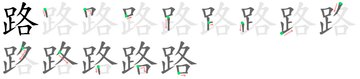 | |||
Han character
路 (radical 157, 足+6, 13 strokes, cangjie input 口一竹水口 (RMHER), four-corner 67164, composition ⿰⻊各)
Derived characters
References
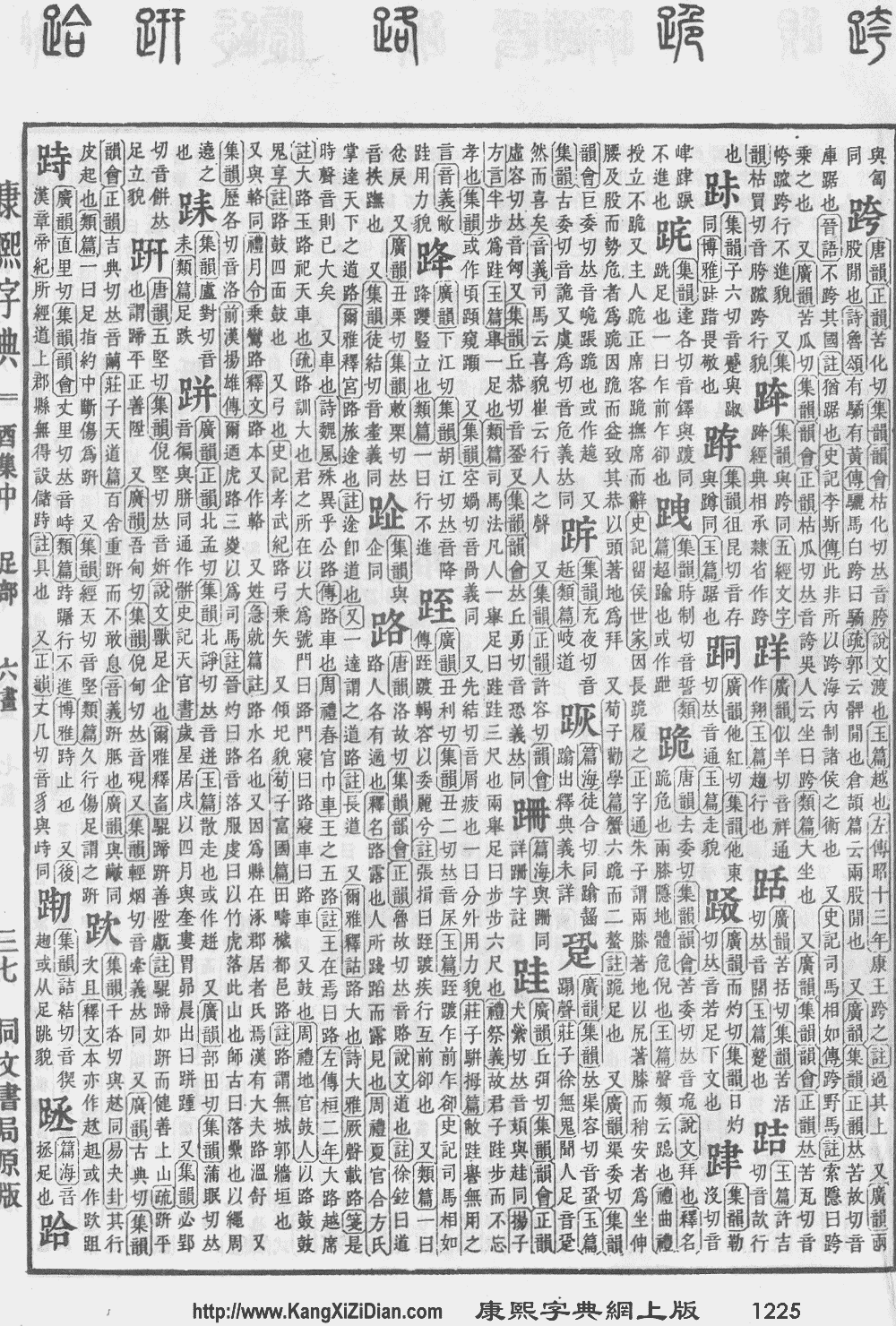
- KangXi: page 1225, character 22
- Dai Kanwa Jiten: character 37524
- Dae Jaweon: page 1697, character 6
- Hanyu Da Zidian: volume 6, page 3704, character 6
- Unihan data for U+8DEF
Chinese
| simp. and trad. |
路 | |
|---|---|---|
Glyph origin
| Historical forms of the character 路 | |||
|---|---|---|---|
| Western Zhou | Warring States | Shuowen Jiezi (compiled in Han) | Liushutong (compiled in Ming) |
| Bronze inscriptions | Chu Slip and silk script | Small seal script | Transcribed ancient scripts |
 |
 |
 |
 |
| Characters in the same phonetic series (各) (Zhengzhang, 2003) | |
|---|---|
| Old Chinese | |
| 髂 | *kʰraːɡs |
| 路 | *ɡ·raːɡs |
| 輅 | *ɡ·raːɡs |
| 賂 | *ɡ·raːɡs |
| 虂 | *ɡ·raːɡs |
| 露 | *ɡ·raːɡs |
| 潞 | *raːɡs |
| 鷺 | *raːɡs |
| 璐 | *raːɡs |
| 簬 | *raːɡs |
| 簵 | *ɡ·raːɡs |
| 洛 | *ɡ·raːɡ |
| 駱 | *ɡ·raːɡ |
| 絡 | *ɡ·raːɡ |
| 酪 | *ɡ·raːɡ |
| 烙 | *ɡ·raːɡ |
| 雒 | *ɡ·raːɡ |
| 珞 | *ɡ·raːɡ |
| 硌 | *ɡ·raːɡ |
| 袼 | *ɡ·raːɡ, *klaːɡ |
| 笿 | *ɡ·raːɡ |
| 鉻 | *ɡ·raːɡ, *kraːɡ |
| 鮥 | *ɡ·raːɡ |
| 鵅 | *ɡ·raːɡ, *kraːɡ |
| 挌 | *ɡ·raːɡ, *kraːɡ |
| 落 | *ɡ·raːɡ |
| 各 | *klaːɡ |
| 胳 | *klaːɡ |
| 閣 | *klaːɡ |
| 格 | *klaːɡ, *kraːɡ |
| 擱 | *klaːɡ |
| 恪 | *kʰlaːɡ |
| 愙 | *kʰaːɡ |
| 貉 | *ɡlaːɡ, *mɡraːɡ |
| 狢 | *ɡlaːɡ |
| 佫 | *ɡlaːɡ |
| 略 | *ɡ·raɡ |
| 茖 | *kraːɡ |
| 骼 | *kraːɡ |
| 觡 | *kraːɡ |
| 蛒 | *kraːɡ |
| 敋 | *kraːɡ |
| 客 | *kʰraːɡ |
| 喀 | *kʰraːɡ |
| 揢 | *kʰraːɡ |
| 額 | *ŋɡraːɡ |
| 峉 | *ŋɡraːɡ |
| 頟 | *ŋɡraːɡ |
| 詻 | *ŋɡraːɡ |
| 垎 | *ɡraːɡ |
| 楁 | *ɡraːɡ |
Phono-semantic compound (形聲, OC *ɡ·raːɡs) : semantic 足 + phonetic 各 (OC *klaːɡ).
Pronunciation
Definitions
路
Compounds
Derived terms from 路
|
|
|
Japanese
Kanji
路
- This term needs a translation to English. Please help out and add a translation, then remove the text
{{rfdef}}.
Readings
Etymology 1
| Kanji in this term |
|---|
| 路 |
| ち Grade: 3 |
| kun’yomi |
From Old Japanese.[1] May be cognate with Korean 길 (gil, “road”).
Pronunciation
Alternative forms
Suffix
- (obsolete) attaches to place names, indicating a road to that place
- This usage has generally been replaced by -ji below.
Etymology 2
| Kanji in this term |
|---|
| 路 |
| じ Grade: 3 |
| kun’yomi |
Contraction of the michi reading. [2]
Pronunciation
Alternative forms
Suffix
Etymology 3
| Kanji in this term |
|---|
| 路 |
| みち Grade: 3 |
| kun’yomi |
Originally a compound of 御 (mi, honorific prefix) + 路 (chi, “road, street, way”).[1] The prefix mi was in reference to the 神 (kami, “god or spirit”) of roads.
Pronunciation
Alternative forms
Noun
References
- 1 2 1988, 国語大辞典(新装版) (Kokugo Dai Jiten, Revised Edition) (in Japanese), Tōkyō: Shogakukan
- ↑ Frellesvig, Bjarke (2010) A History of the Japanese Language, Cambridge: Cambridge University Press, →ISBN, page 43
- ↑ 2006, 大辞林 (Daijirin), Third Edition (in Japanese), Tōkyō: Sanseidō, →ISBN
- ↑ 1998, NHK日本語発音アクセント辞典 (NHK Japanese Pronunciation Accent Dictionary) (in Japanese), Tōkyō: NHK, →ISBN
Korean
Hanja
路 • (ro>no) (hangeul 로>노, revised ro>no, McCune–Reischauer ro>no, Yale lo>no)
- This term needs a translation to English. Please help out and add a translation, then remove the text
{{rfdef}}.
Vietnamese
Han character
路 (lộ, lọ, lồ, lựa, trọ, trò, lần)
- This term needs a translation to English. Please help out and add a translation, then remove the text
{{rfdef}}.
This article is issued from
Wiktionary.
The text is licensed under Creative Commons - Attribution - Sharealike.
Additional terms may apply for the media files.