U+5C65, 履
CJK UNIFIED IDEOGRAPH-5C65

[U+5C64]
CJK Unified Ideographs
[U+5C66]

Translingual

Han character

(radical 44 +12, 15 strokes, cangjie input 尸竹人水 (SHOE), four-corner 77247, composition)

Derived characters

  • 𢖓, 𭌆, 𭗫

References

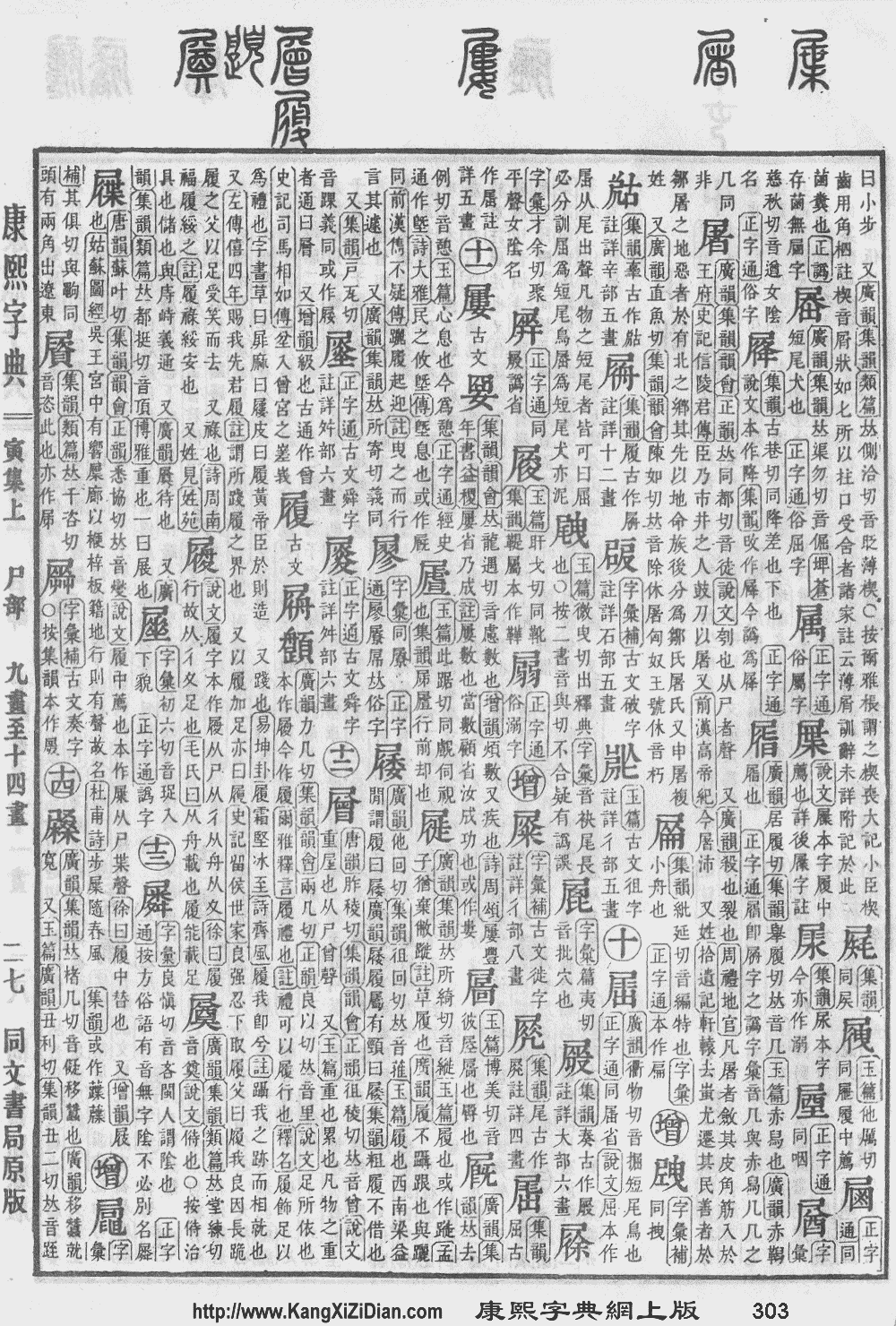
  • KangXi: page 303, character 41
  • Dai Kanwa Jiten: character 7799
  • Dae Jaweon: page 602, character 1
  • Hanyu Da Zidian: volume 2, page 980, character 3
  • Unihan data for U+5C65

Chinese

simp. and trad.
alt. forms 𨇐

Glyph origin

Historical forms of the character
Western Zhou Shuowen Jiezi (compiled in Han) Liushutong (compiled in Ming)
Bronze inscriptions Small seal script Transcribed ancient scripts

Shuowen: Ideogrammic compound (會意) :  +  (step) +  (foot) +  ((shoe-shaped) boat). Possibly phono-semantic (形聲) , with (OC *hli) functioning as a phonetic component.

Bronze inscriptions: Ideogrammic compound (會意) :  +  (person with prominent head) +  (foot) +  (shoe or (shoe-shaped) boat).

Modern form is a compound of  +  (return).

Pronunciation


  • Dialectal data
Variety Location
Mandarin Beijing /ly²¹⁴/
Harbin /ly²¹³/
Tianjin /luei¹³/
/ly¹³/
Jinan /li⁵⁵/
Qingdao /li⁴²/
Zhengzhou /li³¹²/
Xi'an /li⁴⁴/
Xining /l̩⁵³/
Yinchuan /ly⁵³/
Lanzhou /li⁴⁴²/
/ly⁴⁴²/
Ürümqi /ly⁵¹/
Wuhan /ni⁴²/
Chengdu /ny⁵³/
Guiyang /li⁴²/
Kunming /li⁵³/
Nanjing /ly²¹²/
Hefei /zz̩ʷ²⁴/
Jin Taiyuan /ly⁵³/
Pingyao /li⁵³/
Hohhot /ly⁵³/
Wu Shanghai /ly²³/
Suzhou /li³¹/
Hangzhou /li⁵³/
Wenzhou /løy³⁵/
Hui Shexian /ly³⁵/
Tunxi /li³¹/
Xiang Changsha /li⁴¹/
Xiangtan /ni⁴²/
Gan Nanchang /li²¹³/
Hakka Meixian /li³¹/
Taoyuan
Cantonese Guangzhou /lei²³/
Nanning /ly²⁴/
Hong Kong /lei¹³/
Min Xiamen (Min Nan) /li⁵³/
Fuzhou (Min Dong) /ly³²/
Jian'ou (Min Bei) /ly²¹/
Shantou (Min Nan) /li⁵³/
Haikou (Min Nan) /li³¹/

Rime
Character
Reading # 1/1
Initial () (37)
Final () (15)
Tone (調) Rising (X)
Openness (開合) Open
Division () III
Fanqie
Reconstructions
Zhengzhang
Shangfang
/liɪX/
Pan
Wuyun
/liX/
Shao
Rongfen
/ljɪX/
Edwin
Pulleyblank
/liX/
Li
Rong
/liX/
Wang
Li
/liX/
Bernard
Karlgren
/liX/
Expected
Mandarin
Reflex
BaxterSagart system 1.1 (2014)
Character
Reading # 1/1
Modern
Beijing
(Pinyin)
Middle
Chinese
‹ lijX ›
Old
Chinese
/*[r]ijʔ/
English tread on; sandal

Notes for Old Chinese notations in the Baxter–Sagart system:

* Parentheses "()" indicate uncertain presence;
* Square brackets "[]" indicate uncertain identity, e.g. *[t] as coda may in fact be *-t or *-p;
* Angle brackets "<>" indicate infix;
* Hyphen "-" indicates morpheme boundary;

* Period "." indicates syllable boundary.
Zhengzhang system (2003)
Character
Reading # 1/1
No. 8603
Phonetic
component
Rime
group
Rime
subdivision
2
Corresponding
MC rime
Old
Chinese
/*riʔ/
Notes

Definitions

  1. shoe; footgear
  2. foot
  3. territory
  4. to tread on; to walk on
  5. to put on shoes
  6. to ascend the throne; to assume (a role)
  7. to experience; to undergo
  8. to fulfil; to implement; to carry out
  9. to carry out personally
  10. tenth hexagram of the I Ching

Compounds


Japanese

Kanji

(common “Jōyō” kanji)

  1. footgear

Readings

Compounds

  •  () (せん) (risen)
  •  () (たん) (ritan)
  •  () (どう) (おう) (けん) (ridōōken)

Korean

Hanja

(ri) (hangeul , revised ri, McCuneReischauer ri)

  1. footgear
  2. shoes
  3. walk on
  4. tread

Derived terms


Vietnamese

Han character

(giầy, giày, )

  1. to go
  2. attire
This article is issued from Wiktionary. The text is licensed under Creative Commons - Attribution - Sharealike. Additional terms may apply for the media files.