bread
English
Pronunciation
- (General Australian) enPR: brĕd, IPA(key): /bɹɛd/ or IPA(key): /bɹeːd/
- (UK, US) enPR: brĕd, IPA(key): /bɹɛd/
Audio (UK) (file) Audio (US) (file) - Rhymes: -ɛd
- Homophone: bred
Etymology 1
From Middle English bred, breed, from Old English brēad (“fragment, bit, morsel, crumb", also "bread”), from Proto-Germanic *braudą (“cooked food, leavened bread”), from Proto-Indo-European *bʰerw-, *bʰrew- ("to boil, seethe"; see brew). An alternative etymology derives bread from Proto-Germanic *braudaz, *brauþaz (“broken piece, fragment”), from Proto-Indo-European *bʰera- (“to split, beat, hew, struggle”) (see brittle). Perhaps a conflation of the two. Cognate with Scots breid (“bread”), Saterland Frisian Brad (“bread”), West Frisian brea (“bread”), Dutch brood (“bread”), German Brot (“bread”), Danish and Norwegian brød (“bread”), Swedish bröd (“bread”), Icelandic brauð (“bread”), Albanian brydh (“I make crumbly, friable, soft”), Latin frustum (“crumb”).
Noun
bread (countable and uncountable, plural breads)
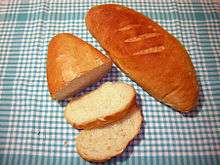
- (uncountable) A foodstuff made by baking dough made from cereals.
- 1913, Joseph C. Lincoln, chapter 8, in Mr. Pratt's Patients:
- Philander went into the next room […] and came back with a salt mackerel that dripped brine like a rainstorm. Then he put the coffee pot on the stove and rummaged out a loaf of dry bread and some hardtack.
- 1981, Shel Silverstein, “How Many, How Much”, A Light in the Attic, Harper & Row:
- How many slices in a[sic] bread? / Depends how thin you cut it.
-
- (countable) Any variety of bread.
- (slang) Money.
- Food; sustenance; support of life, in general.
- Bible, Matthew vi. 11
- Give us this day our daily bread.
- Bible, Matthew vi. 11
Usage notes
Synonyms
- (slang: money): dough, folding stuff, lolly, paper, spondulicks, wonga
Hyponyms
|
|
|
|
Derived terms
|
|
|
Related terms
|
|
|
|
Translations
|
|


|
- The translations below need to be checked and inserted above into the appropriate translation tables, removing any numbers. Numbers do not necessarily match those in definitions. See instructions at Wiktionary:Entry layout#Translations.
|
Verb
bread (third-person singular simple present breads, present participle breading, simple past and past participle breaded)
- (transitive) to coat with breadcrumbs
Derived terms
Translations
See also
Etymology 2
From Middle English brede, from Old English brǣdu (“breadth, width, extent”), from Proto-Germanic *braidį̄ (“breadth”). Cognate with Scots brede, breid (“breadth”), Dutch breedte (“breadth”), German Breite (“breadth”), Swedish bredd (“breadth”), Icelandic breidd (“breadth”).
Noun
bread (plural breads)
Derived terms
Etymology 3
From Middle English breden, from Old English brǣdan (“to make broad, extend, spread, stretch out; be extended, rise, grow”), from Proto-Germanic *braidijaną (“to make broad, broaden”).
Verb
bread (third-person singular simple present breads, present participle breading, simple past and past participle breaded)
Etymology 4
Variant of braid, from Middle English breden, from Old English brēdan, breġdan (“to braid”).
Alternative forms
Verb
bread (third-person singular simple present breads, present participle breading, simple past and past participle breaded)
Noun
bread (plural breads)
- A piece of embroidery; a braid.
Anagrams
Old English
Alternative forms
- brēod
Etymology
From Proto-Germanic *braudą, whence also Old Frisian brād (English brea), Old Saxon brōd (German Low German Broot, Brot), Dutch brood, Old High German brōt (German Brot), Old Norse and Icelandic brauð (Swedish bröd).
Pronunciation
- IPA(key): /bræːɑ̯d/
Noun
brēad n (nominative plural brēadru)
Inflection
Synonyms
- (bread): hlāf
Derived terms
Descendants
Spanish
Verb
bread