bar
English
| ||||||||
Pronunciation
Etymology 1
From Middle English barre, from Old French barre (“beam, bar, gate, barrier”), from Vulgar Latin *barra, of uncertain origin. Perhaps from Old Frankish *bara (“bar, beam, barrier, fence”), from Proto-Germanic *barō (“beam, bar, barrier”), from Proto-Indo-European *bʰAr- (“log, board, plank”). If so, then cognate with Old High German para, bara (“bar, beam, one's cherished land”), Old Frisian ber (“attack, assault”), Swedish bärling (“a spoke”), Norwegian berling (“a small bar in a vehicle, rod”), Latin forus (“gangway, plank”), Russian забо́р (zabór, “fencing, paling, fence”), Russian бо́р (bór), Ancient Greek φάρος (pháros, “piece of land, furrow, marker, beacon, lighthouse”). May well have been reinforced by existing Old English term from the same root.
Noun
bar (countable and uncountable, plural bars)
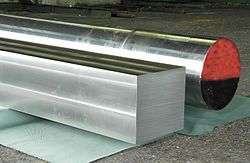
- A solid, more or less rigid object of metal or wood with a uniform cross-section smaller than its length.
- The window was protected by steel bars.
- (countable, uncountable, metallurgy) A solid metal object with uniform (round, square, hexagonal, octagonal or rectangular) cross-section; in the US its smallest dimension is .25 inch or greater, a piece of thinner material being called a strip.
- Ancient Sparta used iron bars instead of handy coins in more valuable alloy, to physically discourage the use of money.
- We are expecting a carload of bar tomorrow.
- A cuboid piece of any solid commodity.
- bar of chocolate
- bar of soap
- A broad shaft, or band, or stripe.
- a bar of light; a bar of colour
- A long, narrow drawn or printed rectangle, cuboid or cylinder, especially as used in a bar code or a bar chart.
- (typography) Various lines used as punctuation or diacritics, such as the pipe ⟨|⟩, fraction bar (as in 12), and strikethrough (as in Ⱥ), formerly (obsolete) inclusive of oblique marks such as the slash.
- (mathematics) The sign indicating that the characteristic of a logarithm is negative, conventionally placed above the digit(s) to show that it applies to the characteristic only and not to the mantissa.
- (physics) A similar sign indicating that the charge on a particle is negative (and that consequently the particle is in fact an antiparticle).
- A business licensed to sell alcoholic drinks for consumption on the premises, or the premises themselves; public house.
- The street was lined with all-night bars.
- The counter of such a premises.
- Step up to the bar and order a drink.
- A counter, or simply a cabinet, from which alcoholic drinks are served in a private house or a hotel room.
- (by extension, In combinations such as coffee bar, juice bar etc.) A premises or counter serving any type of beverage.
- An informal establishment selling food to be consumed on the premises.
- a burger bar; a local fish bar
- An official order or pronouncement that prohibits some activity.
- The club has lifted its bar on women members.
- Anything that obstructs, hinders, or prevents; an obstruction; a barrier.
- Dryden
- Must I new bars to my own joy create?
- 2013, Terence Dillon, A Long Way Home (page 184)
- Mr Harding could look back on his initial judgement of Paul's talent with great satisfaction while Paul could reflect that to be Irish was not necessarily a bar to progress.
- Dryden
- (programming, whimsical, derived from fubar) A metasyntactic variable representing an unspecified entity, often the second in a series, following foo.
- Suppose we have two objects, foo and bar.
- (Britain, Parliament) A dividing line (physical or notional) in the chamber of a legislature beyond which only members and officials may pass.
- (Britain, law) The railing surrounding the part of a courtroom in which the judges, lawyers, defendants and witnesses stay
- (US, law) "the Bar" or "the bar" The bar exam, the legal licensing exam.
- He's studying hard to pass the Bar this time; he's failed it twice before.
- (law, metonymically, "the Bar", "the bar") A collective term for lawyers or the legal profession; specifically applied to barristers in some countries but including all lawyers in others.
- (telecommunications) A bar-shaped symbol that denotes levels of reception, or reception itself.
- I don't have any bars in the middle of this desert.
- (music) A vertical line across a musical staff dividing written music into sections, typically of equal durational value.
- (music) One of those musical sections.
- (sports) A horizontal pole that must be crossed in high jump and pole vault
- (figuratively) Any level of achievement regarded as a challenge to be overcome.
- (football-most codes) The crossbar
- (backgammon) The central divider between the inner and outer table of a backgammon board, where stones are placed if they are hit.
- An addition to a military medal, on account of a subsequent act
- A linear shoaling landform feature within a body of water.
- (geography, nautical, hydrology) A ridge or succession of ridges of sand or other substance, especially a formation extending across the mouth of a river or harbor or off a beach, and which may obstruct navigation. (FM 55-501).
- (heraldry) One of the ordinaries in heraldry; a fess.
- A city gate, in some British place names.
- Potter's Bar
- (mining) A drilling or tamping rod.
- (mining) A vein or dike crossing a lode.
- (architecture) A gatehouse of a castle or fortified town.
- (farriery) The part of the crust of a horse's hoof which is bent inwards towards the frog at the heel on each side, and extends into the centre of the sole.
- (farriery, in the plural) The space between the tusks and grinders in the upper jaw of a horse, in which the bit is placed.
Synonyms
- (business licensed to sell intoxicating beverages): barroom, ginshop, pub (British), public house, tavern
- (official order prohibiting some activity): ban, prohibition
- (typography): See pipe and strikethrough
- (section of a staff, in music): measure
- See also Thesaurus:pub
Derived terms
Translations
|
|
|
|
|
|
|
|
|
- The translations below need to be checked and inserted above into the appropriate translation tables, removing any numbers. Numbers do not necessarily match those in definitions. See instructions at Wiktionary:Entry layout#Translations.
|
Descendants
- Arabic: بَار m (bār)
- Armenian: բար (bar)
- Chinese:
- Mandarin: 吧 (bā)
- Danish: bar c
- Dutch: bar m
- Georgian: ბარი (bari)
- German: Bar f
- Greek: μπαρ n (bar)
- Hungarian: bár
- Icelandic: bar m
- Irish: beár m
- Italian: bar m
- Japanese: バー (bā)
- Korean: 바 (ba)
- Polish: bar m
- Portuguese: bar
- Russian: бар m (bar)
- Serbo-Croatian: бар m, bar m
- Spanish: bar m
- Swedish: bar c
- Thai: บาร์ (baa)
See also
Verb
bar (third-person singular simple present bars, present participle barring, simple past and past participle barred)
- (transitive) To obstruct the passage of (someone or something).
- 1906, Alfred Noyes, The Highwayman:
- "One kiss, my bonny sweetheart, I'm after a prize to-night,
But I shall be back with the yellow gold before the morning light;
Yet, if they press me sharply, and harry me through the day,
Then look for me by moonlight,
Watch for me by moonlight,
I'll come to thee by moonlight, though Hell should bar the way."
- "One kiss, my bonny sweetheart, I'm after a prize to-night,
- Our way was barred by a huge rockfall.
-
- (transitive) To prohibit.
- I couldn't get into the nightclub because I had been barred.
- (transitive) To lock or bolt with a bar.
- bar the door
- to imprint or paint with bars, to stripe
- 1899, Joseph Conrad, Heart of Darkness, section 1
- I lived in a hut in the yard, but to be out of the chaos I would sometimes get into the accountant’s office. It was built of horizontal planks, and so badly put together that, as he bent over his high desk, he was barred from neck to heels with narrow strips of sunlight.
- 1899, Joseph Conrad, Heart of Darkness, section 1
Synonyms
Derived terms
Translations
Preposition
bar
- Except, other than, besides.
- He invited everyone to his wedding bar his ex-wife.
- (horse racing) Denotes the minimum odds offered on other horses not mentioned by name.
- Leg At Each Corner is at 3/1, Lost My Shirt 5/1, and it's 10/1 bar.
Synonyms
Derived terms
- bar none
- all over bar the shouting
Translations
References
Etymology 2
Borrowed from Ancient Greek βάρος (báros, “weight”), coined circa 1900.
Noun
bar (plural bars)
Synonyms
Derived terms
Related terms
Translations
Further reading


Anagrams
Afar
Noun
bar
Afrikaans
Pronunciation
- IPA(key): [bɑɾ]
Adjective
bar (attributive barre, comparative barder, superlative barste)
References
- 2007. The UCLA Phonetics Lab Archive. Los Angeles, CA: UCLA Department of Linguistics.
Albanian
Etymology 1
From Proto-Albanian *bara, from Proto-Indo-European *bʰerH- (compare Ancient Greek φάρμακον (phármakon, “drug, medicine”), Lithuanian bùrti (“to conjure”)).[1] Alternatively from Proto-Indo-European *bʰars- (“spike, prickle”) (compare Old Norse barr (“corn, grain, barley”), Welsh bara (“bread”), Latin far (“spelt”), Serbo-Croatian бра̏шно/brȁšno.
Noun
bar m (indefinite plural barna, definite singular bari)
- grass (plant)
- herb, herbaceous plant
- (colloquial) spice
- medicine, medication, medicinal plant
- (figuratively, colloquial) cure, palliative, solution
- (figuratively, colloquial) marijuana, likely calque from English or French
Alternative forms
- barë (neuter; Tosk)
Derived terms
References
- ↑ D.Q. Adams, "Heal: *bher-", in Encyclopedia of Indo-European Culture (London: Fitzroy-Dearborn, 1997), 262.
Etymology 2
from Proto-Albanian *bara, from *bera (“to carry”) (modern bie). More at bie.
Verb
bar
Alternative forms
Derived terms
Related terms
Catalan
Noun
bar m (plural bars)
Cimbrian
Pronoun
bar
Synonyms
References
- “bar” in Umberto Martello Martalar, Alfonso Bellotto, Dizionario della lingua Cimbra dei Setti Communi vicentini, 1st edition, 1974.
Czech
Pronunciation
- IPA(key): /bar/
Etymology 1
Noun
bar m
- bar (a business selling beverages)
- bar (the counter of such a premises)
- bar (a cabinet used to store alcoholic drinks in a private house or a hotel room)
Declension
Derived terms
- barový m
Related terms
- barman m
Etymology 2
Borrowing from modern European languages, originally coined based on Ancient Greek βάρος (báros, “weight”).[2]
Noun
bar m
- bar, a non-SI unit of pressure equal to 100,000 pascals
Declension
References
Further reading
- bar in Příruční slovník jazyka českého, 1935–1957
- bar in Slovník spisovného jazyka českého, 1960–1971, 1989
Dalmatian
Etymology
From Latin bibere, present active infinitive of bibō. Compare Italian bere, Romanian bea.
Verb
bar (second-person plural present baite)
- to drink
Danish
Pronunciation
- IPA(key): /baːr/, [b̥ɑːˀ]
- Rhymes: -aːˀr
Etymology 1
From Old Norse berr (“bare”). Compare Old English bær.
Adjective
bar
Inflection
| Inflection of bar | |||
|---|---|---|---|
| Positive | Comparative | Superlative | |
| Common singular | bar | — | —2 |
| Neuter singular | bart | — | —2 |
| Plural | bare | — | —2 |
| Definite attributive1 | bare | — | — |
| 1) When an adjective is applied predicatively to something definite, the corresponding "indefinite" form is used. 2) The "indefinite" superlatives may not be used attributively. | |||
Etymology 2
Noun
bar c (singular definite baren, plural indefinite barer)
- bar (business licensed to sell intoxicating beverages, counter of such a premises)
Inflection
Etymology 3
From Ancient Greek βάρος (báros, “weight”).
Noun
bar c (plural indefinite bar)
- bar (unit of pressure)
Etymology 4
See etymology on the main entry.
Verb
bar
- past tense of bære
Dutch
Pronunciation
- Rhymes: -ɑr
- IPA(key): /bɑr/
Etymology 1
Noun
bar m (plural bars, diminutive barretje n)
Derived terms
Etymology 2
Adjective
bar (comparative barder, superlative barst)
- harsh, tough (used mainly with koude (“cold”), or omstandigheden (“conditions”))
- barren, inhospitable, bare
- crude, grim, unfriendly
Inflection
| Inflection of bar | ||||
|---|---|---|---|---|
| uninflected | bar | |||
| inflected | barre | |||
| comparative | barder | |||
| positive | comparative | superlative | ||
| predicative/adverbial | bar | barder | het barst het barste | |
| indefinite | m./f. sing. | barre | bardere | barste |
| n. sing. | bar | barder | barste | |
| plural | barre | bardere | barste | |
| definite | barre | bardere | barste | |
| partitive | bars | barders | — | |
Adverb
bar
- extremely (only in a negative sense)
Etymology 3
From Ancient Greek βάρος (báros, “weight”), coined c. 1900.
Noun
bar
Derived terms
Related terms
References
- M. J. Koenen & J. Endepols, Verklarend Handwoordenboek der Nederlandse Taal (tevens Vreemde-woordentolk), Groningen, Wolters-Noordhoff, 1969 (26th edition) [Dutch dictionary in Dutch]
Faroese
Verb
bar
Conjugation
Derived terms
French
Pronunciation
- IPA(key): /baʁ/
audio (file) - Rhymes: -aʁ
Noun
bar m (plural bars)
Further reading
- “bar” in le Trésor de la langue française informatisé (The Digitized Treasury of the French Language).
Galician
Etymology 1
Noun
bar m (plural bares)
Etymology 2
Borrowed from English bar and this from Ancient Greek βάρος (báros, “weight”).
Noun
bar m (plural bares)
- bar (unit of pressure)
German
Pronunciation
audio (file) - Rhymes: -aːɐ̯
Adjective
bar (not comparable)
Declension
| number & gender | singular | plural | |||
|---|---|---|---|---|---|
| masculine | feminine | neuter | all genders | ||
| predicative | er ist bar | sie ist bar | es ist bar | sie sind bar | |
| strong declension (without article) |
nominative | barer | bare | bares | bare |
| genitive | baren | barer | baren | barer | |
| dative | barem | barer | barem | baren | |
| accusative | baren | bare | bares | bare | |
| weak declension (with definite article) |
nominative | der bare | die bare | das bare | die baren |
| genitive | des baren | der baren | des baren | der baren | |
| dative | dem baren | der baren | dem baren | den baren | |
| accusative | den baren | die bare | das bare | die baren | |
| mixed declension (with indefinite article) |
nominative | ein barer | eine bare | ein bares | (keine) baren |
| genitive | eines baren | einer baren | eines baren | (keiner) baren | |
| dative | einem baren | einer baren | einem baren | (keinen) baren | |
| accusative | einen baren | eine bare | ein bares | (keine) baren | |
Adverb
bar
Preposition
bar
- (+genitive) without
Synonyms
Gothic
Romanization
bar
- Romanization of 𐌱𐌰𐍂
Icelandic
Pronunciation
- IPA(key): /paːr/
- Rhymes: -aːr
Etymology 1
Borrowed from English bar (1), from Old French barre.
Noun
bar m (genitive singular bars, nominative plural barir)
- bar (establishment offering alcoholic drinks for consumption on the premises)
- bar (counter at which such beverages are sold or offered)
- (by extension) a counter where a buffet or a specialized kind of food is offered
Declension
Etymology 2
Borrowed from English bar (2), from Ancient Greek βάρος (báros, “weight”).
Noun
bar n (genitive singular bars, nominative plural bör)
- bar (unit of pressure)
Declension
Irish
Etymology
Borrowed from English bar, from Ancient Greek βάρος (báros, “weight”).
Noun
bar m (genitive singular bair, nominative plural bair)
- bar (unit of pressure)
Declension
First declension
|
Bare forms:
|
Forms with the definite article:
|
Mutation
| Irish mutation | ||
|---|---|---|
| Radical | Lenition | Eclipsis |
| bar | bhar | mbar |
| Note: Some of these forms may be hypothetical. Not every possible mutated form of every word actually occurs. | ||
Further reading
- "bar" in Foclóir Gaeilge-Béarla, An Gúm, 1977, by Niall Ó Dónaill.
- Entries containing “bar” in New English-Irish Dictionary by Foras na Gaeilge.
Italian
Etymology
Noun
bar m (plural bar)
Derived terms
Kashmiri
Noun
bar
- a door
Kurdish
Etymology
Noun
bar m
- burden (a heavy load)
This Kurdish entry was created from the translations listed at burden. It may be less reliable than other entries, and may be missing parts of speech or additional senses. Please also see bar in the Kurdish Wiktionary. This notice will be removed when the entry is checked. (more information) October 2009
Latvian
Verb
bar
- 2nd person singular present indicative form of bārt
- 3rd person singular present indicative form of bārt
- 3rd person plural present indicative form of bārt
- 2nd person singular imperative form of bārt
- (with the particle lai) 3rd person singular imperative form of bārt
- (with the particle lai) 3rd person plural imperative form of bārt
Norwegian Bokmål
Etymology 1
From Old Norse berr and Old Danish bar.
Adjective
bar (neuter singular bart, definite singular and plural bare, comparative barere, indefinite superlative barest, definite superlative bareste)
- bare, naked
- 2014, "Ikke provosèr ham", by Inger Torill Jørgensen, eBokNorden AS →ISBN
- Han kom tettere inn til henne, la armen rundt ryggen hennes og bøyet hodet sitt ned mot hennes bare skulder, kysset den.
- He came closer to her, put his arm around her back and bowed his head down to her bare shoulder, and kissed it.
- 2014, "Ikke provosèr ham", by Inger Torill Jørgensen, eBokNorden AS →ISBN
Derived terms
See also
- berr (Nynorsk)
Etymology 2
Noun
bar m (definite singular baren, indefinite plural barer, definite plural barene)
Related terms
- bartender (sense 1)
Etymology 3
Verb
bar
- simple past of bære
References
- “bar” in The Bokmål Dictionary. (adjective on page 2)
Norwegian Nynorsk
Pronunciation
- IPA(key): /bɑːr/
Etymology 1
Noun
bar m (definite singular baren, indefinite plural barar, definite plural barane)
Related terms
- bartender (sense 1)
Etymology 2
From Ancient Greek βάρος (báros, “weight”), coined circa 1900.
Noun
bar m (definite singular baren, indefinite plural barar, definite plural barane)
Derived terms
Related terms
Etymology 3
Noun
bar n (definite singular baret, uncountable)
- the needles of the conifers, twigs and branches of conifers
- 1860, Aasmund Olavsson Vinje, "Vaaren":
- Derfor eg fann millom Bjørkar og Bar i Vaaren ei Gaata […]
- Therefore I found, between the birches and conifers, in spring a riddle […]
- Derfor eg fann millom Bjørkar og Bar i Vaaren ei Gaata […]
- 1860, Aasmund Olavsson Vinje, "Vaaren":
Derived terms
- barskog
- granbar
Etymology 4
Verb
bar
- past tense of bera
References
- “bar” in The Nynorsk Dictionary.
Old English
Etymology
From Proto-Germanic *bairaz.
Pronunciation
- IPA(key): /ˈbɑːr/, [ˈbɑːrˠ]
Noun
bār m
Declension
Old High German
Etymology
From Proto-Germanic *bazaz, whence also Old English bær, Old Norse berr.
Pronunciation
- IPA(key): /bar/
Adjective
bar
Old Saxon
Etymology
From Proto-Germanic *bazaz, whence also Old English bær, Old Norse berr.
Adjective
bār
Declension
| Strong declension | ||||||
|---|---|---|---|---|---|---|
| gender | masculine | neuter | feminine | |||
| case | singular | plural | singular | plural | singular | plural |
| nominative | bār | bāre | bār | bāru | bār | bāre |
| accusative | bārana | bāre | bāra | bāru | bār | bāre |
| genitive | bāres | bārarō | bāraro | bārarō | bāres | bārarō |
| dative | bārumu | bārum | bāraro | bārum | bārumu | bārum |
| Weak declension | ||||||
| gender | masculine | neuter | feminine | |||
| case | singular | plural | singular | plural | singular | plural |
| nominative | bāro | bāru | bāra | bāru | bāra | bāru |
| accusative | bārun | bārun | bārun | bārun | bāra | bārun |
| genitive | bārun | bāronō | bārun | bāronō | bārun | bāronō |
| dative | bārun | bārum | bārun | bārum | bārun | bārum |
Old Swedish
Etymology
From Old Norse *barr (Old West Norse berr), from Proto-Germanic *bazaz.
Adjective
bar
Declension
| singular | masculine | feminine | neuter |
|---|---|---|---|
| nominative | bar | bar | bart |
| accusative | baran | bara | bart |
| dative | barum, -om | barri, -re | baru, -o |
| genitive | bars | barrar | bars |
| plural | masculine | feminine | neuter |
| nominative | barir, -e(r) | barar | bar |
| accusative | bara | barar | bar |
| dative | barum, -om | barum, -om | barum, -om |
| genitive | barra | barra | barra |
| singular | masculine | feminine | neuter |
|---|---|---|---|
| nominative | bari, -e | bara | bara |
| accusative | bara | baru, -o | bara |
| dative | bara | baru, -o | bara |
| genitive | bara | baru, -o | bara |
| plural | masculine | feminine | neuter |
| nominative | baru, -o | baru, -o | baru, -o |
| accusative | baru, -o | baru, -o | baru, -o |
| dative | baru, -o | baru, -o | baru, -o |
| genitive | baru, -o | baru, -o | baru, -o |
Descendants
- Swedish: bar
Polish
Pronunciation
- IPA(key): /bar/
audio (file)
Etymology 1
Noun
bar m inan
- bar, luncheon bar, buffet
- bar (a long table or counter where drinks are served)
Declension
Derived terms
- barowy
Related terms
Etymology 2
Noun
| Chemical element | |
|---|---|
| Ba | Previous: cez (Cs) |
| Next: lantan (La) | |
bar m inan
Declension
Etymology 3
From Ancient Greek βάρος (báros, “weight”), probably borrowed via science literature in another European language.
Noun
bar m inan
- bar (unit of pressure equal to 100,000 pascals)
Declension
Further reading
- bar in Polish dictionaries at PWN
Portuguese
Pronunciation
- (Portugal) IPA(key): /ˈbaɾ/
- (Brazil) IPA(key): /ˈbaʁ/
- (Caipira) IPA(key): [ˈbaɹ], [ˈbaɻ]
- (South Brazil) IPA(key): [ˈbaɻ], [ˈbaɾ]
- (Carioca) IPA(key): [ˈbaχ]
- (Nordestino) IPA(key): [ˈbah]
Etymology 1
Noun
bar m (plural bares)
Etymology 2
Originally from Ancient Greek βάρος (báros, “weight”).
Noun
bar m (plural bars)
- bar (unit of pressure)
Romani
Noun
bar f (plural bara)
bar m (plural bar)
Derived terms
- barari
- pedongi bar
Serbo-Croatian
Etymology 1
Pronunciation
- IPA(key): /bâːr/.
Noun
bȃr m (Cyrillic spelling ба̑р)
Declension
Etymology 2
From Ancient Greek βάρος (báros, “weight”), coined circa 1900.
Pronunciation
- IPA(key): /bâːr/
Noun
bȃr m (Cyrillic spelling ба̑р)
- bar (unit of pressure)
Declension
Etymology 3
Clipping of bàrem.
Pronunciation
- IPA(key): /bâr/
Adverb
bȁr (Cyrillic spelling ба̏р)
References
Somali
Verb
bar
- Alternative spelling of baro
Spanish
Etymology 1
Noun
bar m (plural bares)
Etymology 2
Borrowed from English bar and this from Ancient Greek βάρος (báros, “weight”).
Noun
bar m (plural bares)
- bar (unit of pressure)
Swedish
Pronunciation
audio (file)
Etymology 1
From Old Swedish bar, from Old Norse *barr (Old West Norse berr), from Proto-Germanic *bazaz, from Proto-Indo-European *bʰos- (“bare, barefoot”). Cognate with English bare. See Old English bær.[1]
Adjective
bar (comparative barare, superlative barast)
- bare, uncovered; not covered by e.g. clothes (about people), fur (about certain animals) or a snow cover (about the ground)
Declension
| Inflection of bar | |||
|---|---|---|---|
| Indefinite | Positive | Comparative | Superlative2 |
| Common singular | bar | barare | barast |
| Neuter singular | bart | barare | barast |
| Plural | bara | barare | barast |
| Definite | Positive | Comparative | Superlative |
| Masculine singular1 | bare | barare | baraste |
| All | bara | barare | baraste |
| 1) Only used, optionally, to refer to things whose natural gender is masculine. 2) The indefinite superlative forms are only used in the predicative. | |||
Etymology 2
See bära.
Verb
bar
- past tense of bära.
Etymology 3
Noun
bar c
- a bar, pub; place where mainly alcoholic drinks are served.
- a (bar) counter
Declension
| Declension of bar | ||||
|---|---|---|---|---|
| Singular | Plural | |||
| Indefinite | Definite | Indefinite | Definite | |
| Nominative | bar | baren | barer | barerna |
| Genitive | bars | barens | barers | barernas |
Etymology 4
Originally from Ancient Greek βάρος (báros, “weight”).
Noun
bar c
- A bar; a unit of pressure
References
Turkish
Etymology
Noun
bar (definite accusative barı, plural barlar)
- (dialectal) dance, round dance
Declension
| Inflection | ||
|---|---|---|
| Nominative | ||
| Definite accusative | ||
| Singular | Plural | |
| Nominative | ||
| Definite accusative | ||
| Dative | ||
| Locative | ||
| Ablative | ||
| Genitive | ||
References
- Ačaṙean, Hračʿeay (1971–1979), “պար”, in Hayerēn armatakan baṙaran [Dictionary of Armenian Root Words] (in Armenian), 2nd edition, Yerevan: University Press
- “bar”, in Türkiye'de halk ağzından derleme sözlüğü [Compilation Dictionary of Popular Speech in Turkey] (in Turkish), Ankara: Türk Dil Kurumu, 1963–1982
This etymology is incomplete. You can help Wiktionary by elaborating on the origins of this term.
Wakhi
Etymology
Noun
bar
Zazaki
Etymology
Noun
bar ?