sand
English
Pronunciation
- IPA(key): /sænd/
Audio (US) (file) - Rhymes: -ænd
Etymology 1
From Middle English sand, from Old English sand, from Proto-Germanic *samdaz (compare West Frisian sân, Dutch zand, German Sand, Danish, Swedish and Norwegian sand), from Proto-Indo-European *sámh₂dʰos (compare Latin sabulum, Ancient Greek ἄμαθος (ámathos)), from *sem- (“to pour”) (compare English dialectal samel (“sand bottom”), Old Irish to-ess-sem (“to pour out”), Latin sentina (“bilge water”), Lithuanian sémti (“to scoop”), Ancient Greek ἀμάω (amáō, “to gather”), ἄμη (ámē, “water bucket”)).
Noun
sand (usually uncountable, plural sands)
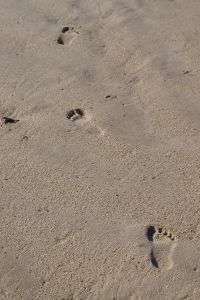
- (uncountable) Rock that is ground more finely than gravel, but is not as fine as silt (more formally, see grain sizes chart), forming beaches and deserts and also used in construction.
- 1913, Joseph C. Lincoln, chapter 1, in Mr. Pratt's Patients:
- For a spell we done pretty well. Then there came a reg'lar terror of a sou'wester same as you don't get one summer in a thousand, and blowed the shanty flat and ripped about half of the weir poles out of the sand.
-
- (countable, often in the plural) A beach or other expanse of sand.
- The Canadian tar sands are a promising source of oil.
- 1892, James Yoxall, chapter 7, in The Lonely Pyramid:
- It was the Lost Oasis, the Oasis of the vision in the sand. […] Deep-hidden in the hollow, beneath the cliffs, it lay; and round it the happy verdure spread for many a rood. […] Yes, the quest was ended, the Lost Oasis was the Found!
- (uncountable, dated, circa 1920) Personal courage.
- 1884, Twain, Mark, The Adventures of Huckleberry Finn:
- You may say what you want to, but in my opinion she had more sand in her than any girl I ever see; in my opinion she was just full of sand.
- 1968, Charles Portis, True Grit
- He said, “I admire your sand but I believe you will find I am not liable for such claims. Let me say too that your valuation of the horse is high by about two hundred dollars.”
- 1979, L'Amour, Louis, Bendigo Shafter, →ISBN, OL 24369989M:
- There was youngsters all around him, and he stood there lookin’ at me and never turned a hair. He had sand, that Morrell.
-
- (uncountable, geology) A particle from 62.5 microns to 2 mm in diameter, following the Wentworth scale.
- A light beige colour, like that of typical sand.
- sand colour:
- (countable, obsolete) A single grain of sand.
- (Can we find and add a quotation of Shakespeare to this entry?)
- (countable, figuratively) A moment or interval of time; the term or extent of one's life (referring to the sand in an hourglass).
- William Shakespeare (1564-1616)
- The sands are numbered that make up my life.
- William Shakespeare (1564-1616)
Derived terms
|
|
|
|
Translations
|
|
|
- The translations below need to be checked and inserted above into the appropriate translation tables, removing any numbers. Numbers do not necessarily match those in definitions. See instructions at Wiktionary:Entry layout#Translations.
See also
Adjective
sand
- Of a light beige colour, like that of typical sand.
Translations
Verb
sand (third-person singular simple present sands, present participle sanding, simple past and past participle sanded)
- (transitive) To abrade the surface of (something) with sand or sandpaper in order to smooth or clean it.
- (transitive) To cover with sand.
- 1938, Xavier Herbert, Capricornia, New York: D. Appleton-Century, 1943, Chapter IX, page 141,
- Sudden stopping, which could be effected easily by sanding the rails and reversing the driving-gear, was dangerous, because the train might telescope and overwhelm the engine.
- 1958, Boris Pasternak, Doctor Zhivago, translated by Max Hayward and Manya Harari, New York: Pantheon, Chapter 4, page 96,
- The golden domes of churches and the freshly sanded paths in the town gardens were a glaring yellow.
- 1938, Xavier Herbert, Capricornia, New York: D. Appleton-Century, 1943, Chapter IX, page 141,
- (transitive, historical) To blot ink using sand.
- 1859, Charles Dickens, A Tale of Two Cities
- The officer wrote until he had finished, read over to himself what he had written, sanded it, and handed it to Defarge, with the words "In secret."
- 1859, Charles Dickens, A Tale of Two Cities
Translations
|
- The translations below need to be checked and inserted above into the appropriate translation tables, removing any numbers. Numbers do not necessarily match those in definitions. See instructions at Wiktionary:Entry layout#Translations.
|
See also
- Appendix:Colors
Etymology 2
Abbreviation of sand(piper).
Noun
sand (plural sands)
- (colloquial) A sandpiper.
Anagrams
Danish
Pronunciation
- IPA(key): /san/, [sanˀ]
- Rhymes: -anˀ
Etymology 1
From Old Norse sannr, saðr, from Proto-Germanic *sanþaz, from Proto-Indo-European *h₁sónts (“being, existing”), the present participle of *h₁es- (“to be”).
Adjective
sand
Inflection
| Inflection of sand | |||
|---|---|---|---|
| Positive | Comparative | Superlative | |
| Common singular | sand | — | —2 |
| Neuter singular | sandt | — | —2 |
| Plural | sande | — | —2 |
| Definite attributive1 | sande | — | — |
| 1) When an adjective is applied predicatively to something definite, the corresponding "indefinite" form is used. 2) The "indefinite" superlatives may not be used attributively. | |||
Related terms
Etymology 2
From Old Norse sandr, from Proto-Germanic *samdaz, from Proto-Indo-European *sámh₂dʰos.
Noun
sand n (singular definite sandet, not used in plural form)
- sand (finely ground rock)
Declension
| neuter gender |
Singular | |
|---|---|---|
| indefinite | definite | |
| nominative | sand | sandet |
| genitive | sands | sandets |
See also

Faroese
Noun
sand
- accusative of sandur
Icelandic
Noun
sand
- indefinite accusative singular of sandur
Middle English
Alternative forms
Etymology
From Old English sand, from Proto-Germanic *samdaz, from Proto-Indo-European *sámh₂dʰos.
Pronunciation
- IPA(key): /saːnd/, /sand/, /sɔnd/
Noun
sand (uncountable)
Derived terms
Descendants
References
- “sā̆nd (n.)” in MED Online, Ann Arbor, Mich.: University of Michigan, 2007, retrieved 2018-04-05.
Norwegian Bokmål
Etymology
From Old Norse sandr, from Proto-Germanic *samdaz, from Proto-Indo-European *sámh₂dʰos.
Pronunciation
Noun
sand m (definite singular sanden)
Derived terms
Norwegian Nynorsk
Etymology
Pronunciation
- IPA(key): /sɑnd/, /sɑnː/
Noun
sand m (definite singular sanden)
Derived terms
Further reading
- “sand” in The Nynorsk Dictionary.
Old English
Pronunciation
- IPA(key): /ˈsɑnd/
Etymology 1
From Proto-Germanic *sandō. See also the verb sendan.
Noun
sand f
Etymology 2
From Proto-Germanic *samdaz, from Proto-Indo-European *sámh₂dʰos. Compare Old Frisian sand, Old Saxon sand, Old High German sant, Old Norse sandr.
Noun
sand n
Derived terms
Descendants
Old Saxon
Etymology
Noun
sand n
Swedish
Etymology
From Old Swedish sander, from Old Norse sandr, from Proto-Germanic *samdaz, from Proto-Indo-European *sámh₂dʰos.
Pronunciation
audio (file)
Noun
sand c
- sand (finely ground rock)
Declension
| Declension of sand | ||||
|---|---|---|---|---|
| Uncountable | ||||
| Indefinite | Definite | |||
| Nominative | sand | sanden | — | — |
| Genitive | sands | sandens | — | — |
Related terms
|
|
References
- sand in Svenska Akademiens Ordlista över svenska språket (13th ed., online)