dance
English
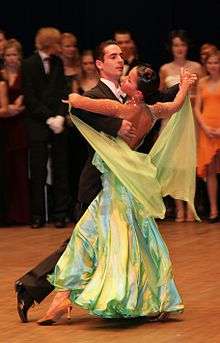
A man and woman dancing.
Alternative forms
- daunce (obsolete)
Etymology
From Middle English dauncen, daunsen, a borrowing from Anglo-Norman dauncer, dancer (“to dance”) (compare Old French dancier), from Frankish *dansōn (“to draw, pull, stretch out, gesture”) (compare Old High German dansōn (“to draw, pull”)), from Proto-Germanic *þansōną, from *þinsaną (“to draw, pull”). More at thin.
Pronunciation
- IPA(key): /dæns/
- (US, Canada) IPA(key): [dɛəns~deəns]
- (Northern England, Ireland) IPA(key): [dæns~dans]
- IPA(key): /dɑːns/
- (Received Pronunciation, Cockney) IPA(key): [dɑːns]
Audio (UK) (file) Audio (US) (file) - Rhymes: -ɑːns, -æns
Noun
dance (plural dances)
- A sequence of rhythmic steps or movements usually performed to music, for pleasure or as a form of social interaction.
- 1907, Robert William Chambers, chapter II, in The Younger Set (Project Gutenberg; EBook #14852), New York, N.Y.: D. Appleton & Company, published 1 February 2005 (Project Gutenberg version), OCLC 24962326:
- "I ought to arise and go forth with timbrels and with dances; but, do you know, I am not inclined to revels? There has been a little—just a very little bit too much festivity so far …. Not that I don't adore dinners and gossip and dances; not that I do not love to pervade bright and glittering places. […]"
-
- A social gathering where dancing is the main activity.
- 1907, Robert William Chambers, chapter II, in The Younger Set (Project Gutenberg; EBook #14852), New York, N.Y.: D. Appleton & Company, published 1 February 2005 (Project Gutenberg version), OCLC 24962326:
- "I ought to arise and go forth with timbrels and with dances; but, do you know, I am not inclined to revels? There has been a little—just a very little bit too much festivity so far …. Not that I don't adore dinners and gossip and dances; not that I do not love to pervade bright and glittering places. […]"
-
- (heraldry) A normally horizontal stripe called a fess that has been modified to zig-zag across the center of a coat of arms from dexter to sinister.
- A genre of modern music characterised by sampled beats, repetitive rhythms and few lyrics.
- (uncountable) The art, profession, and study of dancing.
- A piece of music with a particular dance rhythm.[1]
- 1909, Archibald Marshall [pseudonym; Arthur Hammond Marshall], chapter I, in The Squire’s Daughter, London: Methuen, OCLC 12026604; republished New York, N.Y.: Dodd, Mead and Company, 1919, OCLC 491297620:
- They stayed together during three dances, went out on to the terrace, explored wherever they were permitted to explore, paid two visits to the buffet, and enjoyed themselves much in the same way as if they had been school-children surreptitiously breaking loose from an assembly of grown-ups.
-
Hyponyms
- See also Thesaurus:dance
Derived terms
Terms derived from dance (noun)
Translations
movements to music
|
|
Verb
dance (third-person singular simple present dances, present participle dancing, simple past and past participle danced)
- (intransitive) To move with rhythmic steps or movements, especially in time to music.
- 1898, Winston Churchill, chapter 4, in The Celebrity:
- “Well,” I answered, at first with uncertainty, then with inspiration, “he would do splendidly to lead your cotillon, if you think of having one.” ¶ “So you do not dance, Mr. Crocker?” ¶ I was somewhat set back by her perspicuity.
- I danced with her all night long.
-
- (intransitive) To leap or move lightly and rapidly.
- His eyes danced with pleasure as he spoke. She accused her political opponent of dancing around the issue instead of confronting it.
- Byron
- Shadows in the glassy waters dance.
- (transitive) To perform the steps to.
- Have you ever danced the tango?
- (transitive) To cause to dance, or move nimbly or merrily about.
- William Shakespeare
- to dance our ringlets to the whistling wind
- William Shakespeare
- Thy grandsire loved thee well; / Many a time he danced thee on his knee.
- William Shakespeare
Synonyms
Derived terms
Descendants
Translations
move rhythmically to music
|
|


See also
- Appendix:Dances
- modern
- musical theatre
- tap dancing
- terpsichorean
References
- ↑ J. A. Simpson and E. S. C. Weiner (prepared by), The Compact Oxford English Dictionary, 2nd edition (Claredon Press, Oxford 1991 [1989], →ISBN), page 387
Further reading


Anagrams
French
Etymology
Pronunciation
- IPA(key): /dɑ̃s/
Noun
dance f (uncountable)
Galician
Verb
dance
- first-person singular present subjunctive of danzar
- third-person singular present subjunctive of danzar
Middle French
Etymology
Noun
dance f (plural dances)
Descendants
- French: danse
Old French
Etymology
Noun
dance f (oblique plural dances, nominative singular dance, nominative plural dances)
- dance
- circa 1180, Chrétien de Troyes, Lancelot ou le Chevalier de la charrette:
- Baules et queroles et dance
- Dancing, singing and dance
- Baules et queroles et dance
-
Portuguese
Verb
dance
- First-person singular (eu) present subjunctive of dançar
- Third-person singular (ele, ela, also used with tu and você?) present subjunctive of dançar
- First-person singular (eu) affirmative imperative of dançar
- Third-person singular (você) affirmative imperative of dançar
- First-person singular (eu) negative imperative of dançar
- Third-person singular (você) negative imperative of dançar
Spanish
Pronunciation
- (Castilian) IPA(key): [ˈda̠n̟.θe̞]
- (Latin America) IPA(key): [ˈda̠n.se̞]
Verb
dance
This article is issued from
Wiktionary.
The text is licensed under Creative Commons - Attribution - Sharealike.
Additional terms may apply for the media files.