hoof
English
Etymology
From Middle English hoof, hof, from Old English hōf, from Proto-Germanic *hōfaz (compare West Frisian hoef, Dutch hoef, German Huf, Danish hov, Norwegian hov and Swedish hov), from Proto-Indo-European *ḱoph₂ós (compare Russian копы́то (kopýto, “hoof”), копа́ть (kopátʹ, “to dig”), Avestan 𐬯𐬀𐬟𐬀 (safa, “hoof”), Sanskrit शफ (śaphá, “hoof, claw”)).
Pronunciation
- (US) enPR: ho͝of, ho͞of, IPA(key): /hʊf/, /huːf/
Audio (US) (file) - Rhymes: -ʊf, -uːf
Noun
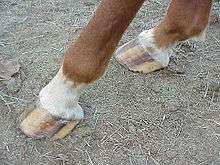
hooves of a horse.
- The tip of a toe of an ungulate such as a horse, ox or deer, strengthened by a thick keratin covering.
- (slang) The human foot.
- Get your hooves off me!
- (geometry, dated) An ungula.
Translations
tip of a toe of ungulates
|
|
Verb
hoof (third-person singular simple present hoofs, present participle hoofing, simple past and past participle hoofed)
- To trample with hooves.
- (colloquial) To walk.
- (informal) To dance, especially as a professional.
- (colloquial, football (soccer), transitive) To kick, especially to kick a football a long way downfield with little accuracy.
Synonyms
- (to kick): boot
Derived terms
Afrikaans
Etymology
Noun
hoof (plural hoofde)
Limburgish
Etymology
From Middle Dutch hof, from Old Dutch hof, from Proto-Germanic *hufą.
Noun
hoof m
- garden (an outdoor area containing one or more types of plants)
This article is issued from
Wiktionary.
The text is licensed under Creative Commons - Attribution - Sharealike.
Additional terms may apply for the media files.