frog
English
Pronunciation
Etymology 1
From Middle English frogge, from Old English frogga, frocga (“frog”), from Proto-Germanic *fruþgô (“frog”), a pet-form of Proto-Germanic *fruþ-, *frauþaz (“frog”), deverbative of Proto-Indo-European *prew- (“to jump, hop”). Cognate with Old Norse frauki (“frog”), Sanskrit प्लवक (plavaka, “frog”), Lithuanian sprūgti (“to leave, escape”), Russian пры́гнуть (prýgnutʹ, “to leap”), пры́гать (prýgatʹ, “to jump around”), Albanian fryj (“to blow”)).[1] See also frosh, frosk.
Noun
_(14781357673).jpg)
frog (plural frogs)
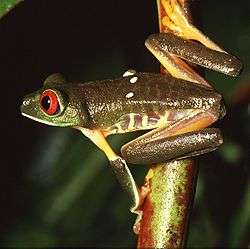
- A small tailless amphibian of the order Anura that typically hops.
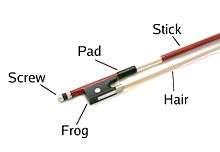
- The part of a violin bow (or that of other similar string instruments such as the viola, cello and contrabass) located at the end held by the player, to which the horsehair is attached.
- (Cockney rhyming slang) Road. Shorter, more common form of frog and toad.
- The depression in the upper face of a pressed or handmade clay brick.
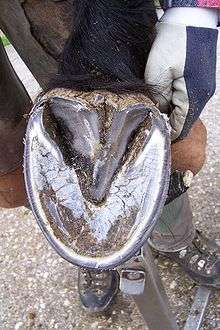
- An organ on the bottom of a horse’s hoof that assists in the circulation of blood.
- (rail transport) The part of a railway switch or turnout where the running-rails cross (from the resemblance to the frog in a horse’s hoof).
Synonyms
Derived terms
- Australian ground frog
- brown frog
- bush frog
- clawed frog
- common frog
- Darwin's frog
- disc-tongued frog
- edible frog
- European common brown frog
- European common frog
- fine as frog hair, finer than frog hair
- Frog
- frog belly
- frogbit
- frog chorus
- frogeater, frog eater
- frogeye
- frogeyed
- frog face
- frogfish
- frogged
- froggery
- frogging
- froggish
- froggy
- Froggy
- froghopper
- a frog in one’s throat
- frog kick
- frog kingdom
- frog legs
- froglike
- frog lily
- frogly
- frogman
- frogmarch, frog-march
- frogmouth
- frog orchid
- frogpond, frog pond
- frog pose
- frog's-bit
- frog's legs
- frogspawn, frog spawn
- frog spit
- frog spittle
- frog sticker
- frogstool
- ghost frog
- glass frog
- green frog
- have a frog in one's throat
- leapfrog, leap-frog
- leapfrogged, leap-frogged
- leapfrogging
- leapfrog test, leap-frog test, leap frog test
- litter frog
- male frog test
- marsh frog
- marsupial frog
- moss frog
- narrow-mouthed frog
- painted frog
- parsley frog
- poison dart frog
- pool frog
- robber frog
- screeching frog
- sedge frog
- Seychelles frog
- shovelnose frog
- tailed frog
- tongueless frog
- tree frog
- Tukeit Hill frog
- tropical frog
- true frog
Translations
|
|


References
- ↑ J.P. Mallory & D.Q. Adams, eds, Encyclopedia of Indo-European Culture, s.v. "Jump" (London: Fitzroy Dearborn, 1997), 323.
See also
Verb
frog (third-person singular simple present frogs, present participle frogging, simple past and past participle frogged)
- To hunt or trap frogs.
- (transitive, biology) To use a pronged plater to transfer (cells) to another plate.
- (transitive, cooking) To spatchcock (a chicken).
Derived terms
- frog stitch
Etymology 2
From frog legs, stereotypical food of the French. Compare rosbif (“English person”), from roast beef, corresponding French term for English, likewise based on stereotypical food.
Noun
frog (plural frogs)
- (offensive) A French person.
- Synonym: baguette
- (Canada, offensive) A French-speaking person from Quebec.
Antonyms
- (French person): rosbif (of an English, by French)
Translations
See also
References
- frog in Webster’s Revised Unabridged Dictionary, G. & C. Merriam, 1913
Etymology 3
_(Seite_08_Posamenten-Knebelverschluss%2C_Ausschnitt).jpg)
Unknown. Possibly from Portuguese froco (“flock”), from Latin floccus (“flock”).
Noun
frog (plural frogs)
- A leather or fabric loop used to attach a sword or bayonet, or its scabbard, to a waist or shoulder belt.
- An ornate fastener for clothing consisting of an oblong button (covered with netted thread), toggle, or knot, that fits through a loop.
- 1844, Alexander Dumas, The Count of Monte Cristo:
- The visitor was about fifty-two years of age, dressed in one of the green surtouts, ornamented with black frogs, which have so long maintained their popularity all over Europe.
- 1844, Alexander Dumas, The Count of Monte Cristo:
Translations
|
Verb
frog (third-person singular simple present frogs, present participle frogging, simple past and past participle frogged)
Etymology 4
Supposedly from ribbit (“sound made by a frog”) sounding similar to "rip it".
Verb
frog (third-person singular simple present frogs, present participle frogging, simple past and past participle frogged)
References
“frog” in Douglas Harper, Online Etymology Dictionary, 2001–2018.
Irish
Etymology
Pronunciation
- IPA(key): [fˠɾˠɔɡ]
Noun
frog m, f (genitive singular froig, nominative plural froganna)
- frog (amphibian; organ in a horse’s foot)
Declension
First declension
|
Bare forms:
|
Forms with the definite article:
|
Derived terms
|
|
|
Mutation
| Irish mutation | ||
|---|---|---|
| Radical | Lenition | Eclipsis |
| frog | fhrog | bhfrog |
| Note: Some of these forms may be hypothetical. Not every possible mutated form of every word actually occurs. | ||
Further reading
- "frog" in Foclóir Gaeilge-Béarla, An Gúm, 1977, by Niall Ó Dónaill.
- Entries containing “frog” in English-Irish Dictionary, An Gúm, 1959, by Tomás de Bhaldraithe.
- Entries containing “frog” in New English-Irish Dictionary by Foras na Gaeilge.
Volapük
Pronunciation
- IPA(key): [fɾoɡ]
Noun
frog (plural frogs)
- frog (amphibian)
Declension
| singular | plural | |
|---|---|---|
| nominative | frog | frogs |
| genitive | froga | frogas |
| dative | froge | froges |
| accusative | frogi | frogis |
| predicative | frogu | frogus |
| vocative | o frog! | o frogs! |
Derived terms
|
|
|