鏡
| ||||||||
Translingual
Han character
鏡 (radical 167, 金+11, 19 strokes, cangjie input 金卜廿山 (CYTU), four-corner 80116, composition ⿰釒竟)
References
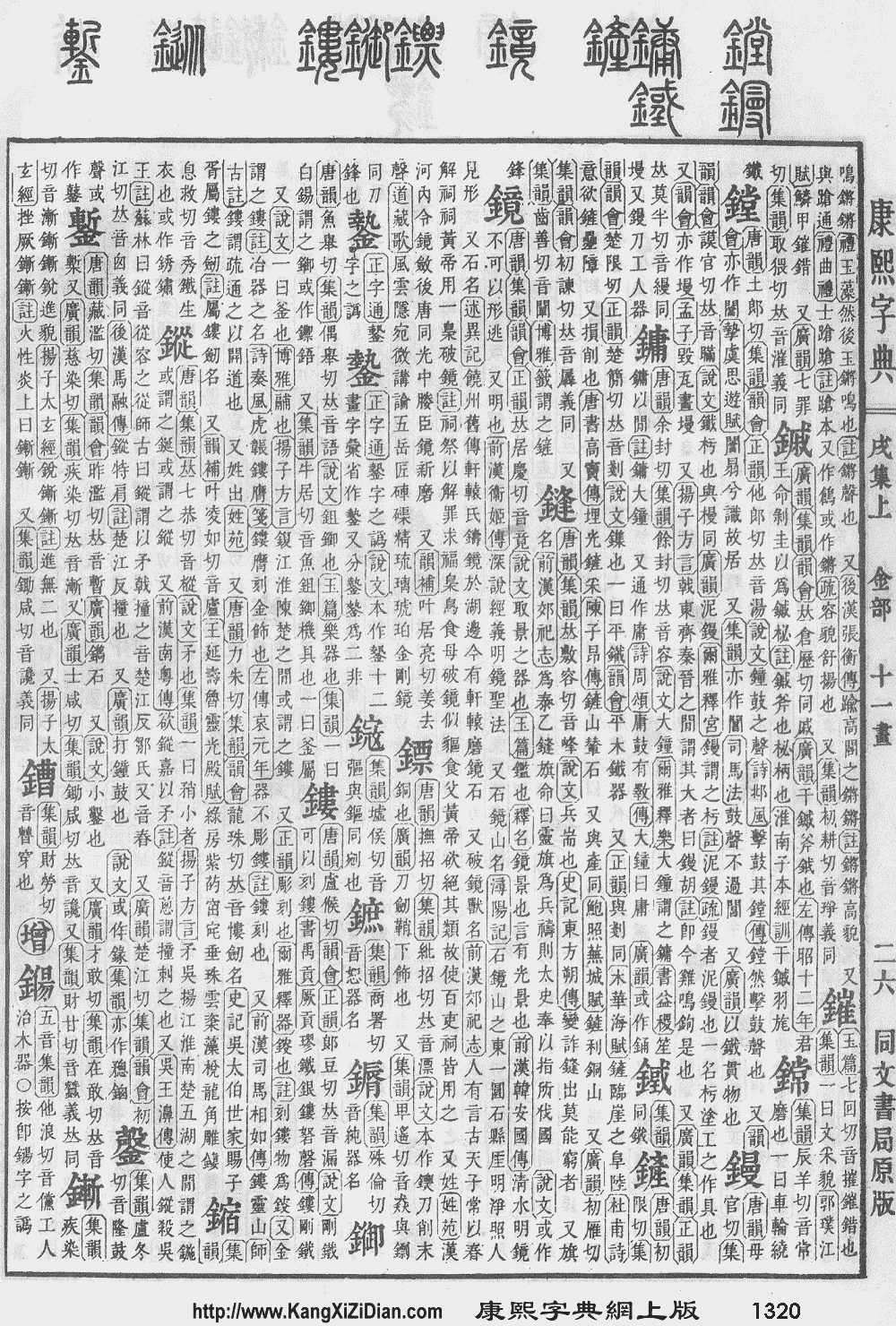
- KangXi: page 1320, character 10
- Dai Kanwa Jiten: character 40812
- Dae Jaweon: page 1820, character 5
- Hanyu Da Zidian: volume 6, page 4250, character 10
- Unihan data for U+93E1
Chinese
| trad. | 鏡 | |
|---|---|---|
| simp. | 镜 | |
| alt. forms | ⿰钅井 second round simplified | |
Glyph origin
| Historical forms of the character 鏡 | |
|---|---|
| Shuowen Jiezi (compiled in Han) | Liushutong (compiled in Ming) |
| Small seal script | Transcribed ancient scripts |
 |
 |
| Characters in the same phonetic series (竟) (Zhengzhang, 2003) | |
|---|---|
| Old Chinese | |
| 滰 | *ɡaŋʔ |
| 境 | *kraŋʔ |
| 竟 | *kraŋs |
| 鏡 | *kraŋs |
| 獍 | *kraŋs |
| 樈 | *ɡraŋ |
| 璄 | *qraŋʔ |
| 摬 | *qraŋʔ |
Phono-semantic compound (形聲, OC *kraŋs) : semantic 釒 + phonetic 竟 (OC *kraŋs).
Etymology
Unknown. Various hypotheses exist:
Pronunciation
Definitions
鏡
- mirror; reflecting glass
- to mirror; to reflect
- to perceive; to observe clearly
- to use for reference; to draw lessons from
- clear
- (physics) lens; -scope
- spectacles; glasses
- A surname.
Synonyms
| Dialectal synonyms of 鏡子 (“mirror”) [map] | ||
|---|---|---|
| Variety | Location | Words |
| Classical Chinese | 鏡、鑒 | |
| Formal (Written Standard Chinese) | 鏡子 | |
| Mandarin | Beijing | 鏡子 |
| Taiwan | 鏡子 | |
| Harbin | 鏡子 | |
| Jinan | 鏡子 | |
| Muping | 鏡子 | |
| Luoyang | 鏡子 | |
| Jiedian | 鏡子 | |
| Xi'an | 鏡兒 | |
| Xining | 鏡兒 | |
| Yinchuan | 鏡子 | |
| Lanzhou | 鏡子 | |
| Ürümqi | 鏡子 | |
| Wuhan | 鏡子 | |
| Chengdu | 鏡子 | |
| Guiyang | 鏡子 | |
| Liuzhou | 鏡子 | |
| Yangzhou | 鏡子 | |
| Nanjing | 鏡子 | |
| Hefei | 鏡子 | |
| Cantonese | Guangzhou | 鏡 |
| Hong Kong | 鏡 | |
| Dongguan | 鏡 | |
| Hong Kong (Weitou) | 鏡 | |
| Taishan | 鏡 | |
| Yangjiang | 鏡 | |
| Gan | Nanchang | 鏡子 |
| Lichuan | 鏡 | |
| Pingxiang | 鏡子 | |
| Hakka | Meixian | 鏡仔 |
| Yudu | 鏡子 | |
| Miaoli (N. Sixian) | 鏡仔 | |
| Liudui (S. Sixian) | 鏡仔 | |
| Hsinchu (Hailu) | 鏡仔 | |
| Dongshi (Dabu) | 鏡 | |
| Zhuolan (Raoping) | 鏡仔 | |
| Yunlin (Zhao'an) | 鏡 | |
| Hong Kong | 鏡 | |
| Huizhou | Jixi | 鏡 |
| Jin | Taiyuan | 鏡兒、鏡子 |
| Xinzhou | 鏡兒 | |
| Min Bei | Jian'ou | 鏡 |
| Min Dong | Fuzhou | 鏡 |
| Matsu | 鏡 | |
| Min Nan | Xiamen | 鏡 |
| Quanzhou | 鏡 | |
| Zhangzhou | 鏡 | |
| Taipei | 鏡 | |
| Penang | 鏡 | |
| Philippines (Manila) | 鏡 | |
| Chaozhou | 鏡 | |
| Shantou | 鏡 | |
| Haikou | 鏡 | |
| Leizhou | 鏡 | |
| Pinghua | Nanning | 鏡 |
| Wu | Shanghai | 鏡子 |
| Suzhou | 鏡子 | |
| Hangzhou | 鏡子 | |
| Wenzhou | 鏡、玻璃鏡 | |
| Chongming | 鏡子 | |
| Danyang | 鏡子 | |
| Jinhua | 鏡 | |
| Ningbo | 鏡子 | |
| Xiang | Changsha | 鏡子 |
| Shuangfeng | 鏡子 | |
| Loudi | 鏡子 | |
Compounds
|
|
|
Descendants
Others:
- Vietnamese: gương
Japanese
Kanji
Readings
Compounds
- 鏡鞍 (kagamigura, a type of saddle)
- 鏡映 (kyōei, “mirror image, mirrored projection”)
- 鏡王女 (Kagami no Ōkimi, “one of the poets of the Man'yōshū”)
- 鏡架 (kyōka, “mirror stand”)
- 鏡花 (kyōka, “a flower in a mirror”, metaphor for something that can be seen but not touched)
- 鏡花水月 (kyōka suigetsu, “a flower in a mirror, the moon in the water”, metaphor for something that can be seen but not touched)
Etymology
| Kanji in this term |
|---|
| 鏡 |
| かがみ Grade: 4 |
| kun’yomi |
Originally a compound of 影 (kaga, “shadow; outline; figure; image”, ancient combining form of modern reading kage) + 見 (mi, “seeing”, the 連用形 (ren'yōkei, “stem or continuative form”) of verb 見る miru, “to see, to look at”, cognate with 目 me, “eye”).[1][2]
Pronunciation
Alternative forms
Noun
鏡 (hiragana かがみ, rōmaji kagami)
- a mirror (smooth reflecting surface)
- c. 759, Man'yōshū (book 14, poem 3468)[3], text here
- 夜麻杼里乃乎呂能波都乎尓可賀美可家刀奈布倍美許曽奈尓与曽利鶏米 [Man'yōgana]
- 山鳥の峰ろのはつをに鏡懸け唱ふべみこそ汝に寄そりけめ [Modern spelling]
- yamadori no oro no hatsuo ni kagami kake tonau bemi koso na ni yoserikeme
- (please add an English translation of this example)
- 1999 March 6, “ミラージュ [Mirage]”, in Starter Box (in Japanese), Konami:
- 手にする鏡から仲間を呼び出すことのできる鳥のけもの。
- Te ni suru kagami kara nakama o yobidasu koto no dekiru tori no kemono.
- An avian beast that can call upon its companions from inside the mirror in its hands.
- 手にする鏡から仲間を呼び出すことのできる鳥のけもの。
- 1999 July 22, “アブソリューター [Absolutor]”, in Vol.4 (in Japanese), Konami:
- 相手を鏡の中の世界に吸い込むことができる。
- Aite o kagami no naka no sekai ni suikomu koto ga dekiru.
- It can suck opponents into the world inside the mirror.
- 相手を鏡の中の世界に吸い込むことができる。
- c. 759, Man'yōshū (book 14, poem 3468)[3], text here
- (Noh) the panel at the back of a Noh stage that is painted with an image of an old pine tree
- the barrelhead or lid of a saké barrel
- 昨日、鏡を抜いた。
- Kinō, kagami o nuita.
- They removed the barrelhead yesterday. → They opened the saké barrel yesterday.
- 昨日、鏡を抜いた。
Idioms
- 鏡は女の魂 (kagami wa onna no tamashii): "a mirror is a woman's soul"
- 鏡が曇ると魂が曇る (kagami ga kumoru to tamashii ga kumoru): "if the looking glass is cloudy, so too is one's soul" → (particularly regarding women) one's appearance is a reflection of one's psyche, and a disordered appearance indicates a disordered mind
- 鏡は重磨によって輝く (kagami wa jūma ni yotte kagayaku): "a mirror shines from heavy polishing" → practice makes perfect
- 鏡は容貌を見せ酒は心を現す (kagami wa katachi o mise, sake wa kokoro o arawasu):"a mirror shows one's appearance; alcohol brings out one's true thoughts" → a metaphor for how drinking can lead to freer expression of what one really thinks
- 鏡に掛く (kagami ni kaku): "show in a mirror" → extremely clear, extremely certain: as clear as day
- 鏡を掛く (kagami o kaku): "hang a mirror" → to know something in detail as if looking at it in a mirror: to know something like the back of one's hand, to know something inside and out
Derived terms
- 鏡いご (kagami igo): a type of gelatin made from cooked-down seaweed, used as a side dish during Obon in certain regions
- 鏡ヶ池 (Kagami-ga-Ike): "Mirror Pond", a place name: any of several ponds in Tokyo, Aichi, and elsewhere
- 鏡なす (kagaminasu): to hold something dear and treat it with care (as one used to do when mirrors were rare and expensive); to be mirror-like (obsolete, and only applied to specific bodies of water)
- 鏡の家 (kagami no ie): a box or case for a mirror
- 鏡の奩 (kagami no su): a box or case for a mirror
- 鏡の間 (kagami no ma): in Noh, a room or alcove behind the curtain and affixed with a mirror for players to check their appearance; a similar space in other theaters; a room with mirrors on all four walls, such as at Versailles
- 鏡板 (kagami ita): a panel that forms the back wall of a Noh stage and is traditionally painted with a picture of an old pine tree
- 鏡の松 (kagami no matsu): a painting of an old pine tree on the 鏡板 (kagami ita) that forms the back wall of a Noh stage
- 鏡の御影 (kagami no miei): (painting) a depiction of a round window through which can be seen gods, spirits, or Buddhas
Proper noun
鏡 (hiragana かがみ, rōmaji Kagami)
- A place name
- A surname.
- A female given name
References
- ↑ 1988, 国語大辞典(新装版) (Kokugo Dai Jiten, Revised Edition) (in Japanese), Tōkyō: Shogakukan
- 1 2 2006, 大辞林 (Daijirin), Third Edition (in Japanese), Tōkyō: Sanseidō, →ISBN
- ↑ Satake, Akihiro; Hideo Yamada; Rikio Kudō; Masao Ōtani; Yoshiyuki Yamazaki (c. 759) Shin Nihon Koten Bungaku Taikei 3: Man’yōshū 3 (in Japanese), Tōkyō: Iwanami Shoten, published 2002, →ISBN.
Korean
Hanja
鏡 • (gyeong) (hangeul 경, revised gyeong, McCune–Reischauer kyŏng, Yale kyeng)
Okinawan
Etymology
Cognate with mainland Japanese 鏡 (kagami, “mirror”), itself derived as a compound of 影 (kaga, “shadow; outline; image”, ancient combining form of modern reading kage) + 見 (mi, “seeing”, the 連用形 (ren'yōkei, “stem or continuative form”) of verb 見る miru, “to see, to look at”, cognate with 目 me, “eye”).
Kanji
Noun
鏡 (hiragana かがん, romaji kagan)
Vietnamese
Han character
- This term needs a translation to English. Please help out and add a translation, then remove the text
{{rfdef}}.
Yonaguni
Etymology
Cognate with mainland Japanese 鏡 (kagami, “mirror”), itself derived as a compound of 影 (kaga, “shadow; outline; image”, ancient combining form of modern reading kage) + 見 (mi, “seeing”, the 連用形 (ren'yōkei, “stem or continuative form”) of verb 見る miru, “to see, to look at”, cognate with 目 me, “eye”).
Kanji
鏡 (hiragana かか゚ん, romaji kaŋan)
Noun
鏡 (hiragana かか゚ん, romaji kaŋan)