See also: 𠀋 and
U+4E08, 丈
CJK UNIFIED IDEOGRAPH-4E08

[U+4E07]
CJK Unified Ideographs
[U+4E09]

Translingual

Han character

(radical 1, +2, 3 strokes, cangjie input 十大 (JK), four-corner 50000)

References

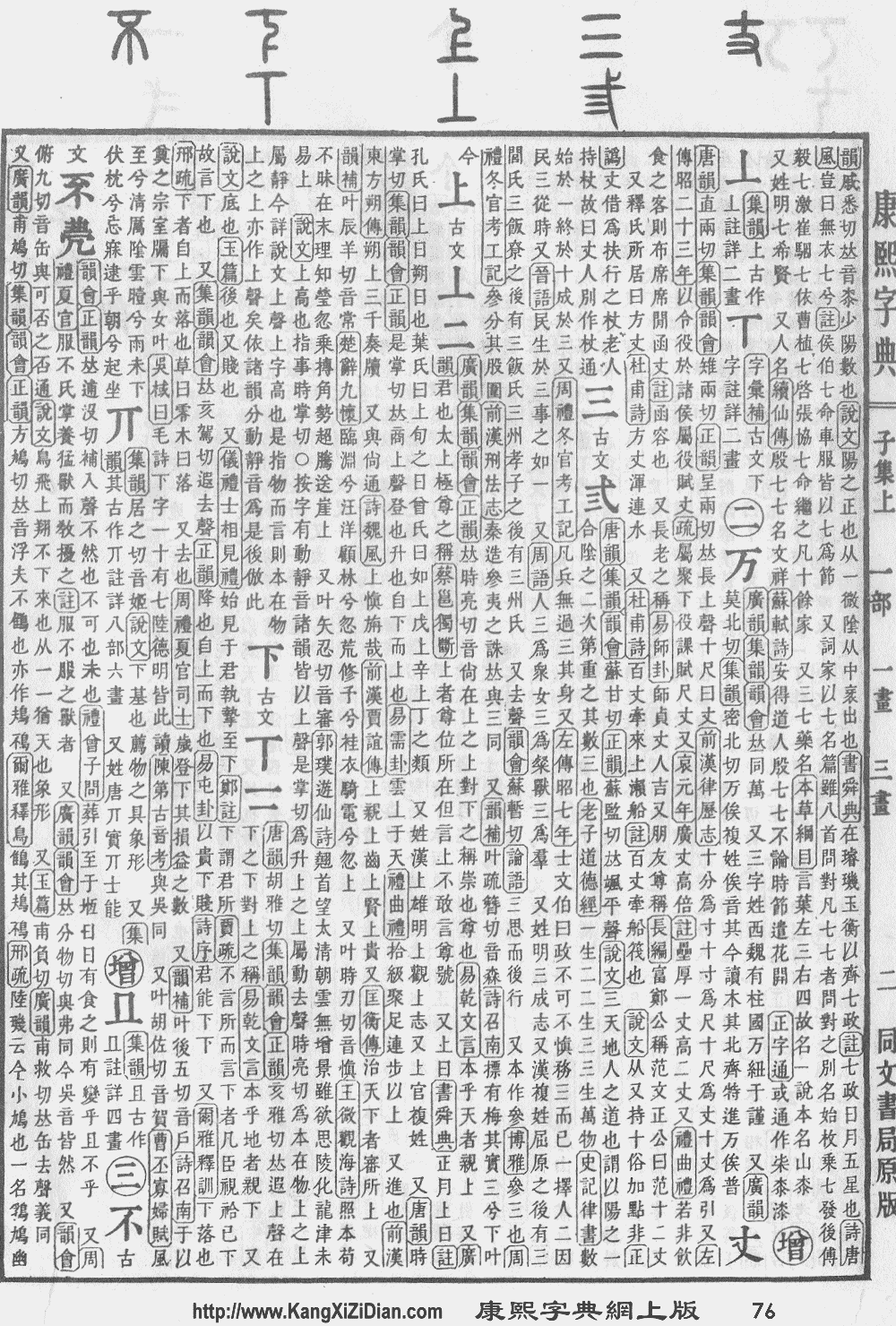
  • KangXi: page 76, character 4
  • Dai Kanwa Jiten: character 11
  • Dae Jaweon: page 137, character 8
  • Hanyu Da Zidian: volume 1, page 9, character 2
  • Unihan data for U+4E08

Chinese

simp. and trad.

Glyph origin

Historical forms of the character
Western Zhou Shuowen Jiezi (compiled in Han) Liushutong (compiled in Ming)
Bronze inscriptions Small seal script Transcribed ancient scripts


References:

Mostly from Richard Sears' Chinese Etymology site (authorisation),
which in turn draws data from various collections of ancient forms of Chinese characters, including:

  • Shuowen Jiezi (small seal),
  • Jinwen Bian (bronze inscriptions),
  • Liushutong (Liushutong characters) and
  • Yinxu Jiaguwen Bian (oracle bone script).
Characters in the same phonetic series () (Zhengzhang, 2003) 
Old Chinese
*daŋʔ
*daŋʔ
*daŋʔ, *daŋs

Ideogrammic compound (會意) :  (ten) +  (hand) – ten chi () is one zhang ().

Pronunciation


Note:
  • dâung - unit of measure;
  • diông/tiông - kinship term.
Note:
  • tiūⁿ/tiōⁿ/tiǔⁿ, tn̄g/tňg - vernacular;
  • tiōng/tiāng/tiǒng - literary.
    • (Teochew)
      • Peng'im: deng6 / ziang6 / diên6 / dion6
      • Pe̍h-ōe-jī-like: tṳ̆ng / tsiăng / tiĕⁿ / tiŏⁿ
      • IPA (key): /tɯŋ³⁵/, /t͡siaŋ³⁵/, /tĩẽ³⁵/, /tĩõ³⁵/
Note:
  • deng6 - unit of measurement;
  • ziang6 - “to measure”;
  • diên6/dion6 - “gentleman”.

Rime
Character
Reading # 1/1
Initial () (11)
Final () (105)
Tone (調) Rising (X)
Openness (開合) Open
Division () III
Fanqie
Reconstructions
Zhengzhang
Shangfang
/ɖɨɐŋX/
Pan
Wuyun
/ɖiɐŋX/
Shao
Rongfen
/ȡiɑŋX/
Edwin
Pulleyblank
/ɖɨaŋX/
Li
Rong
/ȡiaŋX/
Wang
Li
/ȡĭaŋX/
Bernard
Karlgren
/ȡʱi̯aŋX/
Expected
Mandarin
Reflex
zhàng
BaxterSagart system 1.1 (2014)
Character
Reading # 1/1
Modern
Beijing
(Pinyin)
zhàng
Middle
Chinese
‹ drjangX ›
Old
Chinese
/*[d]raŋʔ/
English ten feet

Notes for Old Chinese notations in the Baxter–Sagart system:

* Parentheses "()" indicate uncertain presence;
* Square brackets "[]" indicate uncertain identity, e.g. *[t] as coda may in fact be *-t or *-p;
* Angle brackets "<>" indicate infix;
* Hyphen "-" indicates morpheme boundary;

* Period "." indicates syllable boundary.
Zhengzhang system (2003)
Character
Reading # 1/1
No. 16836
Phonetic
component
Rime
group
Rime
subdivision
0
Corresponding
MC rime
Old
Chinese
/*daŋʔ/

Definitions

  1. A unit of measurement.
    1. The zhang, a traditional Chinese unit of length equal to 10 chi ()
    2. The mainland zhang, a unit of length standardized in 1984 as 3 1/3 meters.
    3. The Taiwanese zhang, a unit of length standardized as 3 1/33 meters, identical to the Japanese .
    4. The Hong Kong jeuhng, standardized as 3.71475 meters.
  2. to survey (land); to measure
  3. gentleman; man; husband
       zhàng   husband

Synonyms

  • (mainland zhang): 市丈 (shìzhàng)

See also

Compounds

  • 一丈青
  • 一落千丈 (yīluòqiānzhàng)
  • 一跳八丈
  • 丈丈
  • 丈二金剛丈二金刚
  • 丈人 (zhàngren)
  • 丈人峰
  • 丈人行
  • 丈八燈臺丈八灯台
  • 丈八蛇矛 (Zhàng bā shémáo)
  • 丈六金身
  • 丈夫 (zhàngfu)
  • 丈夫女
  • 丈夫子
  • 丈室
  • 丈母 (zhàngmǔ)
  • 丈母娘 (zhàngmuniáng)
  • 丈量 (zhàngliáng)
  • 不丈夫
  • 偉丈夫伟丈夫
  • 光焰萬丈光焰万丈
  • 光芒萬丈光芒万丈
  • 公丈
  • 函丈
  • 國丈国丈
  • 大丈夫 (dàzhàngfū)
  • 大八丈
  • 女丈夫
  • 女中丈夫
  • 妹丈 (mèizhàng)
  • 姊丈 (zǐzhàng)
  • 姑丈 (gūzhàng)
  • 姑丈人
  • 姨丈 (yízhàng)
  • 家丈人
  • 小丈夫
  • 尺水丈波
  • 岳丈 (yuèzhàng)
  • 師丈师丈
  • 席間函丈席间函丈
  • 方丈 (fāngzhàng)
  • 方丈之饌方丈之馔
  • 方丈盈前
  • 日高三丈
  • 清丈
  • 火冒三丈 (huǒmàosānzhàng)
  • 烈丈夫
  • 百丈 (bǎizhàng)
  • 百丈山
  • 百丈清規百丈清规
  • 百丈竿頭百丈竿头
  • 眇小丈夫
  • 紅塵萬丈红尘万丈
  • 老丈
  • 老丈人
  • 萬丈万丈 (wànzhàng)
  • 萬丈深淵万丈深渊
  • 萬丈竿頭万丈竿头
  • 蓑衣丈人
  • 豪情萬丈豪情万丈
  • 賤丈夫贱丈夫
  • 雄心萬丈雄心万丈
  • 食前方丈
  • 食味方丈
  • 黎丘丈人

Japanese

Kanji

(common “Jōyō” kanji)

Readings

Etymology 1

From Chinese (zhang)

Noun

(hiragana じょう, rōmaji , historical hiragana ぢやう)

  1. , a traditional Japanese unit of length based on 10 shaku, standardized as equal to 3 1/33 meters.

Etymology 2

/take2/: [takye] → [take]. Cognate with (taka, height), 高い (takai, high), and 長ける (takeru, to be high).

Alternative forms

Noun

(hiragana たけ, rōmaji take)

  1. height
    • 970-999, Utsubo Monogatari (Toshikage)
      [...] いひ教ふる事もなくておほしたつるに、年にもあはず、たかく心かしこし。

Particle

(hiragana だけ, rōmaji dake)

  1. only, limit
    ローマ ()だけ () (しょ)
    Rōmaji dake no jisho.
    A rōmaji-only dictionary.
     ()たいだけ ()ていい。
    Netai dake nete ii.
    You can sleep as much as you want.
Usage notes
  • The Kanji spelling is rarely used.

Proper noun

(hiragana じょう, rōmaji , historical hiragana ぢやう)

  1. A male given name
Compounds
  • はちじょう (hachijō)

References


Korean

Hanja

• (jang)

  • Eumhun:
    • Sound (hangeul): (revised: jang, McCuneReischauer: chang, Yale: cang)
    • Name (hangeul): 어른 (revised: eoleun, McCuneReischauer: ǒrǔn)
  1. This term needs a translation to English. Please help out and add a translation, then remove the text {{rfdef}}.

References


Vietnamese

Han character

(trượng)

  1. This term needs a translation to English. Please help out and add a translation, then remove the text {{rfdef}}.
This article is issued from Wiktionary. The text is licensed under Creative Commons - Attribution - Sharealike. Additional terms may apply for the media files.