fat
English
Pronunciation
- enPR: făt, IPA(key): /fæt/
Audio (US) (file) Audio (US) (file) - Rhymes: -æt
- Homophone: phat
Etymology 1
From Middle English fat, from Old English fǣtt (“fatted, fat”), from Proto-Germanic *faitidaz (“fatted”), originally the past participle of the verb *faitijaną (“to make fat”), from *faitaz (“fat”), from Proto-Indo-European *poid- (“to abound in water, milk, or fat”), from *poi- (“sap, juice”). Cognate with German feist (“fatted, plump, obese”). Related also to Saterland Frisian fat (“fat”), Dutch vet (“fat”), German fett (“fat, corpulent”), Swedish fet (“fat, oily, fatty”), Icelandic feitur (“fat”).
Adjective
fat (comparative fatter, superlative fattest)
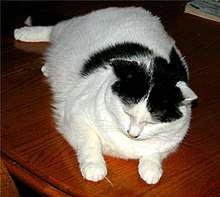
- Carrying more fat than usual on one's body; plump; not lean or thin.
- The fat man had trouble getting through the door.
- The fattest pig should yield the most meat.
- Thick.
- The fat wallets of the men from the city brought joy to the peddlers.
- 1908, W[illiam] B[lair] M[orton] Ferguson, Zollenstein, New York, N.Y.: D. Appleton & Company, OCLC 29686887 , chapter IV:
- So this was my future home, I thought! […] Backed by towering hills, the but faintly discernible purple line of the French boundary off to the southwest, a sky of palest Gobelin flecked with fat, fleecy little clouds, it in truth looked a dear little city; the city of one's dreams.
- Bountiful.
- Oily; greasy; unctuous; rich; said of food.
- (obsolete) Exhibiting the qualities of a fat animal; coarse; heavy; gross; dull; stupid.
- Ralph Waldo Emerson (1803-1882)
- making our western wits fat and mean
- Bible, Isaiah vi. 10
- Make the heart of this people fat.
- Ralph Waldo Emerson (1803-1882)
- Fertile; productive.
- a fat soil; a fat pasture
- Rich; producing a large income; desirable.
- a fat benefice; a fat office; a fat job
- Thomas Carlyle (1795-1881)
- now parson of Troston, a fat living in Suffolk
- Abounding in riches; affluent; fortunate.
- Jonathan Swift (1667–1745)
- persons grown fat and wealthy by long impostures
- Jonathan Swift (1667–1745)
- (dated, printing) Of a character which enables the compositor to make large wages; said of matter containing blank, cuts, or many leads, etc.
- a fat take; a fat page
- Alternative form of phat
Synonyms
Antonyms
Derived terms
Translations
|
|
|
- The translations below need to be checked and inserted above into the appropriate translation tables, removing any numbers. Numbers do not necessarily match those in definitions. See instructions at Wiktionary:Entry layout#Translations.
|
Noun
fat (usually uncountable, plural fats)
- (uncountable) A specialized animal tissue with a high oil content, used for long-term storage of energy.
- (countable) A refined substance chemically resembling the oils in animal fat.
- That part of an organization deemed wasteful.
- We need to trim the fat in this company
- (slang) An erection.
- I saw Daniel crack a fat.
- (golf) A poorly played shot where the ball is struck by the top part of the club head. (see also thin, shank, toe)
- The best or richest productions; the best part.
- to live on the fat of the land
- (dated, printing) Work containing much blank, or its equivalent, and therefore profitable to the compositor.
Synonyms
- (animal tissue): adipose tissue, lard (in animals; derogatory slang when used of human fat)
- (substance chemically resembling the oils in animal fat): grease, lard
Derived terms
Translations
|
|
|
|
- The translations below need to be checked and inserted above into the appropriate translation tables, removing any numbers. Numbers do not necessarily match those in definitions. See instructions at Wiktionary:Entry layout#Translations.
|
|
See also

Verb
fat (third-person singular simple present fats, present participle fatting, simple past and past participle fatted)
- (transitive, archaic) To make fat; to fatten.
- (intransitive, archaic) To become fat; to fatten.
Translations
Etymology 2
From Middle English, from Old English fæt (“vat, vessel, jar, cup, casket, division”), from Proto-Germanic *fatą (“vessel”), from Proto-Indo-European *pod- (“vessel”). Cognate with Dutch vat (“barrel, vessel”), German Fass (“barrel, drum”), Swedish fat (“barrel, dish, cask”). See vat.
Noun
fat (plural fats)
- (obsolete) A large tub or vessel for water, wine, or other liquids; a cistern.
- 1611, Bible (King James Version), Joel 2:24:
- And the floors shall be full of wheat, and the fats shall overflow with wine and oil.
- 1882, James Edwin Thorold Rogers, A History of Agriculture and Prices in England, volume 4, page 429:
- In 1431 New College purchases brewing vessels, under the names of a mash fat, for 6s. 10d., a wort fat for 2s., a 'Gilleding' tub for 2s. 6d., and two tunning barrels at 8d. each, a leaden boiler for 24s., another for 12s., and a great copper beer pot for 13s. 4d.
-
- (obsolete) A dry measure, generally equal to nine bushels.
Synonyms
Translations
Anagrams
Albanian
Etymology
Noun
fat m
Buli (Indonesia)
Etymology
From Proto-Halmahera-Cenderawasih *pat, from Proto-Eastern Malayo-Polynesian *pat, from Proto-Central-Eastern Malayo-Polynesian *əpat, from Proto-Malayo-Polynesian *əpat, from Proto-Austronesian *Səpat.
Numeral
fat
Catalan
Etymology
Noun
fat m (uncountable)
Chuukese
Adjective
fat
Dutch
Pronunciation
Audio (file)
Noun
fat (m)
- dandy, a man obsessed with his looks
French
Etymology
From Old Occitan fat, from Latin fatuus.
Pronunciation
- IPA(key): /fa/
Adjective
fat (feminine singular fate, masculine plural fats, feminine plural fates)
Further reading
- “fat” in le Trésor de la langue française informatisé (The Digitized Treasury of the French Language).
Anagrams
Friulian
Etymology 1
Verb
fat
- past participle of fâ
Adjective
fat
Etymology 2
Noun
fat m (plural fats)
Related terms
Icelandic
Etymology
From Old Norse fat, from Proto-Germanic *fatą, from Proto-Indo-European *pod-.
Pronunciation
- IPA(key): /faːt/
- Rhymes: -aːt
Noun
fat n (genitive singular fats, nominative plural föt)
Declension
Kowiai
Etymology
From Proto-Central-Eastern Malayo-Polynesian *əpat, from Proto-Malayo-Polynesian *əpat, from Proto-Austronesian *Səpat.
Numeral
fat
Ladin
Noun
fat m (plural fac)
Derived terms
Adjective
fat m (feminine singular fata, masculine plural fats, feminine plural fates)
Molise Croatian
Etymology
Pronunciation
- IPA(key): /fât/
Noun
fat m
Declension
| singular | plural | |
|---|---|---|
| nominative | fat | fata |
| genitive | fata | fati, fat |
| dative | fatu | fati, fatami |
| accusative | fat, fata | fata |
| locative | fatu | fata |
| instrumental | fatom, fatam | fati, fatami |
References
- Breu, W., Mader Skender, M. B. & Piccoli, G. 2013. Oral texts in Molise Slavic (Italy): Acquaviva Collecroce. In Adamou, E., Breu, W., Drettas, G. & Scholze, L. (eds.). 2013. EuroSlav2010: Elektronische Datenbank bedrohter slavischer Varietäten in nichtslavophonen Ländern Europas – Base de données électronique de variétés slaves menacées dans des pays européens non slavophones. Konstanz: Universität / Paris: Lacito (Internet Publication).
Norwegian Bokmål
Etymology
Noun
fat n (definite singular fatet, indefinite plural fat or fater, definite plural fata or fatene)
Derived terms
References
- “fat” in The Bokmål Dictionary.
Norwegian Nynorsk
Etymology
Pronunciation
- IPA(key): /fɑːt/
Noun
fat n (definite singular fatet, indefinite plural fat, definite plural fata)
Derived terms
References
- “fat” in The Nynorsk Dictionary.
Old Saxon
Etymology
From Proto-Germanic *fatą.
Noun
fat n
Declension
Swedish
Etymology
From Old Norse fat, from Proto-Germanic *fatą, from Proto-Indo-European *pod-.
Pronunciation
Audio (file)
Noun
fat n
- saucer; a small dish
- plate (serving dish)
- barrel (oil or wine), cask, keg (beer)
- barrel; a unit of volume. Usually referring to the oil barrel of 158.9873 liters
Declension
| Declension of fat | ||||
|---|---|---|---|---|
| Singular | Plural | |||
| Indefinite | Definite | Indefinite | Definite | |
| Nominative | fat | fatet | fat | faten |
| Genitive | fats | fatets | fats | fatens |
Derived terms
- (saucer): tefat
- (serving dish): serveringsfat, kakfat
- (barrel; container): fatöl
Idioms
- ha någons huvud på ett fat ― have someone's head on a platter
- det ligger någon i fatet ― it's in someone's plate(about something that is, or is by others perceived as, an obstacle (physical or mental) to someone)
Tboli
Etymology
From Proto-Philippine *əpat, from Proto-Malayo-Polynesian *əpat, from Proto-Austronesian *Səpat.
Numeral
fat
Volapük
Etymology
Pronunciation
- IPA(key): /fat/
Noun
fat (plural fats)
Declension
Derived terms
Yamdena
Alternative forms
Etymology
From Proto-Central-Eastern Malayo-Polynesian *əpat, from Proto-Malayo-Polynesian *əpat, from Proto-Austronesian *Səpat.
Numeral
fat