bus
English
Etymology
Shortening of omnibus, from Latin omnibus (“for all, for everybody”); dative plural of omnis (“all”). The electrical sense is derived from figurative application of the automotive sense.
Pronunciation
Noun
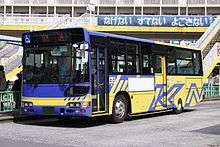
- (automotive) A motor vehicle for transporting large numbers of people along roads.
- An electrical conductor or interface serving as a common connection for two or more circuits or components.
- (medical industry, slang) An ambulance.
Synonyms
Hyponyms
Derived terms
Descendants
Translations
|
|
Verb
bus (third-person singular simple present busses or buses, present participle bussing or busing, simple past and past participle bussed or bused)
- (transitive, automotive, transport) To transport via a motor bus.
- (transitive, automotive, transport, chiefly US) To transport students to school, often to a more distant school for the purposes of achieving racial integration.
- 2008, Ashley R. Holm, Racial Differences in Student Engagement and Attainment: A Study of Topeka High School, 1939--1984, ProQuest →ISBN, page 23
- ...to strike down Detroit's federal court order to bus students across school district lines for the purpose of desegregation and therefore nullify many busing programs throughout the country.
- 2008, Ashley R. Holm, Racial Differences in Student Engagement and Attainment: A Study of Topeka High School, 1939--1984, ProQuest →ISBN, page 23
- (intransitive, automotive, transport) To travel by bus.
- (transitive, US, food service) To clear meal remains from.
- He bussed tables as the restaurant emptied out.
- (intransitive, US, food service) To work at clearing the remains of meals from tables or counters; to work as a busboy.
- He’s been bussing for minimum wage.
Usage notes
The Canadian Oxford Dictionary only presents the spellings buses, busing, and bused, implying that these are the predominant forms in Canada.
Derived terms
- (clear meal remains): busboy
Translations
Anagrams
Afrikaans
Noun
bus (plural busse, diminutive bussie)
- (automotive) bus
Catalan
Etymology 1
Cognate to Spanish buso (“underwater snail”) and Portuguese búzio (“underwater snail”), from Latin būcina (“horn”).
Noun
bus m, f (plural bussos)
Etymology 2
Probably from Old Norse buza (“big wide ship”).
Noun
bus m (plural bussos)
- (archaic) A large sailing ship used in the 12th and 13th centuries, broad of beam and with two or three masts.
Etymology 3
Probably from Persian بوس (bus, “kiss”).
Noun
bus m (plural busos)
- (archaic) flattery
Usage notes
Only found in the phrase fer lo bus (“to kiss up”).
Etymology 4
Reduction of autobús
Noun
bus m (plural busos)
- bus (vehicle)
Etymology 5
Noun
bus m (plural busos)
- bus (electrical connector)
Czech
Noun
bus m
- bus (motor vehicle for transporting large numbers of people along roads)
Synonyms
Danish
Etymology
Shortening of omnibus, from French omnibus, from Latin omnibus (“for all”), dative plural of omnis (“all”).
Pronunciation
- IPA(key): /bus/, [b̥us]
Noun
bus c (singular definite bussen, plural indefinite busser)
Inflection
Dutch
Pronunciation
- Rhymes: -ʏs
- IPA(key): /bʏs/
audio (file)
Etymology 1
Shortening of omnibus, from Latin omnibus (“for everything/all”); dative plural of omnis (“all”).
Noun
bus m (plural bussen, diminutive busje n)
- (transport) bus, omnibus (vehicle)
- (transport, in diminutive) minibus, minivan
- bus (electrical conductor)
Derived terms
Etymology 2
From Old Dutch *bussa, from Proto-Germanic *buhsijōn, *buhsuz. Compare German Büchse.
Noun
bus f (plural bussen, diminutive busje n)
Derived terms
- brievenbus
- busmeester
- drinkbus
- schoolbus
Etymology 3
See etymology on the main entry. Related to etymology 2.
Verb
bus
French
Etymology 1
Pronunciation
Noun
bus m, f (plural bus)
Synonyms
Etymology 2
Inflected forms.
Pronunciation
Verb
bus
Verb
bus m pl
- masculine plural of the past participle of boire
Further reading
- “bus” in le Trésor de la langue française informatisé (The Digitized Treasury of the French Language).
Irish
Etymology
Pronunciation
- IPA(key): [bˠʊsˠ]
Noun
bus m (genitive singular bus, nominative plural busanna)
Declension
Fourth declension
|
Bare forms
|
Forms with the definite article
|
Derived terms
|
|
Mutation
| Irish mutation | ||
|---|---|---|
| Radical | Lenition | Eclipsis |
| bus | bhus | mbus |
| Note: Some of these forms may be hypothetical. Not every possible mutated form of every word actually occurs. | ||
Further reading
- "bus" in Foclóir Gaeilge-Béarla, An Gúm, 1977, by Niall Ó Dónaill.
- “bus” in New English-Irish Dictionary by Foras na Gaeilge.
- Entries containing “bus” in English-Irish Dictionary, An Gúm, 1959, by Tomás de Bhaldraithe.
Lithuanian
Pronunciation
- IPA(key): [bʊs]
Verb
bùs
- third-person singular future tense of būti.
- third-person plural future tense of būti.
- third-person singular future tense of busti.
- third-person plural future tense of busti.
Lombard
Pronunciation
- IPA(key): /byːs/
Noun
bus m
Middle Irish
Etymology
From Proto-Celtic *bussus, from Proto-Indo-European *bʰew- (“to swell, bulge”).
Noun
bus (gender unknown)
- (rare, poetic) lip
References
- “4 bus” in Dictionary of the Irish Language, Royal Irish Academy, 1913–76.
- Matasović, Ranko (2009), “*bussu-”, in Etymological Dictionary of Proto-Celtic (Leiden Indo-European Etymological Dictionary Series; 9), Leiden: Brill, →ISBN, page 84
Norman
Verb
bus
- first-person singular preterite of baithe
Polish
Etymology
Pronunciation
- IPA(key): /bus/
Audio (file)
Noun
bus m anim (diminutive busik)
- (colloquial) bus
Declension
Romagnol
Pronunciation
- IPA(key): /bus/
Noun
bus m
- hole
- September 2012, Daniela Cortesi, Bônanòta in la Ludla, il Papiro, page 15:
- un sorg e’ cor in priscia int e’ su bus.
- a mouse runs hastily towards its hole.
- September 2012, Daniela Cortesi, Bônanòta in la Ludla, il Papiro, page 15:
Scottish Gaelic
Etymology 1
Noun
bus m (genitive singular bus, plural busaichean)
Etymology 2
Noun
bus m (genitive singular buis, plural buis or busan)
- pout (facial expression)
Spanish
Etymology
Pronunciation
- IPA(key): /bus/
Noun
bus m (plural buses)
Related terms
Swedish
Etymology
From the verb busa (“to do mischief”).
Pronunciation
- IPA(key): [bʉ͍ːs]
- Rhymes: -ʉːs
Noun
bus n (uncountable)
- very innocent mischief, prank
- Trick or Treat is often translated with Bus eller godis
- general noise or trouble made by gangs of youths
Declension
| Declension of bus | ||||
|---|---|---|---|---|
| Uncountable | ||||
| Indefinite | Definite | |||
| Nominative | bus | buset | — | — |
| Genitive | bus | busets | — | — |
Derived terms
Tagalog
Etymology
Pronunciation
- IPA(key): /bus/
Noun
bus
- bus (vehicle)
Related terms
Tok Pisin
Etymology
Noun
bus
- bush (remote rural areas)
- 1989, Buk Baibel long Tok Pisin, Bible Society of Papua New Guinea, Genesis 1:25 (translation here):
- God i kamapim ol kain kain animal bilong ples na ol bikpela na liklik animal bilong bus. God i lukim olgeta dispela samting i gutpela, na em i amamas.
- 1989, Buk Baibel long Tok Pisin, Bible Society of Papua New Guinea, Genesis 1:25 (translation here):
Derived terms
West Flemish
Etymology 1
From Middle Dutch busch, variant of bosch, from Old Dutch *busk, from Proto-Germanic *buskaz.
Noun
bus n
Etymology 2
Noun
bus m