van
English
Pronunciation
- enPR: văn, IPA(key): /væn/
Audio (US) (file) - Rhymes: -æn
Etymology 1
Short for caravan.
Noun
van (plural vans)
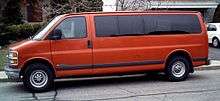
- A (covered) vehicle used for carrying goods or people, usually roughly cuboid in shape, longer and higher than a car but smaller than a truck (USA) / lorry (English).
- The van sped down the road.
- (Britain) An enclosed railway vehicle for transport of goods.
- (Britain, dated) A light wagon, either covered or open, used by tradesmen and others for the transportation of goods.
- Shortened form of caravan. (Can we add an example for this sense?)
Derived terms
Translations
|
|
|
- The translations below need to be checked and inserted above into the appropriate translation tables, removing any numbers. Numbers do not necessarily match those in definitions. See instructions at Wiktionary:Entry layout#Translations.
|
Verb
van (third-person singular simple present vans, present participle vanning, simple past and past participle vanned)
- (transitive) To transport in a van or similar vehicle (especially of horses).
- 1966, United States Congress, Senate, Committee on Commerce, (Please provide the book title or journal name):
- I have to have a license to own them, a license to train them, my jockey has to have a license to ride them, the van company must have a license to van them, and the black shoe man must have a license to shoe them.
- 1999, Bonnie Bryant, Changing Leads, page 53:
- [They] had their own horses, but they hadn't bothered to van them over to Pine Hollow for this outing.
-
- to be arrested by law enforcement (not necessarily in a van, derived from the slang "party van")
- 2011 The hackers hacked: main Anonymous IRC servers invaded
- One Anon explained the reason for this, saying: "As for the domains, they were transferred to Ryan after some of us got vanned so he can keep the network up. What he did certainly wasn't the plan." (Getting "vanned" refers to getting picked up by the police.)
- 2012 FBI names, arrests Anon who infiltrated its secret conference call
- He later told CW that he had been "v&" or "vanned" by the police, and he expressed surprise that the police showed him detailed transcripts of his conversations.
- 2013 Redditor Confesses to Murder with Meme, Gets Doxed by Other Redditors, Deletes His Account and Disappears
- But not before someone supposedly forwarded all the information onto the FBI. In a last-ditch effort to avoid getting "vanned," Naratto tried to put the memie back in the bottle
- 2015 3-year-old credited with hacking CIA director’s AOL account gives bizarre, possibly final interview
- The hacker says he thinks he is about to be v&, or “vanned,” meaning being raided by law enforcement, sometime soon.
- 2016 Teen Allegedly Behind CIA, FBI Breaches: 'They're Trying to Ruin My Life.'
- On Wednesday night, Motherboard spoke to the teenager accused of being Cracka. "I got fucking v&," he told Motherboard, using "v&," the slang for "vanned," or getting arrested. (At this point, the arrest had not been made public.)
- 2017 Dark Ops: An Anonymous Story page 8
- Commander X: Yep, so now you all know how I got vanned. And you just met the snitch who did it to me.
- 2011 The hackers hacked: main Anonymous IRC servers invaded
Synonym
See also
Etymology 2
Truncation of vanguard
Noun
van (plural vans)
- Shortened form of vanguard.
- 1667, John Milton, Paradise Lost, book 5, lines 588–590:
- Ten thousand thousand Ensignes high advanc'd, / Standards, and Gonfalons twixt Van and Reare / Streame in the Aire, and for distinction serve
- 1698, Ned Ward, The London Spy:
- Then a bumper to the Queen led the van of our good wishes, another to the Church Established, a third was left to the whim of the toaster […]
- 1749, Henry Fielding, The History of Tom Jones, a Foundling, London: A[ndrew] Millar, OCLC 928184292:
- As for the guides, they were debarred from the pleasure of discourse, the one being placed in the van, and the other obliged to bring up the rear.
- 1898, Winston Churchill, chapter 5, in The Celebrity:
- We expressed our readiness, and in ten minutes were in the station wagon, rolling rapidly down the long drive, for it was then after nine. We passed on the way the van of the guests from Asquith.
- 1965, Chakravarthi V. Narasimhan, “Virāṭa Parva”, in The Mahābhārata, book 4, 33, page 84:
- Bhīṣma then outlined the following strategy: “… Let Karṇa, clad in armour, stand in the van. And I shall command the entire army in the rear.”
-
Etymology 3
Noun
van (plural vans)
Verb
van (third-person singular simple present vans, present participle vanning, simple past and past participle vanned)
- (mining) To wash or cleanse, as a small portion of ore, on a shovel.
- (Can we find and add a quotation of Raymond to this entry?)
Etymology 4
Latin vannus (“a van, or fan for winnowing grain”): compare French van and English fan, winnow.
Noun
van (plural vans)
- A fan or other contrivance, such as a sieve, for winnowing grain.
- A wing with which the air is beaten.
- 1671, John Milton, “Book the Fourth”, in Paradise Regain’d. A Poem. In IV Books. To which is Added, Samson Agonistes, London: Printed by J. M[acock] for John Starkey […], OCLC 228732398, lines 578–580, pages 108–109:
- So Satan fell; and ſtrait a fiery Globe / Of Angels on full ſail of wing flew nigh, / Who on their plumy Vans receiv'd him ſoft […]
- 1717, John Dryden, Ovid's Metamorphoses, book XII:
- He wheeled in air, and stretched his vans in vain; / His vans no longer could his flight sustain.
- 1930, T.S. Eliot, Ash Wednesday:
- Because these wings are no longer wings to fly / But merely vans to beat the air […]
-
Anagrams
Afrikaans
Etymology
Pronunciation
- IPA(key): /fan/
Preposition
van
Particle
van
- (used with a following definite article) some of (the)
- Van die wêreld se beste wyne kom van hierdie streek af.
- Some of the world’s best wines are from this region.
- Ons het met van die belangrikste politieke leiers gespreek.
- We have spoken to some of the most important political leaders.
- Van die wêreld se beste wyne kom van hierdie streek af.
Catalan
Pronunciation
Verb
van
- third-person plural present indicative form of anar
Danish
Etymology 1
From Old Norse vanr (pl vanir (“one of two groups of gods in Norse mythology”)).
Pronunciation
- IPA(key): /vaːn/, [væːˀn]
Noun
van c (singular definite vanen, plural indefinite vaner)
- one of the Vanir
Inflection
Etymology 2
Pronunciation
- IPA(key): /vaːn/, [væːn]
Noun
van c (singular definite vanen, plural indefinite vaner)
Inflection
Etymology 3
From Old Norse vanr (“wont, accustomed”).
Pronunciation
- IPA(key): /van/, [van]
Adverb
van
- (dated) pleje van – nurse, take care of
Usage notes
Dutch
Etymology
From Middle Dutch van, from Old Dutch fan (“from”), from Proto-Germanic *fanē, from Proto-Indo-European *pone, *pana (“from”), from Proto-Indo-European *apo-, *pā- (“off, of”). Cognate with Old Saxon fana, fan (“from”), Old Frisian fan, fon (“from”), Old High German fona, fon (“from”).
Pronunciation
- Rhymes: -ɑn
- IPA(key): /vɑn/
- (Northern) [fɑn]
- (Suriname) [fan]
Audio (NL) (file)
Preposition
van
- of (possession, property)
- de hoed van het meisje
- the hat of the girl
- het gewicht van een olifant
- the weight of an elephant
- of (general association)
- Zij was van adel.
- She was of noble stock.
- een stad van één miljoen inwoners
- a city of one million inhabitants
- Hij is een man van eer.
- He's a man of honour.
- Dat is hier niet van toepassing.
- That's not applicable here.
- de trein van tien uur
- the train of ten o'clock
- by, of (creator)
- een schilderij van Rubens
- a painting by Rubens
- een plaat van de Beatles
- a record of the Beatles
- from (origin)
- Hij komt van Griekenland.
- He's from Greece.
- from (starting point of a movement or change)
- Hij ging van deur tot deur.
- He went from door to door.
- van vader op zoon.
- from father to son.
- from (starting point in time)
- van toen af aan.
- from then onwards
- van 's avonds laat tot 's morgens vroeg
- from late at night till the early morning
- van dag tot dag
- from day to day
- from, off (removal of something from off something else)
- het vlees van de beenderen snijden.
- to cut the meat from the bones
- of, out of, from, with (cause)
- sidderen van angst
- to tremble with fear
- tranen van geluk
- tears of joy
- of, out of, with (material or resource)
- Deze tafel is gemaakt van hout.
- This table is made (out) of wood.
- Van dit geld kan ik een basgitaar kopen.
- With this money I'm able to buy a bass.
- of, out of, among (out of a larger whole; partitive)
- de jongste van zijn dochters
- the youngest of his daughters
- Van alle mensen ben ik de mooiste.
- Out of all people I am the most beautiful.
- Drink niet te veel van dat bier, het is erg sterk.
- Don't drink too much of that beer, it is very strong.
- from, was, formerly (indicating a change in price)
- van 5 €, voor 3 €
- was €5, now €3
Inflection
Derived terms
Adverb
van
- of, from
- Ik neem er tien van. — I’ll take ten of them.
- from
- Ik vertrek van daar. — I’ll start from there.
- by, from
- Ik word er gek van. — It drives me crazy.
- Men wordt daar sloom van. — It turns one numb.
- of, about
- Wat zegt u daar van? — What do you say about that?
- Ik weet daar niks van. — I don’t know anything about that.
Derived terms
See also
French
Etymology
Pronunciation
- IPA(key): /vɑ̃/
Noun
van m (plural vans)
- a winnowing basket
Further reading
- “van” in le Trésor de la langue française informatisé (The Digitized Treasury of the French Language).
Galician
Etymology
From a variant of Old Portuguese vão, from Latin vānus (“empty”)
Adjective
van m (feminine singular va, masculine plural vans, feminine plural vas)
Noun
van m (plural vans)
Verb
van
- third-person plural present indicative of ir
Gallo
Noun
van m (plural vans)
Haitian Creole
Etymology
Noun
van
Hungarian
Etymology
From Old Hungarian vagyon. See Hungarian volt.
- Forms beginning with v- are from Proto-Finno-Ugric *wole- (“to be”). Cognate with Mansi о̄луӈкве (о̄luŋkwe, о̄li, о̄l-), Finnish olla and Estonian olema. Compare inflected forms such as volt, volna, való and Old Hungarian vola or vala. The root in present tense (vagy-) is result of palatization: /vɒl/ > /vɒʎ/ > /vɒj/ > /vɒɟ/.
- Forms beginning with l- are from Proto-Finno-Ugric *le- (“to become”). Cognate with Finnish lienee (potential of olla), Karelian lienöy (potential of olla), Northern Sami leat.
Pronunciation
- IPA(key): [ˈvɒn]
Audio (file)
Verb
van
- be, exist
- have; someone -nak/-nek has something -ja/-je
- Péternek van egy kutyája.
- Peter has a dog.
- there is
- Van itt valaki?
- Is there anybody here?
- to be (auxiliary verb indicating a type of passive voice along with the adverbial participle form of the main verb)
- A probléma még nincs megoldva.
- The question isn't yet solved.
- 1846, Arany János, Toldi,, canto 6, stanza 13:
- "Szakmány módra van rám mérve minden óra: / Jöttem kegyelmedhez búcsuvevő szóra."
- "Every hour is measured as though by contract. / I come to bid you now farewell."
Usage notes
- Omission of van and vannak:
- When using with an adjective (qualification) or when using with a noun (either with the definite or the indefinite article), the forms van and vannak are not used (their place is left empty).
- Béla okos. - Béla is clever.
- Béla a király. - Béla is the king.
- Béla egy ember. - Béla is a human.
- It still appears if van/vannak is the focus of the sentence. This happens when the sentence means that the property described by the adjective (e.g. strength) reaches or exceeds some specified level and this is emphasized by the speaker. In this case, the adjective is preceded by a word like olyan (such), annyira (that much), elég (enough).
- Béla van annyira erős, hogy felemelje a szekrényt. - Béla is strong enough to lift the cupboard.
- The forms other than van and vannak are always used.
- Béla okos volt. - Béla was clever.
- Okos vagyok. - I am clever.
- Otherwise, all forms are used:
- With adverbs and adverbial participles (suffixed -va/-ve)
- Hogy van? - How is he? (also 'How are you?', formal singular)
- El van törve. - It is broken.
- Using in the "exists" or "there is" sense (and so with have, which is expressed by there is in Hungarian)
- Van egy ház a hegyen. - There is a house on the mountain.
- Van egy kutyám. - I have a dog.
- With adverbs and adverbial participles (suffixed -va/-ve)
- When using with an adjective (qualification) or when using with a noun (either with the definite or the indefinite article), the forms van and vannak are not used (their place is left empty).
Conjugation
| Infinitive | lenni | |||||||
|---|---|---|---|---|---|---|---|---|
| Past participle | volt | |||||||
| Present participle | levő or lévő | |||||||
| Future participle | leendő | |||||||
| Adverbial participle | lévén | |||||||
| Potential | lehet | |||||||
| 1st person sg | 2nd person sg informal | 3rd person sg, 2nd person sg formal |
1st person pl | 2nd person pl informal | 3rd person pl, 2nd person pl formal | |||
| Indicative Mood | Present | Indefinite | vagyok | vagy | van | vagyunk | vagytok | vannak |
| Definite | intransitive verb, definite forms are not used | |||||||
| Past | Indefinite | voltam | voltál | volt | voltunk | voltatok | voltak | |
| Definite | - | |||||||
| Future | Indefinite | leszek | leszel | lesz | leszünk | lesztek | lesznek | |
| Definite | - | |||||||
| Conditional Mood | Present | Indefinite | lennék or volnék |
lennél or volnál |
lenne or volna |
lennénk or volnánk |
lennétek or volnátok |
lennének or volnának |
| Definite | - | |||||||
| Past | Indefinite | lettem volna | lettél volna | lett volna | lettünk volna | lettetek volna | lettek volna | |
| Definite | - | |||||||
| Subjunctive Mood | Present | Indefinite | legyek | légy or legyél |
legyen | legyünk | legyetek | legyenek |
| Definite | - | |||||||
| Conjugated Infinitive | lennem | lenned | lennie | lennünk | lennetek | lenniük | ||
Synonyms
- (exist): létezik
Antonyms
Derived terms
(With verbal prefixes):
(Expressions):
- a falnak is füle van
- az éremnek két oldala van
- hogy van?
- minden rosszban van valami jó
- tele van a hócipője
- tisztában van
- van benne valami
Interlingua
Adjective
van (comparative plus van, superlative le plus van)
Manx
Etymology
Noun
van f (genitive singular van, plural vannyn)
- van (vehicle)
Synonyms
Middle Dutch
Etymology
From Old Dutch fan, from Proto-Germanic *fanē.
Preposition
van
Descendants
Further reading
- “van”, in Vroegmiddelnederlands Woordenboek, 2000
- “van (I)”, in Middelnederlandsch Woordenboek, 1929
Portuguese
Noun
van f (plural vans)
- van (a covered vehicle used for carrying goods)
Synonyms
Romanian
Etymology
Pronunciation
- IPA(key): /van/
Adjective
van m, n (feminine singular vană, masculine plural vani, feminine and neuter plural vane)
Declension
Derived terms
- în van
Related terms
See also
Serbo-Croatian
Etymology 1
From Proto-Slavic *vъnъ
Pronunciation
- IPA(key): /ʋân/
Conjunction
vȁn (Cyrillic spelling ва̏н)
Etymology 2
From Proto-Slavic *vъnъ
Pronunciation
- IPA(key): /ʋân/
Preposition
vȁn (Cyrillic spelling ва̏н) (+ genitive case)
- in front of, before
- van kuće ― outside, outdoors
- out of
- van zemlje ― abroad
Etymology 3
From Proto-Slavic *vъnъ
Pronunciation
- IPA(key): /ʋâːn/
- Rhymes: -âːn
Adverb
vȃn (Cyrillic spelling ва̑н)
Spanish
Etymology
From Latin vadunt, third-person plural present indicative of vadō (“I go”).
Pronunciation
- IPA(key): /ban/, [bãn]
Verb
van
Noun
van m (plural vanes)
- van (vehicle)
Swedish
Etymology
From Old Norse vanr, from Proto-Germanic *wanaz, from Proto-Indo-European *wāno-.
Pronunciation
audio (file)
Adjective
van (comparative vanare, superlative vanast)
- accustomed to; used to, have the habit to
- Han är van vid att stiga upp klockan sju varje morgon.
- “He is used to getting up at seven every morning.”
- Han är van vid att stiga upp klockan sju varje morgon.
- experienced, adept
- Hon är en van bilförare.
- “She is an experienced driver.”
- Hon är en van bilförare.
Antonyms
Derived terms
- med van hand
Related terms
Vietnamese
Pronunciation
- (Hà Nội) IPA(key): [vaːn˧˧]
- (Huế) IPA(key): [vaːŋ˧˧]
- (Hồ Chí Minh City) IPA(key): [vʲaːŋ˧˧]
Etymology 1
Verb
van (呅, 𠹚, 𠺺)
- to beg
Derived terms
|
|
|
Etymology 2
Noun
van
Etymology 3
Noun
van