wagon
English
.jpg)
Alternative forms
- waggon (UK; dated)
Etymology
Borrowed from Dutch wagen, from Middle Dutch wagen, from Old Dutch *wagan, from Proto-Germanic *wagnaz (“wagon”), from Proto-Indo-European *woǵʰnos (“wagon, primitive carriage”), from *weǵʰ- (“to transport”). Cognate with Saterland Frisian Woain (“wagon”), West Frisian wein (“wagon”), German Wagen (“vehicle; wagon”), Danish vogn (“wagon”), Swedish vagn (“wagon”). Doublet of wain (inherited from Old English wæġn) and related also to way, weigh.
Pronunciation
- (UK) IPA(key): /wæɡ.ən/
-
Audio (US) (file) - Rhymes: -æɡən
Noun
wagon (plural wagons)
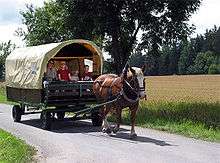
- A four-wheeled cart for hauling loads.
- A freight car on a railway.
- A child's riding toy, four-wheeled and pulled or steered by a long handle in the front.
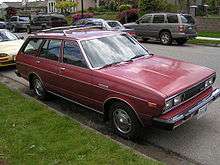
- (US, Australia, slang) A station wagon (or SUV).
- (slang) A paddy wagon.
- A truck, or lorry.
- (Ireland, slang, dated, derogatory) A derogatory term for a woman; bitch; slapper; cow.
- 1974, in Threshold, Issues 25–27, Lyric Players Theatre, page 96:
- “I’m not like that; I know what you mean but I’m not like that. When you said a field I nearly laughed because I was in a field last week with Ursula Brogan behind the football pitch. We followed Cissy Caffery there and two boys from the secondary. She’s a wagon. She did it with them one after the other, and we watched.”
- 1990, Roddy Doyle, The Snapper, Penguin Group (1992), →ISBN:
- pages 30–31: —Don’t know. ——She hates us. It’s prob’ly cos Daddy called her a wagon at tha’ meetin’. ¶ Sharon laughed. She got out of bed. ¶ —He didn’t really call Miss O’Keefe a wagon, she told Tracy. —He was only messin’ with yeh.
- 1998, Neville Thompson, Two Birds/One Stoned, Poolbeg:
- page 8: “Well fuck yeh, yeh stuck-up little wagon.”
- 1974, in Threshold, Issues 25–27, Lyric Players Theatre, page 96:
Derived terms
Descendants
Translations
|
|
|
Verb
wagon (third-person singular simple present wagons, present participle wagoning, simple past and past participle wagoned)
- (transitive) To transport by means of a wagon.
- (intransitive) To travel in a wagon.
See also

-

Anagrams
Dutch
Etymology
From English waggon, from Dutch wagen. The pronunciation was likely influenced by French wagon, which was also borrowed from English.
Pronunciation
- IPA(key): /ʋaˈɣɔn/
-
Audio (file)
Noun
wagon m (plural wagons, diminutive wagonnetje n)
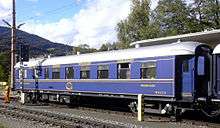
- car (a railway carriage, a nonpowered unit in a railroad train)
French
Etymology
Pronunciation
- (Belgium) IPA(key): /wa.ɡɔ̃/
- (France, Switzerland) IPA(key): /va.ɡɔ̃/
-
wagon (file)
Noun
wagon m (plural wagons)
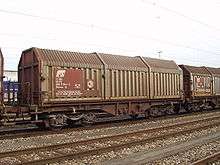
- a railway carriage (note that the word voiture is preferred for passenger transport)
Further reading
- “wagon” in le Trésor de la langue française informatisé (The Digitized Treasury of the French Language).
Japanese
Romanization
wagon
Old Saxon
Alternative forms
- wogon
- -wagian, found in witharwagian (to flow back).
Etymology
From Proto-Germanic *wagōną.
Verb
wagōn
- to sway
Polish
Pronunciation
- IPA(key): /ˈva.ɡɔn/
-
Audio (file)
Noun
wagon m inan