樂
| ||||||||
| ||||||||
| ||||||||
| ||||||||
Translingual
| Traditional | 樂 |
|---|---|
| Shinjitai | 楽 |
| Simplified | 乐 |
Han character
樂 (radical 75, 木+11, 15 strokes, cangjie input 女戈木 (VID), four-corner 22904, composition ⿱⿲幺白幺木)
References
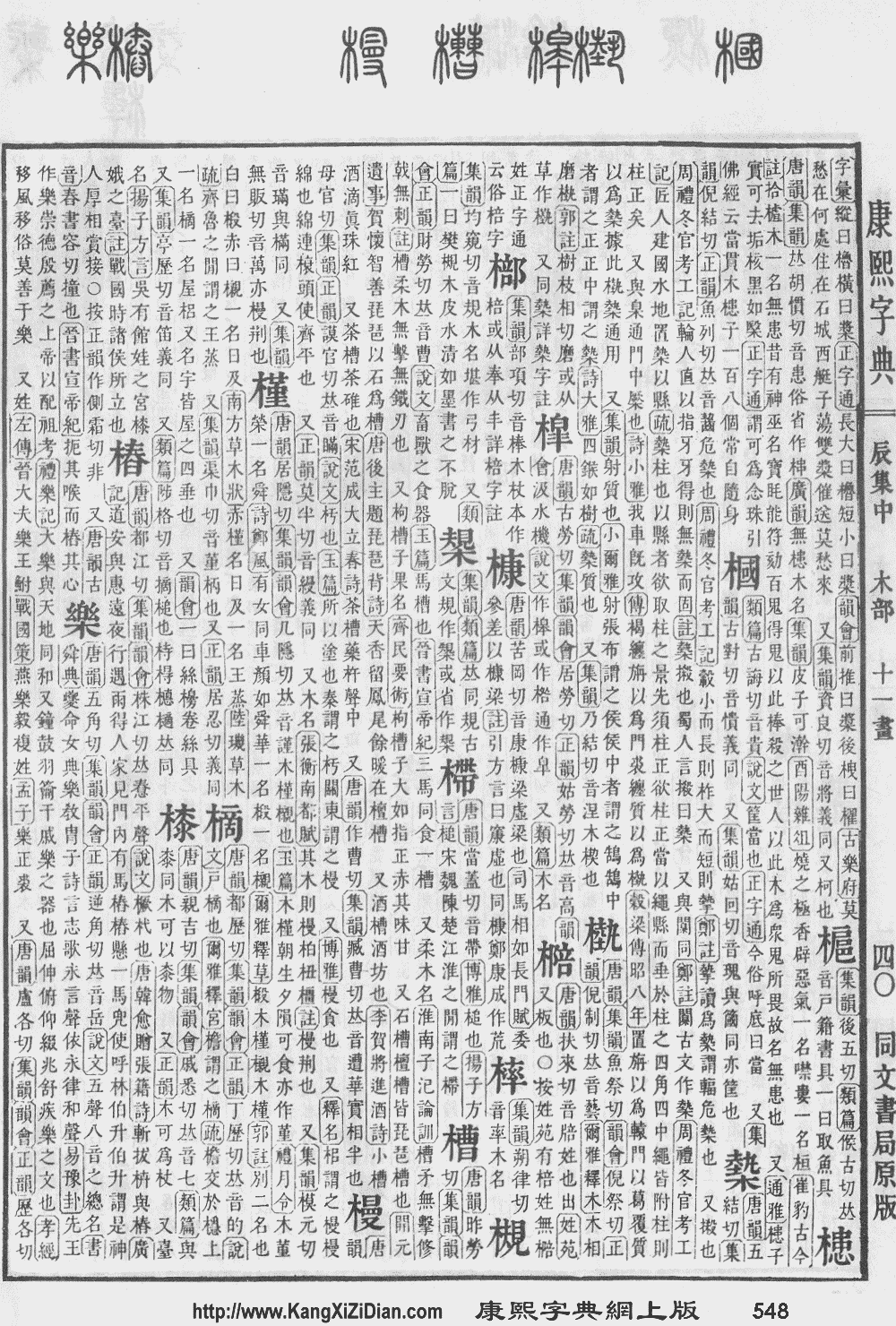
- KangXi: page 548, character 20
- Dai Kanwa Jiten: character 15399
- Dae Jaweon: page 936, character 6
- Hanyu Da Zidian: volume 2, page 1280, character 16
- Unihan data for U+6A02
- Commons: category:樂
Chinese
| trad. | 樂 | |
|---|---|---|
| simp. | 乐 | |
| alt. forms | 楽 | |
Glyph origin
| Historical forms of the character 樂 | |||
|---|---|---|---|
| Shang | Western Zhou | Shuowen Jiezi (compiled in Han) | Liushutong (compiled in Ming) |
| Oracle bone script | Bronze inscriptions | Small seal script | Transcribed ancient scripts |
 |
 |
 |
 |
| Characters in the same phonetic series (樂) (Zhengzhang, 2003) | |
|---|---|
| Old Chinese | |
| 樂 | *ŋraːwɢs, *raːwɢ, *ŋraːwɢ |
| 轢 | *raːd, *raːwɢ, *reːwɢ |
| 濼 | *pqʰlaːwɢ, *raːwɢ, *reːwɢ, *pqʰloːwɢ, *roːwɢ, *roːwɢ |
| 躒 | *raːwɢ, *reːwɢ |
| 擽 | *rawɢ, *reːwɢ |
| 爍 | *qʰljawɢ |
| 鑠 | *qʰljawɢ |
| 藥 | *lawɢ |
| 櫟 | *lawɢ, *reːwɢ |
| 纅 | *lawɢ |
| 礫 | *reːwɢ |
| 瓅 | *reːwɢ |
| 皪 | *reːwɢ |
| 觻 | *reːwɢ, *roːwɢ |
| 嚛 | *qʰloːwɢ, *qʰloːwɢ |
Ideogrammic compound (會意) : 糸 (“string”) + 木 (“wood”) – strings on a piece of wood, i.e. a wooden musical instrument.
The oracle bone form shows two strings connected to the wood. In the bronze inscriptions, a 白 (OC *braːɡ) component was added in between the two strings, which may either represent the thumb (fiddling) or a phonetic part.
Etymology
- “music; joyful”
- The etymological relationship between “music” and “joy” has been discussed in Wulff (1935) and Unger (1983). Unger draws comparison with the following semantic parallelism in Tibetan: རོལ་མོ (rol mo, “music”) and རོལ (rol, “to enjoy; to amuse oneself; to play”).
- Also comparable is Middle Khmer leṅa (“to play”) and bhleṅa (“(playing) music”), whence Thai เล่น (lên, “to play”) and เพลง (pleeng, “music”).
Pronunciation 1
Definitions
樂
Compounds
Derived terms from 樂
|
|
|
Pronunciation 2
Definitions
樂
Compounds
Derived terms from 樂
|
|
|
Pronunciation 3
Definitions
樂
- † to be fond of; to enjoy; to appreciate
Compounds
Derived terms from 樂
|
|
|
Pronunciation 4
Definitions
樂
- Used in placenames.
Pronunciation 5
| For pronunciation and definitions of 樂 – see 療 (“to treat; to cure; to heal; therapy; treatment”). (This character, 樂, is a variant form of 療.) |
Pronunciation 6
Definitions
樂
- Used in certain words.
Compounds
Derived terms from 樂
|
|
|
Japanese
| 楽 | |
| 樂 |
Kanji
樂
(“Jinmeiyō” kanji used for names, kyūjitai kanji, shinjitai form 楽)
- This term needs a translation to English. Please help out and add a translation, then remove the text
{{rfdef}}.
Readings
- Goon: がく (gaku); らく (raku)
- Kan’on: がく (gaku); らく (raku)
- Kun: たのしい (tanoshii, 樂しい); たのしむ (tanoshimu, 樂しむ)
Korean
Etymology 1
Hanja
樂 (eumhun 노래 악 (norae ak))
Etymology 2
Hanja
樂 (eumhun 즐길 락 (jeulgil rak), South Korea 즐길 낙 (jeulgil nak))
Etymology 3
Hanja
- to be fond of; to enjoy; to appreciate
Vietnamese
Han character
- This term needs a translation to English. Please help out and add a translation, then remove the text
{{rfdef}}.
This article is issued from
Wiktionary.
The text is licensed under Creative Commons - Attribution - Sharealike.
Additional terms may apply for the media files.