肴
| ||||||||
Translingual
Han character
肴 (radical 130 肉+4, 8 strokes, cangjie input 大大月 (KKB), four-corner 40227, composition ⿱㐅有)
References
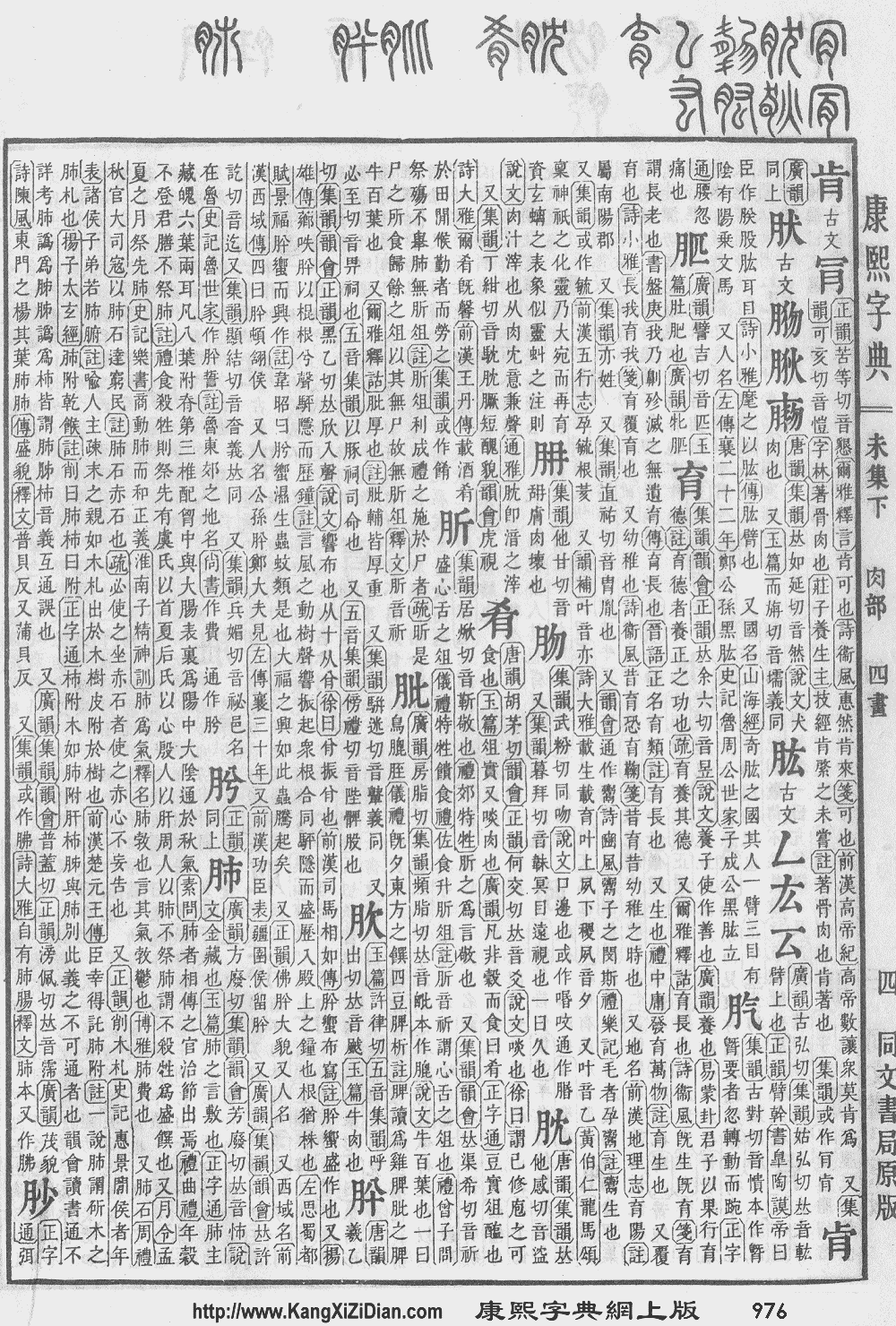
- KangXi: page 976, character 18
- Dai Kanwa Jiten: character 29322
- Dae Jaweon: page 1427, character 31
- Hanyu Da Zidian: volume 3, page 2049, character 17
- Unihan data for U+80B4
Chinese
Glyph origin
| Characters in the same phonetic series (爻) (Zhengzhang, 2003) | |
|---|---|
| Old Chinese | |
| 崤 | *ɢaːw, *ɢraːw |
| 郩 | *qaːwʔ |
| 敎 | *kraːw, *kraːws |
| 較 | *kreːwɢs, *kreːwɢ |
| 肴 | *ɢraːw |
| 淆 | *ɢraːw |
| 倄 | *ɢraːw, *ɢʷɯːʔ |
| 爻 | *ɢraːw |
| 餚 | *ɢraːw |
| 殽 | *ɢraːw |
| 笅 | *ɢraːw |
| 駁 | *praːwɢ |
Phono-semantic compound (形聲, OC *ɢraːw) : phonetic 爻 (OC *ɢraːw) + semantic ⺼ (“meat”) – meat dishes. The character 爻 also has meaning of “cut, divided, sliced”, so connotations of “sliced meat, prepared meat”.
Current form resembles 乂 + 有 – the lower 乂 of 爻 has moved to the side and down.
Etymology 1
| simp. and trad. |
肴 | |
|---|---|---|
Pronunciation
Definitions
肴
Compounds
Etymology 2
| For pronunciation and definitions of 肴 – see 餚 (“prepared meat; food”). (This character, 肴, is the simplified form of 餚.) |
Notes:
|
Japanese
Kanji
(“Jinmeiyō” kanji used for names)
Readings
Compounds
- 佳肴 (kakō), 嘉肴 (kakō)
- 口取り肴 (kuchitorizakana)
- 組み肴 (kumizakana)
- 下戸の肴荒し (geko no sakanaarashi)
- 下肴 (gezakana): inferior fish, cheap fish
- 肴核 (kōkaku)
- 小肴 (kozakana): small fish
- 肴荒らし (sakanaarashi)
- 肴奉行 (sakanabugyō)
- 肴札 (sakanafuda)
- 肴舞 (sakanamai)
- 酒肴 (sakesakana)
- 残肴 (zankō)
- 強い肴 (shiizakana)
- 酒肴 (shukō)
- 酢肴 (suzakana)
- 進め肴 (susumezakana)
- 粗肴 (sokō)
- 珍肴 (chinkō)
- 取り肴 (torizakana)
- 直し肴 (naoshizakana)
- 生肴 (namazakana): raw fish
- 熨斗肴 (noshizakana)
- 箱肴 (hakozakana)
- 鉢肴 (hachizakana)
- 引き肴 (hikizakana)
- 美肴 (bikō)
Etymology 1
.jpg)
| Kanji in this term |
|---|
| 肴 |
| さかな Jinmeiyō |
| kun’yomi |
Compound of Old Japanese elements 酒 (saka, “sake, rice wine”, old combining form of modern sake reading) + 菜 (na, “side dish”).[1][2][3] Likely source of Okinawan さかな (sakana).
Pronunciation
Alternative forms
Noun
肴 (hiragana さかな, rōmaji sakana)
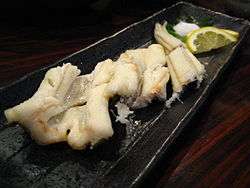
- fish
- a side dish served with alcoholic beverages: not necessarily fish, may be a vegetable or other meat
- entertainment at a drinking party
Usage notes
Idioms
- 肴にする (sakana ni suru): to belittle someone, to make fun of someone
Etymology 2
| Kanji in this term |
|---|
| 肴 |
| な Jinmeiyō |
| kun’yomi |
From Old Japanese. Also spelled variously in kanji in modern Japanese as 肴 (for meat or fish), 菜 (for vegetables), 魚 (for fish).[1]
This reading appears to be obsolete in modern Japanese.
Pronunciation
Noun
Derived terms
- 肴 (sakana) (see above)
- 魚 (sakana) (see above)
References
- 1 2 1988, 国語大辞典(新装版) (Kokugo Dai Jiten, Revised Edition) (in Japanese), Tōkyō: Shogakukan
- 1 2 2006, 大辞林 (Daijirin), Third Edition (in Japanese), Tōkyō: Sanseidō, →ISBN
- ↑ 1995, 大辞泉 (Daijisen) (in Japanese), Tōkyō: Shogakukan, →ISBN
- ↑ 1998, NHK日本語発音アクセント辞典 (NHK Japanese Pronunciation Accent Dictionary) (in Japanese), Tōkyō: NHK, →ISBN
Korean
Hanja
肴 • (hyo) (hangeul 효, revised hyo, McCune–Reischauer hyo, Yale hyo)
- This term needs a translation to English. Please help out and add a translation, then remove the text
{{rfdef}}.