床
| ||||||||
Translingual
| Stroke order | |||
|---|---|---|---|
 | |||
Han character
床 (radical 53 广+4, 7 strokes, cangjie input 戈木 (ID) or X戈木 (XID), four-corner 00294, composition ⿸广木)
See also
References
- KangXi: page 343, character 24
- Dai Kanwa Jiten: character 9242
- Dae Jaweon: page 653, character 12
- Hanyu Da Zidian: volume 2, page 873, character 20
- Unihan data for U+5E8A
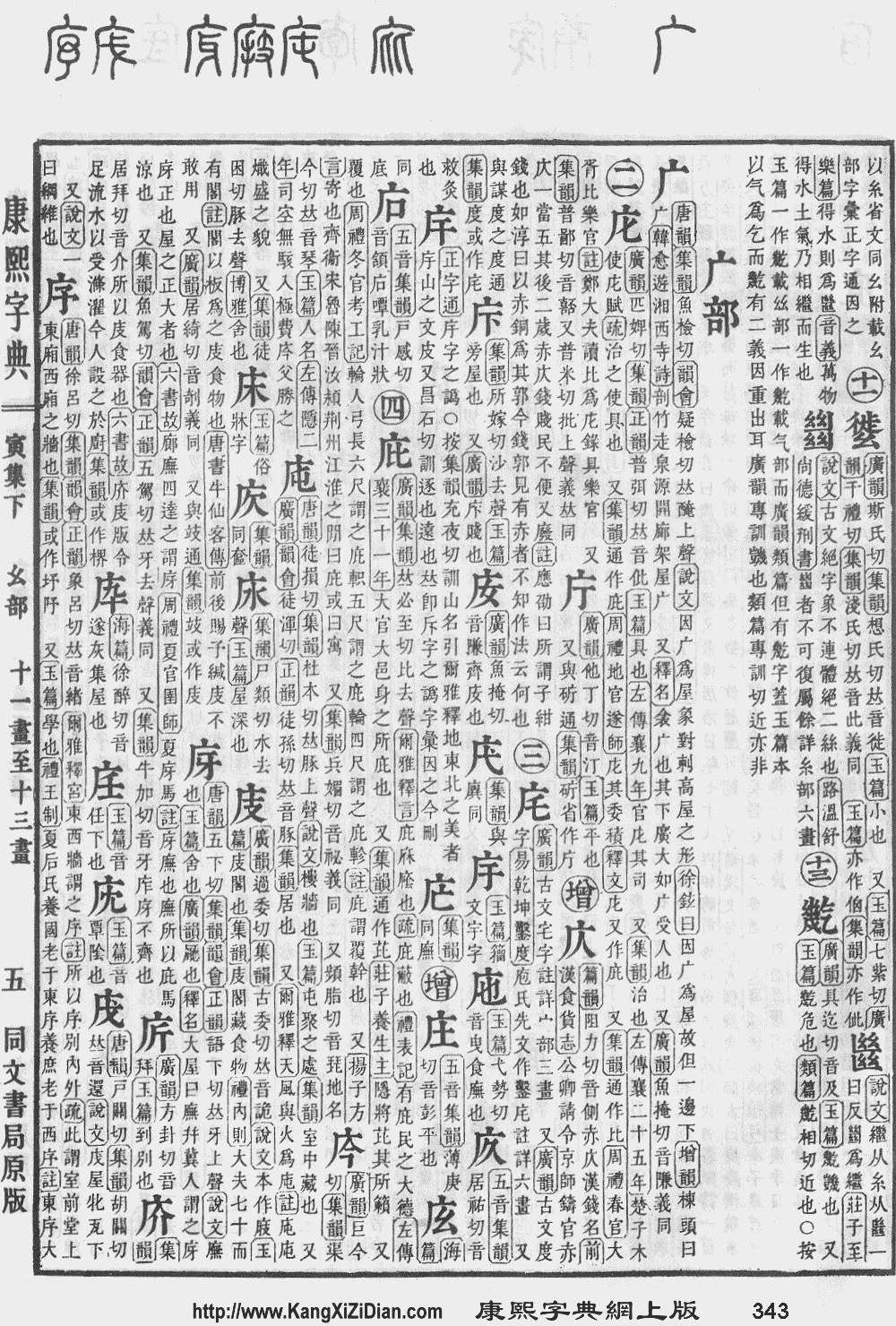
Chinese
| trad. | 床/牀 | |
|---|---|---|
| simp. | 床 | |
Glyph origin
| Characters in the same phonetic series (爿) (Zhengzhang, 2003) | |
|---|---|
| Old Chinese | |
| 臧 | *ʔsaːŋ |
| 牂 | *ʔsaːŋ |
| 戕 | *kaːl, *ʔsaːŋ, *zaŋ |
| 贓 | *ʔsaːŋ |
| 藏 | *zaːŋ, *zaːŋs |
| 奘 | *zaːŋʔ, *zaːŋs |
| 臟 | *zaːŋs |
| 將 | *ʔsaŋ, *ʔsaŋs |
| 漿 | *ʔsaŋ |
| 鱂 | *ʔsaŋ |
| 蔣 | *ʔsaŋ, *ʔsaŋʔ |
| 螿 | *ʔsaŋ |
| 槳 | *ʔsaŋʔ |
| 獎 | *ʔsaŋʔ |
| 醬 | *ʔsaŋs |
| 鏘 | *sʰaŋ |
| 蹡 | *sʰaŋ, *ʔshaŋs |
| 嶈 | *sʰaŋ |
| 斨 | *sʰaŋ |
| 爿 | *braːn, *zaŋ |
| 牆 | *zaŋ |
| 妝 | *ʔsraŋ |
| 莊 | *ʔsraŋ |
| 裝 | *ʔsraŋ, *ʔsraŋs |
| 壯 | *ʔsraŋs |
| 疒 | *rnɯːɡ, *zraŋ |
| 床 | *zraŋ |
| 牀 | *zraŋ |
| 狀 | *zraŋs |
Etymology
Proto-Vietic *k-ɟəːŋ (“bed”), whence Vietnamese giường and Chut kəcɨːŋ², is a borrowing from Old Chinese (Alves, 2015).
Pronunciation
Definitions
床
- bed; couch (Classifier: 張/张)
- framework; chassis
- (Teochew) table
- rails of the well
- bottom
- classifier for bedding, or large vehicles
Synonyms
| Dialectal synonyms of 桌子 (“table”) [map] | ||
|---|---|---|
| Variety | Location | Words |
| Classical Chinese | 桌 | |
| Formal (Written Standard Chinese) | 桌子 | |
| Mandarin | Beijing | 桌子 |
| Taiwan | 桌子 | |
| Tianjin | 桌子 | |
| Jinan | 桌子 | |
| Xi'an | 桌子 | |
| Wuhan | 桌子 | |
| Chengdu | 桌子 | |
| Yangzhou | 桌子 | |
| Hefei | 桌子 | |
| Malaysia | 桌子、檯子 | |
| Cantonese | Guangzhou | 檯 |
| Hong Kong | 檯 | |
| Taishan | 檯 | |
| Yangjiang | 檯 | |
| Gan | Nanchang | 桌子 |
| Hakka | Meixian | 桌仔 |
| Miaoli (N. Sixian) | 桌仔 | |
| Liudui (S. Sixian) | 桌仔 | |
| Hsinchu (Hailu) | 桌仔 | |
| Dongshi (Dabu) | 桌 | |
| Zhuolan (Raoping) | 桌仔、桌 | |
| Yunlin (Zhao'an) | 桌 | |
| Jin | Taiyuan | 桌子 |
| Min Bei | Jian'ou | 桌 |
| Min Dong | Fuzhou | 桌 |
| Min Nan | Xiamen | 桌、桌仔 |
| Quanzhou | 桌、桌仔 | |
| Zhangzhou | 桌 | |
| Taipei | 桌仔 | |
| Kaohsiung | 桌仔 | |
| Tainan | 桌仔 | |
| Taichung | 桌仔 | |
| Hsinchu | 桌仔 | |
| Lukang | 桌仔 | |
| Sanxia | 桌仔 | |
| Yilan | 桌仔 | |
| Kinmen | 桌 | |
| Magong | 桌 | |
| Penang | 桌 | |
| Chaozhou | 床 | |
| Wu | Shanghai | 檯子 |
| Suzhou | 檯子 | |
| Wenzhou | 桌 | |
| Xiang | Changsha | 桌子 |
| Shuangfeng | 桌子 | |
Compounds
|
|
|
Japanese
Kanji
Readings
- Goon: じょう (jō)←じやう (zyau, historical)
- Kan’on: そう (sō)←さう (sau, historical)
- Kan’yōon: しょう (shō, Jōyō)←しやう (syau, historical)
- Kun: ゆか (yuka, 床); とこ (toko, 床, Jōyō); ゆかしい (yukashī, 床しい)
Compounds
Etymology 1
| Kanji in this term |
|---|
| 床 |
| ゆか Grade: S |
| kun’yomi |
From Old Japanese. Attested in the 日本書紀 (Nihon Shoki), completed in 720 and one of the earliest works written in Japanese (see Wikipedia:Nihon Shoki), with a meaning of bed.
According to the 和句解 (Wakuge), published in 1668 by early Edo-period scholar Matsunaga Teitoku (松永貞徳; see Wikipedia:ja:松永貞徳), derives from ゆか (yuka) as the 未然形 (mizenkei, “irrealis form”) stem of the verb 行く (yuku, “to go”) of an original meaning similar to "not going", in reference to a place where one sits down to rest.
Pronunciation
Noun
- the floor (the bottom surface of a room)
- 床を掃く
- yuka o haku
- to sweep the floor
- 床を掃く
- a bed
- (theater) a raised area of a stage where a presenter or musician sits
- a raised platform erected along the Kamo River in Kyōto in summer, used as an outdoor tea shop or restaurant
Antonyms
Coordinate terms
Etymology 2
| Kanji in this term |
|---|
| 床 |
| とこ Grade: S |
| kun’yomi |
⟨to2ko2⟩ → /toko/
From Old Japanese. Cognate with 所 (tokoro, “place”). Attested since at least the Nara period, appearing in the Man'yōshū, completed in 759.[3][4]
Pronunciation
Noun
- a raised platform roughly 30cm tall used in dirt-floored rooms as a seat
- a raised area on which to sleep: a bed
- a sickbed
- the floor
- tatami mats
- the seat of an oxcart
- short for 床間 / 床の間 (toko no ma): an alcove with a raised floor along one wall of a traditional Japanese living room
- an alcove with a raised floor used as a study: see 付書院 (tsuke shoin)
- a box seat, such as at a parade, theater, or stadium
- short for 床店 (tokomise): a stall with a raised floor used as a store
- short for 床屋 (tokoya): a barbershop, from how such shops were historically often tokomise
- short for 床船梁 (toko funabari), 舵床 (kajidoko): the large wooden beam at the very aft of a traditional wood-hulled Japanese ship, upon which the rudder is seated
- the heel of a plough; the part of the bottom of a plough that touches the ground and guides the ploughshare
- short for 苗床 (naedoko): a seedbed
- short for 鉄床, 金床 (kanatoko): an anvil
Synonyms
Etymology 3
| Kanji in this term |
|---|
| 床 |
| しょう Grade: S |
| kan’yōon |
/ʑau/ → /ɕau/ → /ɕɔː/ → /ɕoː/
From Middle Chinese 床 (MC d͡ʒɨɐŋ). Devoicing apparently occurred after borrowing.
Pronunciation
Alternative forms
Counter
References
- 1 2 3 2006, 大辞林 (Daijirin), Third Edition (in Japanese), Tōkyō: Sanseidō, →ISBN
- 1 2 1998, NHK日本語発音アクセント辞典 (NHK Japanese Pronunciation Accent Dictionary) (in Japanese), Tōkyō: NHK, →ISBN
- ↑ 1988, 国語大辞典(新装版) (Kokugo Dai Jiten, Revised Edition) (in Japanese), Tōkyō: Shogakukan
- ↑ c. 759, Man'yōshū (book 20, poem 4331), text here
Korean
Hanja
床 • (sang) (hangeul 상)
Vietnamese
Han character
床 (sàng, giàn, giường, sường, giàng, rương)
- This term needs a translation to English. Please help out and add a translation, then remove the text
{{rfdef}}.