parade
English
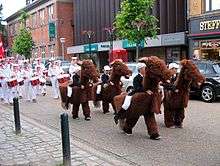
A band marches in a parade in Denmark.
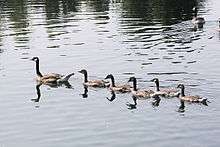
A parade of geese
Etymology
Borrowing from French parade (“show, display, parade, parry, formerly also a halt on horseback”), from Spanish parada (“a halt, stop, pause, a parade”), from parar (“to halt, stop, get ready, prepare”), from Latin parare (“to prepare, in Medieval Latin and Rom. also to halt, stop, prevent, guard against, etc., also dress, trim, adorn”); see pare. Compare parry, a doublet of parade.
Pronunciation
- IPA(key): /pəˈɹeɪd/
Audio (US) (file) - Rhymes: -eɪd
Noun
parade (plural parades)
- An organized procession consisting of a series of consecutive displays, performances, exhibits, etc. displayed by moving down a street past a crowd.
- The floats and horses in the parade were impressive, but the marching bands were really amazing.
- Any succession, series, or display of items.
- The dinner was a parade of courses, each featuring foods more elaborate than the last.
- a parade of shops
- A line of goslings led by one parent and often trailed by the other.
- The ground where a military display is held, or where troops are drilled.
- Pompous show; formal display or exhibition.
- Jonathan Swift
- Be rich, but of your wealth make no parade.
- Jonathan Swift
- (Gallicism) Posture of defense; guard.
- John Locke
- when they are not in parade, and upon their guard
- John Locke
- A public walk; a promenade; now used in street names.
- He was parked on Chester Parade.
- 1914, G. K. Chesterton, "The God of the Gongs", in The Wisdom of Father Brown, p. 216:
- (dated) An open space usable for military parades.
- After walking a mile or two farther, they found that the shore was beginning to be formally embanked, so as to form something like a parade; the ugly lamp-posts became less few and far between and more ornamental, though quite equally ugly.
- (zoology, collective) (uncommon) A term of venery denoting a herd of elephants on the move.
Derived terms
Terms derived from parade
|
|
|
Translations
organized procession
|
|
any succession or series
Verb
parade (third-person singular simple present parades, present participle parading, simple past and past participle paraded)
- (intransitive) To march or to display.
- They paraded around the field, simply to show their discipline.
- (transitive) To display or show; to exhibit in a showy or ostentatious manner; to show off.
- They paraded dozens of fashions past the crowd.
- Parading all her sensibility. Byron.
- (transitive) To march past.
- After the field show, it is customary to parade the stands before exiting the field.
Further reading
Anagrams
French
Verb
parade
Anagrams
Norman
Alternative forms
- pathade (Jersey)
Noun
parade f (plural parades)
Swedish
Adjective
parade
- absolute singular definite and plural form of parad.
Verb
parade
- past tense of para.
This article is issued from
Wiktionary.
The text is licensed under Creative Commons - Attribution - Sharealike.
Additional terms may apply for the media files.