moose
See also: Moose
English
WOTD – 15 October 2011
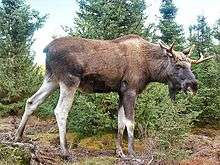
moose
Etymology 1
Earlier mus, moos, from a Northeastern Algonquian language name for the animal, such as Massachusett moos, mws, Narragansett moos or Penobscot mos (cognate to Abenaki moz), from Proto-Algonquian *mo·swa (“it strips”), referring to how a moose strips tree bark when feeding: compare Massachusett moos-u (“he strips, cuts smooth”).[1][2]
Pronunciation
- enPR: mo͞os, IPA(key): /muːs/
-
Audio (US) (file) - Rhymes: -uːs
- Homophone: mousse
Noun
moose (plural moose or (dated) mooses)
- (US) The largest member of the deer family (Alces alces), of which the male has very large, palmate antlers.
- We saw a moose at the edge of the woods.
- (informal) An ugly person
Usage notes
Synonyms
- (largest member of the deer family (Alces alces)): elk (British), Newfoundland speed bump (Canadian, humorous)
Derived terms
Terms derived from moose
|
Descendants
- → Irish: mús
Translations
largest member of the deer family (Alces alces)
|
|
See also

Etymology 2
Noun
moose (plural mooses)
- (obsolete, rare) A stew.
References
- ↑ Online Etymology Dictionary
- ↑ “moose” in Dictionary.com Unabridged, Dictionary.com, LLC, 1995–present.
- ↑ The living Algonquian languages, for their part, pluralize the term with their reflexes of the Algonquian plural sufix -ak, e.g. Abenaki moz, mozak.
Ojibwe
Noun
moose (plural mooseg)
Scots
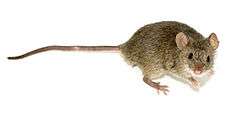
moose
Etymology
From Middle English mous, from Old English mūs, from Proto-Germanic *mūs, from Proto-Indo-European *muh₂s.
Pronunciation
- IPA(key): [mus]
Noun
moose (plural mice)
This article is issued from
Wiktionary.
The text is licensed under Creative Commons - Attribution - Sharealike.
Additional terms may apply for the media files.