coat
English
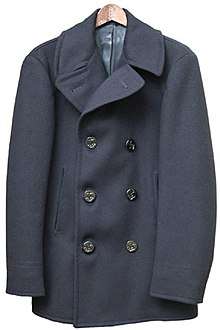
Navy pea coat
Alternative forms
- cote (obsolete)
Etymology
From Middle English cote, coate, cotte, from Old French cote, cotte (“outer garment with sleeves”), from Latin cotta (“undercoat, tunic”), from Proto-Germanic *kuttô, *kuttǭ (“cowl, woolen cloth, coat”), from Proto-Indo-European *gʷewd-, *gud- (“woolen clothes”). Cognate with Old High German kozza, kozzo (“woolen coat”) (Modern German Kotze (“coarse woolen blanket; woolen cape”)), Middle Low German kot (“coat”), Ancient Greek βεῦδος (beûdos, “woman's attire”).
Pronunciation
- (General American) IPA(key): /koʊt/
- (Received Pronunciation) IPA(key): /kəʊt/
Audio (US) (file) Audio (UK) (file) - Rhymes: -əʊt
Noun
coat (countable and uncountable, plural coats)
- (countable) An outer garment covering the upper torso and arms.Wp
- 1906, Stanley J[ohn] Weyman, chapter I, in Chippinge Borough, New York, N.Y.: McClure, Phillips & Co., OCLC 580270828:
- It was April 22, 1831, and a young man was walking down Whitehall in the direction of Parliament Street. He wore shepherd's plaid trousers and the swallow-tail coat of the day, with a figured muslin cravat wound about his wide-spread collar.
- 1977, Agatha Christie, chapter 4, in An Autobiography, part II, London: Collins, →ISBN:
- Mind you, clothes were clothes in those days. […] Frills, ruffles, flounces, lace, complicated seams and gores: not only did they sweep the ground and have to be held up in one hand elegantly as you walked along, but they had little capes or coats or feather boas.
- 1906, Stanley J[ohn] Weyman, chapter I, in Chippinge Borough, New York, N.Y.: McClure, Phillips & Co., OCLC 580270828:
- (countable) A covering of material, such as paint.Wp
- John Milton (1608-1674)
- (countable) The fur or feathers covering an animal's skin.Wp
- When the dog shed its coat, it left hair all over the furniture and the carpet.
- (uncountable, nautical) Canvas painted with thick tar and secured round a mast or bowsprit to prevent water running down the sides into the hold (now made of rubber or leather).
- (obsolete) A petticoat.
- John Locke (1632-1705)
- a child in coats
- John Locke (1632-1705)
- The habit or vesture of an order of men, indicating the order or office; cloth.
- Jonathan Swift (1667–1745)
- Men of his coat should be minding their prayers.
- William Shakespeare (c.1564–1616)
- She was sought by spirits of richest coat.
- Jonathan Swift (1667–1745)
- A coat of arms.Wp
- William Shakespeare (c.1564–1616)
- Hark, countrymen! either renew the fight, / Or tear the lions out of England's coat.
- William Shakespeare (c.1564–1616)
- A coat card.
- Philip Massinger (1583-1640)
- Here's a trick of discarded cards of us! We were ranked with coats as long as old master lived.
- Philip Massinger (1583-1640)
Derived terms
Derived terms
Translations
outer garment covering the upper torso and arms
|
|
covering of material, such as paint
|
|
fur or feathers
|
- The translations below need to be checked and inserted above into the appropriate translation tables, removing any numbers. Numbers do not necessarily match those in definitions. See instructions at Wiktionary:Entry layout#Translations.
Verb
coat (third-person singular simple present coats, present participle coating, simple past and past participle coated)
- To cover with a coat of some material
- One can buy coated frying pans, which are much easier to wash up than normal ones.
- To cover as a coat.
Translations
to cover with a coat of some material
Anagrams
This article is issued from
Wiktionary.
The text is licensed under Creative Commons - Attribution - Sharealike.
Additional terms may apply for the media files.