berry
English
.jpg)
Pronunciation
- IPA(key): /ˈbɛɹi/
- enPR: bĕ'ri
- Rhymes: -ɛri
- Homophones: bury, Barry (in accents with the Mary–marry–merry merger)
-
Audio (US) (file) -
Audio (US) (file)
Etymology 1
From Middle English berye, from Old English beriġe, from Proto-Germanic *bazją[1] (compare German Beere, Norwegian and Danish bær), from Proto-Indo-European *bʰes- (“to blow, chew, rub”), compare Ancient Greek ψάω (psáō, “I rub”), Sanskrit बभस्ति (bábhasti, “he chews, devours”)[2]. For the semantic development, compare Old Church Slavonic гроуша (gruša, “pear”), from гроушити (grušiti, “to break, destroy”); Latin pirum (“pear”), from *peis- (“to stick, pound”)[3].
Noun
berry (plural berries)
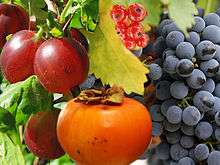
- A small succulent fruit, of any one of many varieties.
- (botany) A soft fruit which develops from a single ovary and contains seeds not encased in pits.
- A coffee bean.
- One of the ova or eggs of a fish.
- (Can we find and add a quotation of Travis to this entry?)
Usage notes
Many fruits commonly regarded as berries, such as the strawberry and raspberry, are not berries in the botanical sense.
Derived terms
- apple-berry
- Avignon berry
- baneberry
- barberry
- bayberry
- bearberry
- beautyberry
- the berries
- berry alder
- berry-bearing alder
- berry-button
- berrying
- berryless
- berry sugar
- berry wax
- bilberry, billberry
- blackberry
- blaeberry
- blueberry
- boxberry
- boysenberry
- bramberry
- brambleberry
- bread-berry
- buckthorn berry
- buffalo berry, buffalo-berry, buffaloberry
- bulberry, bullberry, bull berry
- bunchberry
- candleberry
- cassioberry
- checker-berry, checkerberry
- China-berry, chinaberry
- choke-berry, chokeberry
- Christmas berry
- cloudberry
- coffee-berry
- coral-berry, coralberry
- cow-berry, cowberry
- crackerberry
- cranberry
- crowberry
- cubeb berry
- curlew-berry
- dabbery, dayberry, deberry
- deerberry
- dew-berry, dewberry
- dangleberry, tangleberry
- dingleberry
- dogberry
- dway-berry
- egg-berry
- elderberry
- farkleberry
- feaberry
- fen-berry
- foxberry
- French berry
- fryberry
- gallberry
- gooseberry
- guavaberry
- hackberry, hagberry, heckberry, hegberry
- heathberry, heath-berry
- hedge-berry, hedgeberry
- heurtleberry, hurtleberry
- hillberry
- hindberry
- honeyberry
- hound-berry, hound's-berry
- huckleberry
- hurtleberry
- ink-berry, inkberry
- ivenberry, ivy-berry
- Juneberry
- knotberry, knoutberry
- lemonade berry
- lingberry, lingenberry, lingonberry
- logan berry, loganberry
- marionberry
- marlberry
- moss-berry, mossberry
- mulberry
- myrtle-berry
- nannyberry
- naseberry
- nessberry
- nub-berry
- one-berry
- oso-berry
- partridge berry, partridge-berry, partridgeberry
- peaberry
- Persian berry
- pigeon-berry
- poison berry
- pokeberry
- quinsy-berry
- raccoon-berry, racoon-berry
- ramble-berry
- raspberry
- Rhein-berry
- riberry
- roan-berry, rowan-berry
- roebuck-berry
- rumberry
- salal berry
- salmon berry, salmonberry
- scald-berry
- sea-berry
- service-berry, serviceberry
- shadberry
- sheepberry
- silverberry
- snowberry
- soapberry
- sparkleberry
- spiceberry
- strawberry
- sugar berry, sugar-berry, sugarberry
- sunberry
- tayberry
- tea-berry, teaberry
- tetter-berry
- thimbleberry
- timberry
- tummelberry
- twig and berries
- twinberry
- veitchberry
- wax-berry, waxberry
- wheat berry
- whinberry
- whortleberry
- wickeyberry tree
- wineberry
- winterberry
- wolfberry
- wonderberry
- Worcesterberry
- yellow berry
- youngberry
Translations
|
|
References
- ↑ Marlies Philippa et al., eds., Etymologisch Woordenboek van het Nederlands, A-Z, s.v. “bes” (Amsterdam UP, 3 Dec. 2009) .
- ↑ J.P. Mallory & D.Q. Adams, eds., Encyclopedia of Indo-European Culture, s.vv. “blow”, “rub” (London: Fitzroy Dearborn, 1997), pp. 72, 490.
- ↑ Vladimir Orel, A Handbook of Germanic Etymology, s.v. “*ƀazjan” (Leiden: Brill, 2003), 40.
Verb
berry (third-person singular simple present berries, present participle berrying, simple past and past participle berried)
- To pick berries.
- On summer days Grandma used to take us berrying, whether we wanted to go or not.
- To bear or produce berries.
Usage notes
- Unlikely to be used to refer to commercial harvesting of berries.
Derived terms
Etymology 2
From Middle English berȝe, berghe, from Old English beorġe, dative form of beorg (“mountain, hill, mound, barrow”), from Proto-Germanic *bergaz (“mountain, hill”). More at barrow.
Alternative forms
- berye, berie
Noun
berry (plural berries)
Etymology 3
From Middle English bery (“a burrow”). More at burrow.
Noun
berry (plural berries)
- (dialectal) A burrow, especially a rabbit's burrow.
- An excavation; a military mine.
Etymology 4
From Middle English beryen, berien, from Old English *berian (found only in past participle ġebered (“crushed, kneaded, harassed, oppressed, vexed”)), from Proto-Germanic *barjaną (“to beat, hit”), from Proto-Indo-European *bʰer- (“to rip, cut, split, grate”). Cognate with Scots berry, barry (“to thresh, thrash”), German beren (“to beat, knead”), Icelandic berja (“to beat”), Latin feriō (“strike, hit”, verb).
Verb
berry (third-person singular simple present berries, present participle berrying, simple past and past participle berried)