dam
Translingual
Symbol
dam
- (metrology) Symbol for the decameter (decametre), an SI unit of length equal to 101 meters (metres).
English
Pronunciation
Etymology 1
From Middle English dam, damme, from Old English *dam, *damm (inferred from derivative fordemman (“to hem in”)), from Proto-Germanic *dammaz.
Noun
dam (plural dams)
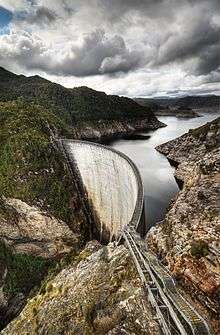
- A structure placed across a flowing body of water to stop the flow or part of the flow, generally for purposes such as retaining or diverting
some of the water or retarding the release of accumulated water to avoid abrupt flooding- A dam is often an essential source of water to farmers of hilly country.
- 1913, Robert Barr, chapter 4, in Lord Stranleigh Abroad:
- Nothing could be more business-like than the construction of the stout dams, and nothing more gently rural than the limpid lakes, with the grand old forest trees marshalled round their margins … .
- 2013 August 16, John Vidal, “Dams endanger ecology of Himalayas”, in The Guardian Weekly, volume 189, number 10, page 8:
- Most of the Himalayan rivers have been relatively untouched by dams near their sources. Now the two great Asian powers, India and China, are rushing to harness them as they cut through some of the world's deepest valleys.
- The water reservoir resulting from placing such structure
- Boats may only be used at places set aside for boating on the dam
- (dentistry) A device to prevent a tooth from getting wet, consisting of a rubber sheet held with a band.
- (South Africa, Australia) A reservoir.
- A firebrick wall, or a stone, which forms the front of the hearth of a blast furnace.
- (India) An obsolete Indian copper coin, equal to a fortieth of a rupee.
- 1839, William Holloway, A General Dictionary of Provincialisms, Written with a View to Rescue from Oblivion the Fast Fading Relics of By-gone Days, Lewes, East Sussex: Sussex Press: Printed and published by Baxter and Son, OCLC 3138091, page 42:
- […] A small Indian coin; whence comes the saying "I don't care a dam for you," that is I don't value you a farthing, and not as generally given, "I don't care a damn" or a "curse for you." [Possibly a folk etymology.]
-
Translations
|
|
Verb
dam (third-person singular simple present dams, present participle damming, simple past and past participle dammed)
- To block the flow of water.
Translations
See also

References
Etymology 2
Variant of dame.
Noun
dam (plural dams)
- Female parent, mother, generally regarding breeding of animals (correlative to sire).
- Shakespeare
- The dam runs lowing up and down, / Looking the way her harmless young one went.
- 1603, John Florio, transl.; Michel de Montaigne, The Essayes, […], printed at London: […] Edward Blount […], OCLC 946730821:, II.12:
- Hunters assure us, that to chuse the best dog, and which they purpose to keepe from out a litter of other young whelps, there is no better meane than the damme herselfe […].
- 1819, Lord Byron, Don Juan, I:
- she / Resolved that Juan should be quite a paragon, / And worthy of the noblest pedigree / (His sire was from Castile, his dam from Aragon) […].
- 1974, Lawrence Durrell, Monsieur, Faber & Faber, 1992, p.112:
- The sky was cloudless—the moon rolled across the surface like a lamb searching for its dam.
- Shakespeare
- A kind of crowned piece in the game of draughts.
Translations
Etymology 3
Noun
dam (plural dams)
Further reading

Anagrams
Afrikaans
Etymology
From Dutch dam, from Middle Dutch dam, from Old Dutch dam, from Proto-Germanic *dammaz.
Noun
dam (plural damme)
Derived terms
Cebuano
Etymology
From English dam, from Middle English dam, damme, from Old English *dam, *damm, from Proto-Germanic *dammaz.
Noun
dam
Crimean Tatar
Noun
dam
Declension
| nominative | dam |
|---|---|
| genitive | damnıñ |
| dative | damğa |
| accusative | damnı |
| locative | damda |
| ablative | damdan |
Synonyms
Danish
Etymology 1
From Old Norse dammr (“dam”).
Noun
dam c (singular definite dammen, plural indefinite damme)
Inflection
Derived terms
- dambrug n
Etymology 2
Borrowed from French jeu de dames (“draughts”).
Noun
dam c, n
Etymology 3
Borrowed from French dame (“lady”).
Noun
dam c (singular definite dammen, plural indefinite dammer)
- king (superior piece in draughts)
Inflection
Dutch
Pronunciation
- IPA(key): /dɑm/
Audio (file) - Rhymes: -ɑm
Etymology 1
From Middle Dutch dam, from Old Dutch dam, from Proto-Germanic *dammaz.
Noun
dam m (plural dammen, diminutive dammetje n)
Derived terms
Descendants
- Afrikaans: dam
Etymology 2
Noun
dam f (plural dammen)
- (checkers) king (double draught/checker)
Etymology 3
See etymology on the main entry.
Verb
dam
French
Etymology
Pronunciation
- IPA(key): /dɑ̃/
Noun
dam m (plural dams)
Derived terms
Related terms
Further reading
- “dam” in le Trésor de la langue française informatisé (The Digitized Treasury of the French Language).
Anagrams
Friulian
Etymology
Noun
dam m (plural dams)
Synonyms
- daneç
Related terms
Irish
Pronoun
dam (emphatic damsa)
- Alternative form of dom (“for/to me”)
Maltese
Verb
dam
Norwegian Bokmål
Etymology
From Middle Norwegian dammr m, from Old Norse damm n. The meaning dam (structure) probably comes from Middle Low German [Term?]. Sense 3 is from French jeu de dames.
Noun
dam m (definite singular dammen, indefinite plural dammer, definite plural dammene)
References
- “dam” in The Bokmål Dictionary.
Norwegian Nynorsk
Etymology
From Middle Norwegian dammr m, from Old Norse damm n. The meaning dam (structure) probably comes from Middle Low German [Term?]. Sense 3 is from French jeu de dames.
Noun
dam m (definite singular dammen, indefinite plural dammar, definite plural dammane)
References
- “dam” in The Nynorsk Dictionary.
Old Irish
Pronunciation
- IPA(key): /daṽ/
Etymology 1
From Proto-Celtic *damos (“bull”), from Proto-Indo-European *demh₂-
Noun
dam m (genitive daim)
Declension
| Masculine o-stem | |||
|---|---|---|---|
| Singular | Dual | Plural | |
| Nominative | dam | damL | daimL |
| Vocative | daim | damL | daumu |
| Accusative | damN | damL | daumu |
| Genitive | daimL | dam | damN |
| Dative | daumL | damaib | damaib |
Initial mutations of a following adjective:
| |||
Descendants
Noun
dam f
Etymology 2
Inflected forms of daimid.
Verb
dam
·dam
- Alternative form of ·daim
Mutation
| Old Irish mutation | ||
|---|---|---|
| Radical | Lenition | Nasalization |
| dam | dam pronounced with /ð(ʲ)-/ |
ndam |
| Note: Some of these forms may be hypothetical. Not every possible mutated form of every word actually occurs. | ||
References
- “1 dam” in Dictionary of the Irish Language, Royal Irish Academy, 1913–76.
- “2 dam” in Dictionary of the Irish Language, Royal Irish Academy, 1913–76.
Polish
Pronunciation
- IPA(key): [d̪ãm]
Verb
dam
- first-person singular present of dać
Noun
dam
- genitive plural of dama
Rohingya
Etymology
From Bengali [Term?].
Noun
dam
Swedish
Pronunciation
audio (file) - IPA(key): /dɑːm/
Noun
dam c
Declension
| Declension of dam | ||||
|---|---|---|---|---|
| Singular | Plural | |||
| Indefinite | Definite | Indefinite | Definite | |
| Nominative | dam | damen | damer | damerna |
| Genitive | dams | damens | damers | damernas |
Synonyms
- (in chess): drottning
Related terms
|
|
|
See also
| Chess pieces in Swedish · schackpjäser (schack + pjäser) (layout · text) | |||||
|---|---|---|---|---|---|
 |
 |
_kopio.jpg) |
 |
 |
 |
| kung | drottning, dam | torn | löpare | springare, häst | bonde |
References
- dam in Svenska Akademiens Ordlista över svenska språket (13th ed., online)
Turkish
Etymology
From Old Turkic [script needed] (tam), from Proto-Turkic *Tām (“roof; wall; hut”), which, according to the controversial Altaic hypothesis, is possibly derived from Proto-Altaic *t`āma (“wall, roof”).
Pronunciation
- IPA(key): /dɑm/
Noun
dam (definite accusative damı, plural damlar)
References
- *Tām Starostin, Sergei; Dybo, Anna; Mudrak, Oleg (2003) Etymological dictionary of the Altaic languages (Handbuch der Orientalistik; VIII.8), Leiden, New York, Köln: E.J. Brill
Uzbek
Noun
dam (plural damlar)