蛙
| ||||||||
Translingual
Han character
蛙 (radical 142 虫+6, 12 strokes, cangjie input 中戈土土 (LIGG), four-corner 54114, composition ⿰虫圭)
References
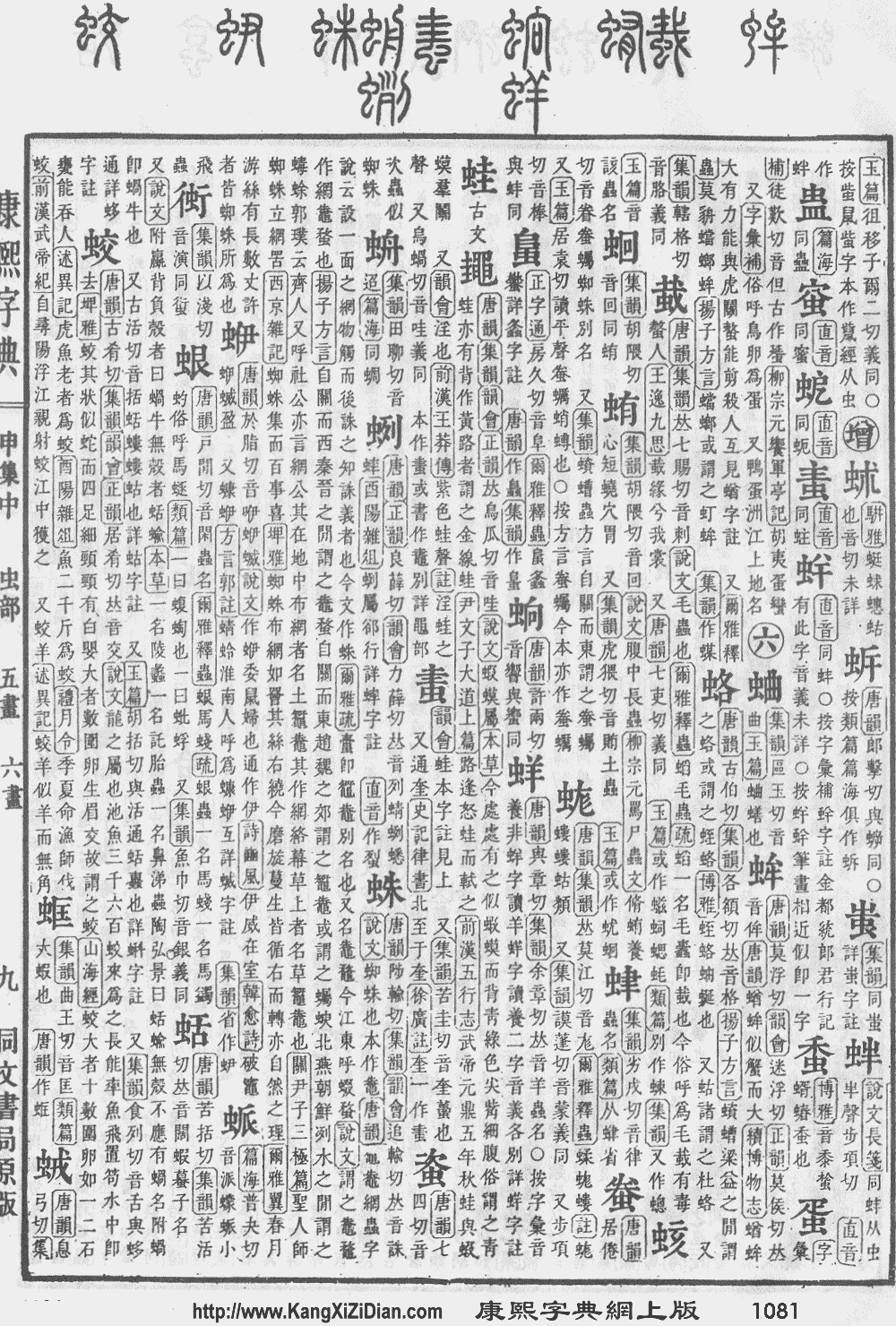
- KangXi: page 1081, character 25
- Dai Kanwa Jiten: character 32997
- Dae Jaweon: page 1549, character 20
- Hanyu Da Zidian: volume 4, page 2847, character 3
- Unihan data for U+86D9
Chinese
| simp. and trad. |
蛙 | |
|---|---|---|
| alt. forms | 鼃 | |
Glyph origin
| Characters in the same phonetic series (圭) (Zhengzhang, 2003) | |
|---|---|
| Old Chinese | |
| 街 | *kreː, *kreː |
| 鞋 | *ɡreː, *ɡreː, *ɡreː |
| 娾 | *ŋreː, *ŋreːʔ |
| 佳 | *kreː |
| 鮭 | *ɡreː, *kʷeː, *kʰʷeː |
| 涯 | *ŋreː, *ŋre |
| 崖 | *ŋreː, *ŋre |
| 啀 | *ŋreː |
| 厓 | *ŋreː |
| 捱 | *ŋreː |
| 睚 | *ŋreːs |
| 娃 | *qreː |
| 洼 | *qreː, *qʷraː, *kʷeː |
| 哇 | *qreː, *qʷraː |
| 胿 | *ɡeː, *kʷeː |
| 溎 | *qeːns |
| 觟 | *ɡʷraːʔ |
| 黊 | *ɡʷraːʔ, *ɡʷreːs, *ɡʷeː |
| 蘳 | *ɡʷraːʔ, *qʰʷe |
| 蛙 | *qʷraː, *qʷreː |
| 窪 | *qʷraː |
| 卦 | *kʷreːs |
| 挂 | *kʷreːs |
| 掛 | *kʷreːs |
| 詿 | *kʷreːs, *ɡʷreːs |
| 罣 | *kʷreːs, *ɡʷreːs, *kʷeːs |
| 絓 | *kʰʷreː, *ɡʷreːs |
| 鼃 | *ɢʷreː, *qʷreː |
| 圭 | *kʷeː |
| 珪 | *kʷeː |
| 邽 | *kʷeː |
| 閨 | *kʷeː |
| 袿 | *kʷeː |
| 窐 | *kʷeː, *ɡʷeː |
| 茥 | *kʷeː, *kʰʷeː |
| 桂 | *kʷeːs |
| 筀 | *kʷeːs |
| 奎 | *kʰʷeː |
| 刲 | *kʰʷeː |
| 蝰 | *kʰʷeː |
| 楏 | *kʰʷeː |
| 睳 | *qʰʷeː |
| 畦 | *ɡʷeː |
| 眭 | *ɡʷeː, *sqʰʷe, *qʰʷe, *qʰʷi |
| 烓 | *qʷeː, *kʰʷeːŋʔ |
| 跬 | *kʰʷeʔ |
| 恚 | *qʷes |
| 硅 | *qʰʷreɡ |
Phono-semantic compound (形聲, OC *qʷraː, *qʷreː) : semantic 虫 (“insect; creature”) + phonetic 圭 (OC *kʷeː).
Etymology 1
Pronunciation
Definitions
蛙
Synonyms
Compounds
Etymology 2
Pronunciation
Definitions
蛙
- Only used in 蝭蛙.
Japanese
Kanji
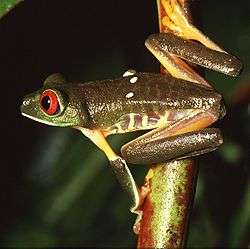
- frog (amphibious animal)
Readings
Compounds
- 蛙黽 (abō)
- 蛙鳴 (amei)
Etymology 1
| Kanji in this term |
|---|
| 蛙 |
| かえる Hyōgaiji |
| kun’yomi |
⟨kaperu⟩ → /kaperu/ → /kaferu/ → /kaweru/ → /kajeru/ → /kaeru/
From Old Japanese.
Only found once in the Man'yōshū, completed some time after 759 CE, where it is used phonetically to spell the name of the maple tree.[1] Generally regarded as the informal or everyday term for frog, in contrast to the formal or poetic term kawazu (see below).[2]
The ultimate derivation is unclear, with numerous theories. Some of the leading ideas include:
- Cognate with 帰る (kaeru, “to return (to a point of origin)”), from the way that some species of frogs return to their birthplace to spawn
- Cognate with 孵る (kaeru, “to hatch (from an egg)”), in reference to tadpoles
- Derived from onomatopoeia, where kape originally referred to the frog's call, suffixed uncertain element -ru
The phonetic development went through a clear stage where the middle mora was pronounced /je/, as illustrated in the 1603 Nippo Jisho entry, spelled cayeru.[3] This was likely a result of the Muromachi period sound shift, where /we/ shifted to /je/, followed later by /je/ merging into /e/ to produce modern /kaeru/.
Now the most common term for frog.
Pronunciation
Alternative forms
Noun
蛙 (hiragana かえる, katakana カエル, rōmaji kaeru, historical hiragana かへる)
- a frog (amphibious animal)
Usage notes
As with many terms that name organisms, this term is often spelled in katakana, especially in biological contexts, as カエル.
Derived terms
Etymology 2
| Kanji in this term |
|---|
| 蛙 |
| かわず Hyōgaiji |
| kun’yomi |
⟨kapadu⟩ → */kapadu/ → /kafad͡zu/ → /kawad͡zu/ → /kawazu/
The more formal or poetic counterpart to kaeru (see above).[2] Found in the Man'yōshū, completed some time after 759 CE.[7]
The ultimate derivation is unclear, but the initial kawa portion (ancient kapa) is very likely 川, 河 (kawa, ancient kapa, “river”).
The phonetic development of the term had already progressed to kawadzu by 1603, as seen in the Nippo Jisho entry, spelled cauazzu.[8]
Pronunciation
Noun
蛙 (hiragana かわず, rōmaji kawazu, historical hiragana かはづ)
- (poetic) a frog (amphibious animal)
- (Noh theater) a specific mask used in certain Noh plays, depicting a drowned person
Derived terms
- 井の中の蛙大海を知らず (i no naka no kawazu taikai o shirazu): “a frog in a well does not know the great ocean” → metaphor of a narrow world view based on limited experience
Etymology 3
| Kanji in this term |
|---|
| 蛙 |
| かいる Hyōgaiji |
| kun’yomi |
⟨kaperu⟩ → /kaperu/ → /kaferu/ → /kaweru/ → /kajeru/ → /kairu/
Sound shift. Existed alongside earlier kayeru in the late 1500s, early 1600s, as seen in the 1603 Nippo Jisho entry, spelled cairu.[9]
Pronunciation
Noun
蛙 (hiragana かいる, rōmaji kairu)
- (archaic, possibly obsolete) a frog (amphibious animal)
See also
References
- ↑ c. 759, Man'yōshū (book 8, poem 1623), text here
- 1 2 1988, 国語大辞典(新装版) (Kokugo Dai Jiten, Revised Edition) (in Japanese), Tōkyō: Shogakukan
- ↑ 1603, 日葡辞書: パリ本 / Vocabulario da Lingoa Iapam (Nippo Jisho: Paris edition / Vocabulary of the Language of Japan) (in Japanese and Portuguese), 1976 reprint, Tōkyō: Bensei Publishing, text here towards the bottom of the right-hand column
- 1 2 2006, 大辞林 (Daijirin), Third Edition (in Japanese), Tōkyō: Sanseidō, →ISBN
- 1 2 1998, NHK日本語発音アクセント辞典 (NHK Japanese Pronunciation Accent Dictionary) (in Japanese), Tōkyō: NHK, →ISBN
- 1 2 1997, 新明解国語辞典 (Shin Meikai Kokugo Jiten), Fifth Edition (in Japanese), Tōkyō: Sanseidō, →ISBN
- ↑ c. 759, Man'yōshū (book 3, poem 356), text here
- ↑ 1603, 日葡辞書: パリ本 / Vocabulario da Lingoa Iapam (Nippo Jisho: Paris edition / Vocabulary of the Language of Japan) (in Japanese and Portuguese), 1976 reprint, Tōkyō: Bensei Publishing, text here, fifth entry from the bottom of the right-hand column
- ↑ 1603, 日葡辞書: パリ本 / Vocabulario da Lingoa Iapam (Nippo Jisho: Paris edition / Vocabulary of the Language of Japan) (in Japanese and Portuguese), 1976 reprint, Tōkyō: Bensei Publishing, text here as the fourth entry in the right-hand column, defined in Portuguese as raã, typographic variant of rãa, earlier form of modern rã (“frog”)
Korean
Hanja
蛙 • (wa, wae) (hangeul 와, 왜, revised wa, wae, McCune–Reischauer wa, wae, Yale wa, way)
- This term needs a translation to English. Please help out and add a translation, then remove the text
{{rfdef}}.
Vietnamese
Han character
蛙 (oa)
- This term needs a translation to English. Please help out and add a translation, then remove the text
{{rfdef}}.