川
| ||||||||
Translingual
| Stroke order | |||
|---|---|---|---|
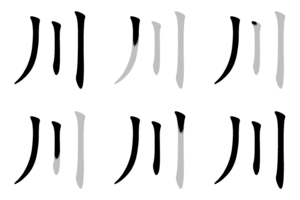 | |||
Han character
川 (radical 47, 巛+0, 3 strokes, cangjie input 中中中 (LLL), four-corner 22000)
Descendants
References
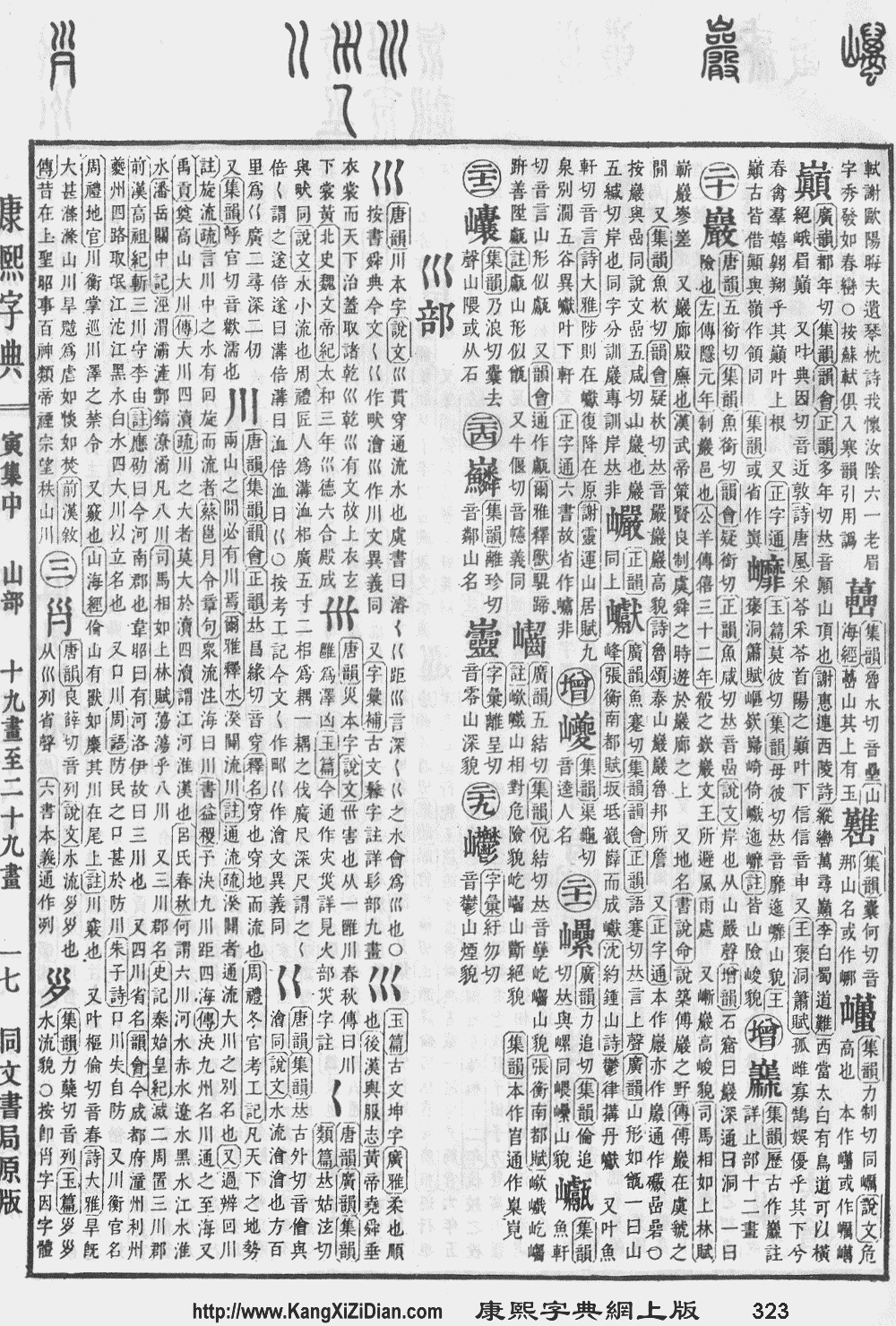
- KangXi: page 323, character 23
- Dai Kanwa Jiten: character 8673
- Dae Jaweon: page 624, character 7
- Hanyu Da Zidian: volume 1, page 32, character 2
- Unihan data for U+5DDD
Chinese
| simp. and trad. |
川 | |
|---|---|---|
Glyph origin
| Historical forms of the character 川 | ||||
|---|---|---|---|---|
| Shang | Western Zhou | Warring States | Shuowen Jiezi (compiled in Han) | Liushutong (compiled in Ming) |
| Oracle bone script | Bronze inscriptions | Chu Slip and silk script | Small seal script | Transcribed ancient scripts |
 |
 |
 |
 |
 |
| Characters in the same phonetic series (川) (Zhengzhang, 2003) | |
|---|---|
| Old Chinese | |
| 川 | *kʰjon |
| 釧 | *kʰjons |
| 巛 | *kʰuːn |
| 巡 | *sɢljun |
| 馴 | *sɢljun |
| 紃 | *sɢljun, *ɢljun |
| 甽 | *kljuns, *kʷeːnʔ |
| 順 | *ɢljuns |
| 訓 | *qʰuns |
Etymology
The Middle and Old Chinese reconstruction of this word is phonologically problematic (STEDT):
- Karlgren (1957) notes that the Middle Chinese form is irregular based on evidence from Shijing rimes.
- Based on velar contacts in the same phonetic series, e.g. 巛, 甽 and 訓, Baxter (1992) and Schuessler (2007) reconstruct the word with a velar initial (Handel, 1998; Sagart, 1999), which undergoes irregular palatalization in the development to Middle Chinese (Baxter, 1992).
- Based on other characters in the same phonetic series, e.g. 順 and 馴, Sagart (1999), and later, Baxter and Sagart (2014), reconstructs 川 with a lateral initial and suggests that only a *t- suffix would account for the Middle Chinese initial /t͡ɕʰ/.
Schuessler (2007) relates this word to Proto-Sino-Tibetan *kl(j)u(ŋ/k) (“river; valley”), whence 江 (OC *kroːŋ, “river”), 谷 (OC *kloːɡ, “valley”), Tibetan ཀླུང (klung, “river”), Burmese ချောင်း (hkyaung:, “stream”). STEDT notes that this does not account for the *-n coda.
STEDT instead compares it to Proto-Sino-Tibetan *m-t(w)əj-n ~ *m-ti-s (“water; fluid; liquid; river; soak; spit”), whence 涕 (OC *tʰiːlʔ, “tears”), Proto-Kuki-Chin *tuj (“water; fluid; liquid”), Chepang तीः (“water; rain; river”); this depends on a reconstruction with a dental initial and requires positing an *‑n suffix not present in Tibeto-Burman languages.
Pronunciation
Definitions
川
- river; stream; brook
- Synonym of 汆 (cuān, “to boil food for a short time in boiled water”).
- Short for 四川 (Sìchuān, “Sichuan Province, China”).
- source (of a river)
- road
- plain
- Alternative form of 穿 (chuān).
- A surname.
See also
Compounds
Japanese
Kanji
Readings
Compounds
- 川上 (kawakami): upstream
- 川下 (kawashimo): downstream
- 川岸 (kawagishi): river bank
- 川口 (kawaguchi): mouth of river
- 川崎 (Kawasaki): Kawasaki
- 川瀬 (kawase): rapids
- 川蝉 (kawasemi): kingfisher
- 川端 (kawabata): riverbank
- 川縁 (kawabuchi), 川縁 (kawaberi): riverside
Pronunciation
Noun
川 (hiragana かわ, rōmaji kawa, historical hiragana かは)
Synonyms
- 河川 (kasen)
Alternative forms
Suffix
川 (hiragana かわ, rōmaji -kawa, historical hiragana かは)
- the ... river, used in named of rivers or streams
川 (hiragana がわ, rōmaji -gawa, historical hiragana がは)
- the ... river
References
- ↑ 1974, 新明解国語辞典 (Shin Meikai Kokugo Jiten), Second Edition (in Japanese), Tōkyō: Sanseidō
Korean
Hanja
- This term needs a translation to English. Please help out and add a translation, then remove the text
{{rfdef}}.
Vietnamese
Han character
- This term needs a translation to English. Please help out and add a translation, then remove the text
{{rfdef}}.