笑
| ||||||||
Translingual
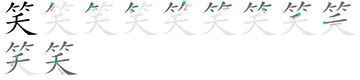
| Stroke order | |||
|---|---|---|---|
 | |||
Han character
笑 (radical 118, 竹+4, 10 strokes, cangjie input 竹竹大 (HHK), four-corner 88432, composition ⿱⺮夭)
Derived characters
- 㗛, 𢞖, 𢲑, 𣉧, 𧏣, 𧜕, 𫹠, 𭡻, 𡮜, 𫂪, 𫛎, 𬕓, 𮆂
References
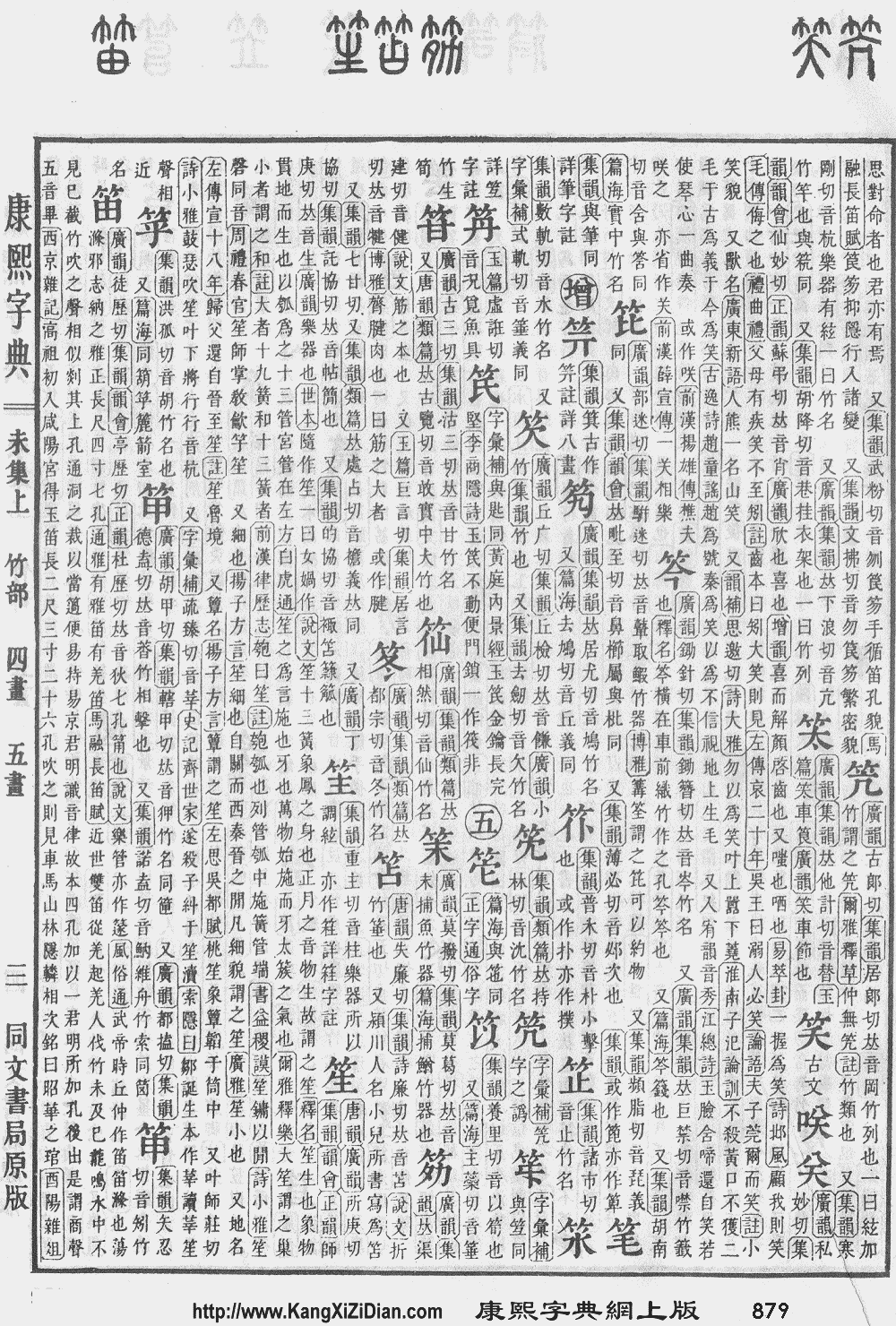
- KangXi: page 879, character 3
- Dai Kanwa Jiten: character 25885
- Dae Jaweon: page 1307, character 5
- Hanyu Da Zidian: volume 5, page 2950, character 10
- Unihan data for U+7B11
Chinese
| simp. and trad. |
笑 | |
|---|---|---|
| alt. forms | 关 咲 㗛 𥬇 𠺑 | |
Glyph origin
| Characters in the same phonetic series (夭) (Zhengzhang, 2003) | |
|---|---|
| Old Chinese | |
| 笑 | *sqʰows |
| 夭 | *qoːwʔ, *qrow, *qrowʔ |
| 镺 | *qoːwʔ, *qoːws |
| 芺 | *qoːwʔ, *qrowʔ |
| 妖 | *qrow |
| 祅 | *qrow |
| 枖 | *qrow |
| 訞 | *qrow |
| 殀 | *qrowʔ |
| 仸 | *qrowʔ |
| 妋 | *pa, *qu |
| 飫 | *qos |
| 沃 | *qoːwɢ |
| 鋈 | *qoːwɢ |
Phono-semantic compound (形聲, OC *sqʰows) : semantic 竹 + phonetic 夭 (OC *qoːwʔ, *qrow, *qrowʔ).
Pronunciation
Definitions
笑
See also
Compounds
|
|
|
Japanese
Kanji
Readings
- Goon: しょう (shō, Jōyō)←せう (seu, historical)
- Kan’on: しょう (shō, Jōyō)←せう (seu, historical)
- Kun: わらう (warau, 笑う, Jōyō)←わらふ (warafu, historical); えむ (emu, 笑む, Jōyō)←ゑむ (wemu, historical)
- Nanori: えみ (emi)←ゑみ (wemi, historical)
Compounds
Etymology 1
| Kanji in this term |
|---|
| 笑 |
| わら(い) Grade: 4 |
| kun’yomi |
The 連用形 (ren'yōkei, “continuative or stem form”) of verb 笑う (warau, “to laugh; to smile”).[1][2]
Pronunciation
Alternative forms
- (internet slang) w
Noun
笑 (hiragana わらい, rōmaji warai, historical hiragana わらひ)
Usage notes
More commonly spelled with the okurigana, as 笑い.
The warai reading is more commonly associated with the laugh senses. The emi reading is more commonly associated with the smile senses.
Etymology 2
| Kanji in this term |
|---|
| 笑 |
| え(み) Grade: 4 |
| kun’yomi |
the 連用形 (ren'yōkei, “continuative or stem form”) of verb 笑む (emu, “to smile; to laugh”).[1][2]
Pronunciation
Noun
笑 (hiragana えみ, rōmaji emi, historical hiragana ゑみ)
Usage notes
More commonly spelled with the okurigana, as 笑み.
The emi reading is more commonly associated with the smile senses. The warai reading is more commonly associated with the laugh senses.
Proper noun
笑 (hiragana えみ, rōmaji Emi, historical hiragana ゑみ)
- a female given name
- a surname
References
Korean
Hanja
笑 • (so)
- This term needs a translation to English. Please help out and add a translation, then remove the text
{{rfdef}}.
Vietnamese
Han character
笑 (tiếu, téo)
- This term needs a translation to English. Please help out and add a translation, then remove the text
{{rfdef}}.