tar
English
Pronunciation
- (Received Pronunciation) IPA(key): /tɑː/
- (General American) IPA(key): /tɑɹ/, [tʰɑɻ], [tʰɑɹ]
Audio (US) (file)
- Rhymes: -ɑː(ɹ)
Etymology 1
From Middle English terr, tarr, from Old English teoru, teru, from Proto-Germanic *terwą (compare West Frisian tarre, Dutch teer), from Proto-Indo-European *derwo- (compare Welsh derw (“oaks”), Lithuanian dervà (“pinewood, resin”), Russian де́рево (dérevo, “tree”), Bulgarian дърво́ (dǎrvó, “tree”)), from *dóru (“tree”). More at tree.
Noun
tar (countable and uncountable, plural tars)
- (uncountable) A black, oily, sticky, viscous substance, consisting mainly of hydrocarbons derived from organic materials such as wood, peat, or coal.
- Coal tar.
- (uncountable) A solid residual byproduct of tobacco smoke.
- (slang, dated) A sailor, because of their tarpaulin clothes. Also Jack Tar.
- (Can we find and add a quotation of Jonathan Swift to this entry?)
- Black tar, a form of heroin.
Derived terms
Translations
|
|
Verb
tar (third-person singular simple present tars, present participle tarring, simple past and past participle tarred)
- (transitive) To coat with tar.
- (transitive) To besmirch.
- The allegations tarred his name, even though he was found innocent.
- Paul Robinson's "The Gate Contracts":
- Dr. Sign: In fact, maybe you think I should get credit, but if I do, Dr. Frendall will be scorned. You know why
- Dr. Ellsworth: Yes, I know. Your critics will tar him with the same brush as you.
Derived terms
Translations
Etymology 2
Noun
tar (plural tars)
- (computing) A program for archiving files, common on Unix.
- (computing) A file produced by such a program.
Derived terms
Translations
Verb
tar (third-person singular simple present tars, present participle tarring, simple past and past participle tarred)
- (computing, transitive) To create a tar archive.
Antonyms
Derived terms
Etymology 3
Alternative forms
- tār
Noun
tar (plural tars)
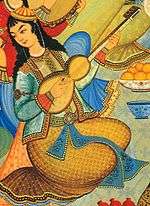
- A Persian long-necked, waisted instrument, shared by many cultures and countries in the Middle East and the Caucasus.
Translations
See also
- Appendix:Glossary of chordophones
Etymology 4
Noun
tar (plural tars)
- A single-headed round frame drum originating in North Africa and the Middle East.
See also
- Appendix:Glossary of membranophones
References
- 2001. Drum Circle: A Guide to World Percussion. Chalo Eduardo, Frank Kumor. Pg. 18.
Anagrams
Aromanian
Noun
tar m (plural tari)
Synonyms
Derived terms
Asturian
Etymology
Ultimately from Latin stāre, present active infinitive of stō. Compare Spanish estar, Aragonese estar, Galician estar, Portuguese estar, Catalan estar.
Verb
tar
- to be (referring to geographical place)
- to be (referring to something temporary)
- to be (for use in constructing continuous verb forms)
- tas xugando ― you are playing
Conjugation
| Impersonal forms | |||||||
|---|---|---|---|---|---|---|---|
| Infinitive | tar | ||||||
| Gerund | tando | ||||||
| Past participle | tao | ||||||
| Personal forms | |||||||
| yo | tu | él~elli/-a/-o | nosotros/-es~nós | vosotros/-es~vós | ellos/-es | ||
| Indicative | Present | to toi |
tas | ta | tamos | tais | tán |
| Imperfect preterite | taba | tabes | taba | tábamos~tábemos | tabais~tabeis | taben | |
| Perfect preterite | tuvi tevi |
tuvisti tuviesti |
tuvo tevo |
tuvimos tuviemos |
tuvistis tuviestis |
tuvieron | |
| Pluperfect preterite | tuviera~tuviere | tuvieras~tuvieres | tuviera~tuviere | tuviéramos~tuviéremos | tuvierais~tuviereis | tuvieran~tuvieren | |
| yo | tu | él~elli/-a/-o | nosotros/-es~nós | vosotros/-es~vós | ellos/-es | ||
| Subjunctive | Present | tea | teas | tea | teamos | teáis | tean |
| Imperfect preterite | tuviera~tuviere | tuvieras~tuvieres | tuviera~tuviere | tuviéramos~tuviéremos | tuvierais~tuviereis | tuvieran~tuvieren | |
| yo | tu | él~elli/-a/-o | nosotros/-es~nós | vosotros/-es~vós | ellos/-es | ||
| Potential | Future | taré | tarás | tará | taremos | taréis | tarán |
| Conditional | taría | taríes | taría | taríamos~taríemos | taríais~taríeis | taríen | |
| - | tu | vusté | nosotros/-es~nós | vosotros/-es~vós | vustedes | ||
| Imperative | ta | vamos tar | tai | ||||
Hungarian
Etymology
Borrowing from a Oghur language, before the times of the Hungarian conquest of the Carpathian Basin (at the turn of the 9th and 10th centuries)[1], from Proto-Turkic *daŕ (“bald”). Cognates include Turkish dazlak (“bald”), Karakhanid تازْ (tāz, “bald”), and Middle Mongolian [script needed] (tarasun, “bald”), the latter perhaps a Turkic borrowing too.
Pronunciation
- IPA(key): [ˈtɒr]
Audio (file)
Adjective
tar (not comparable)
Declension
| Inflection (stem in -o-, back harmony) | ||
|---|---|---|
| singular | plural | |
| nominative | tar | tarok |
| accusative | tart | tarokat |
| dative | tarnak | taroknak |
| instrumental | tarral | tarokkal |
| causal-final | tarért | tarokért |
| translative | tarrá | tarokká |
| terminative | tarig | tarokig |
| essive-formal | tarként | tarokként |
| essive-modal | — | — |
| inessive | tarban | tarokban |
| superessive | taron | tarokon |
| adessive | tarnál | taroknál |
| illative | tarba | tarokba |
| sublative | tarra | tarokra |
| allative | tarhoz | tarokhoz |
| elative | tarból | tarokból |
| delative | tarról | tarokról |
| ablative | tartól | taroktól |
Synonyms
Derived terms
References
- ↑ Gábor Zaicz, Etimológiai szótár: Magyar szavak és toldalékok eredete, Tinta Könyvkiadó, 2006, →ISBN
Irish
Etymology
Pronunciation
- IPA(key): /t̪ˠaɾˠ/
Verb
tar (present analytic tagann, future analytic tiocfaidh, verbal noun teacht, past participle tagtha)
- to come
- to survive
- Bhí a ndeartháir ar leaba an bháis, ach tháinig sé.
- Their brother was on his deathbed, but survived.
- Bádh a hathair agus tháinig a máthair.
- Her father drowned and her mother survived.
Conjugation
*Indirect relative
† Dialect form
Forms based on the stem tig- (e.g. tigim and tig/tigeann) are found in Ulster and parts of Munster; forms based on the stem teag- (e.g. teagaim and teagann) are found in parts of Connacht.
The present analytic tig is particularly common in tar le (“be able”).
The obsolete present subjunctive tí is now found only in the preposition go dtí (“to, toward, up to, until”).
Alternative forms of the second-person singular imperative include tair in Munster, teara in Connemara, and gabh in Ulster.
Derived terms
Mutation
| Irish mutation | ||
|---|---|---|
| Radical | Lenition | Eclipsis |
| tar | thar | dtar |
| Note: Some of these forms may be hypothetical. Not every possible mutated form of every word actually occurs. | ||
Maltese
Etymology
Pronunciation
- IPA(key): /taːr/
Verb
tar (imperfect itir, past participle mtajjar)
- to fly
Conjugation
Manx
Etymology
Verb
tar (verbal noun çheet, simple past haink, future hig, conditional harragh)
- to come
Conjugation
| first | analytical | |||
|---|---|---|---|---|
| singular | plural | |||
| future | independent | higym | higmayd | hig |
| dependent | jigym | jigmayd | jig | |
| relative | (no future relative form) | |||
| conditional | independent | harrin | harragh | |
| dependent | darrin | darragh | ||
| past | haink | |||
| verbal noun | çheet | |||
| past participle | (no past participle form) | |||
Derived terms
- tar er-ash (“return”)
Middle English
Determiner
tar
- (chiefly Northern dialectal) Alternative form of þeir
References
- “their(e, (pron.)” in MED Online, Ann Arbor, Mich.: University of Michigan, 2007, retrieved 4 June 2018.
Norwegian Bokmål
Verb
tar
- present tense of ta
Norwegian Nynorsk
Verb
tar
- present tense of ta
Old Irish
Alternative forms
Etymology
Preposition
tar (with accusative)
Derived terms
Descendants
Portuguese
Alternative forms
- tá (Brazil)
Pronunciation
- (Portugal) IPA(key): /ˈtaɾ/
Verb
tar
- (Portugal) Nonstandard spelling of estar.
- 1983, Manuel da Costa Fontes, Romanceiro da Ilha de São Jorge, Universidade de Coimbra, page 236:
- Eu tou aqui nesta serra
- I’m here in this mountain chain
- 1983, Manuel da Costa Fontes, Romanceiro da Ilha de São Jorge, Universidade de Coimbra, page 236:
Swedish
Verb
tar
- present tense of ta.