wine
English
Pronunciation
- enPR: wīn, IPA(key): /waɪn/
Audio (UK) (file) Audio (US) (file) - Rhymes: -aɪn
- Homophone: whine (in accents with the wine-whine merger)
Etymology 1
From Middle English win, from Old English wīn, from Proto-Germanic *wīną (compare Dutch wijn, German Wein, Icelandic vín), from Latin vīnum, from Proto-Indo-European *wóih₁nom (compare Hittite 𒃾𒅖 (wiyan-), Armenian գինի (gini), Albanian verë, Ancient Greek οἶνος (oînos), neuter of *wih₁ḗn (“grapevine”), from *weih₁- (“to plait, wattle”) (compare Norwegian vegg (“wall”), Latin vieō (“to bind, interweave”), Serbo-Croatian vȉjem (“I twist, wind”), Sanskrit वयति (vayati, “he weaves”).[1][2]
Noun
wine (countable and uncountable, plural wines)
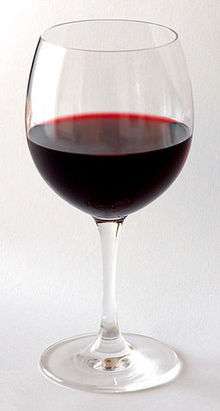
- An alcoholic beverage made by fermenting the juice of grapes.
- Wine is stronger than beer.
- She ordered some wine for the meal.
- 1962 (quoting 1381 text), Hans Kurath & Sherman M. Kuhn, eds., Middle English Dictionary, Ann Arbor, Mich.: University of Michigan Press, ISBN 978-0-472-01044-8, page 1242:
- dorrẹ̅, dōrī adj. & n. […] cook. glazed with a yellow substance; pome(s ~, sopes ~. […] 1381 Pegge Cook. Recipes page 114: For to make Soupys dorry. Nym onyons […] Nym wyn […] toste wyte bred and do yt in dischis, and god Almande mylk.
- An alcoholic beverage made by fermenting the juice of fruits or vegetables other than grapes, usually preceded by the type of the fruit or vegetable; for example, "dandelion wine".
- (countable) A serving of wine.
- I'd like three beers and two wines, please.
- (uncountable) A dark purplish red colour; the colour of red wine.
- wine colour:
Hyponyms
- See also Thesaurus:wine
Derived terms
|
Related terms
|
|
|
Descendants
Translations
|
|


|
|
|
|
Verb
wine (third-person singular simple present wines, present participle wining, simple past and past participle wined)
- (transitive) To entertain with wine.
- 1919, Lee Meriwether, The War Diary of a Diplomat, Dodd, Mead and Company, page 159:
- Neither Major Wadhams nor I is accustomed to being wined and dined by perfect strangers who do not even present themselves, but leave servants to do the honors, consequently to both of us our present situation smacks of romance and adventure;
- 1919, Lee Meriwether, The War Diary of a Diplomat, Dodd, Mead and Company, page 159:
- (intransitive) To drink wine.
- 1839, Thomas Chandler Haliburton, The Clockmaker
- I rushed into my cabin, coffeed, wined, and went to bed sobbing.
- 1839, Thomas Chandler Haliburton, The Clockmaker
Translations
References
See also
Etymology 2
This etymology is incomplete. You can help Wiktionary by elaborating on the origins of this term.
Noun
wine (uncountable)
- (nonstandard, Britain) wind
- 1850, James Orchard Halliwell, A Dictionary of Archaic and Provincial Words, Obsolete Phrases, Proverbs, and Ancient Customs, from the Fourteenth Century:
- Vor voices rawze upon tha wine
- 1869, James Jennings, The Dialect of the West of England, particularly Somersetshire:
- Aw how sholl I tell o’m—vor âll pirty maidens
- When I pass’d ’em look’d back—ther smill rawze on tha wine.
- Aw how sholl I tell o’m—vor âll pirty maidens
- 1850, James Orchard Halliwell, A Dictionary of Archaic and Provincial Words, Obsolete Phrases, Proverbs, and Ancient Customs, from the Fourteenth Century:
Middle High German
Etymology
From Old High German wini.
Noun
wine m
Old English
Etymology
From Proto-Germanic *winiz, from Proto-Indo-European *wenh₁- (“love, desire”). Cognate with Old Frisian wine, Old Saxon wini, Old High German wini, Old Norse vinr (Danish ven, Swedish vän, Norwegian ven/venn). Related to Old English wynn, wenian. The Indo-European root is also the source of Latin venus, Proto-Celtic *wenja- (Old Irish fine, Breton gwenn, Welsh gwen).
Pronunciation
- IPA(key): /ˈwi.ne/
Noun
wine m
- (poetic) friend, lord, protector
- wine werigmod, wætre beflowen on dreorsele: sad-hearted friend, surrounded by water in his lonely hall. (The Wife’s Lament)
Declension
Derived terms
|
|
|
Descendants
- Middle English: wine
References
- wine in John R. Clark Hall (1916) A Concise Anglo-Saxon Dictionary, 2nd ed.