braid
English
Etymology 1
From Middle English braiden, breiden, bræiden, from Old English breġdan (“to move quickly, pull, shake, swing, throw (wrestling), draw (sword), drag; bend, weave, braid, knit, join together; change color, vary, be transformed; bind, knot; move, be pulled; flash”), from Proto-Germanic *bregdaną (“to flicker, flutter, jerk, tug, twitch, flinch, move, swing”), from Proto-Indo-European *bʰrēḱ-, *bʰrēǵ- (“to shine, shimmer”). Cognate with Scots brade, braid (“to move quickly or suddenly”), Saterland Frisian braidje (“to knit”), West Frisian breidzje, Dutch breien (“to knit”), Low German breiden, Bavarian bretten (“to move quickly, twitch”), Icelandic bregða (“to move quickly, jerk”).
Alternative forms
Pronunciation
- IPA(key): /bɹeɪd/
Audio (US) (file) - Homophone: brayed
- Rhymes: -eɪd
Verb
braid (third-person singular simple present braids, present participle braiding, simple past braided, past participle braided or (obsolete) browden)
- (obsolete, transitive) To make a sudden movement with, to jerk.
- (archaic, intransitive) To start into motion.
- (transitive) To weave together, intertwine (strands of fibers, ribbons, etc.); to arrange (hair) in braids.
- Milton
- Braid your locks with rosy twine.
- Milton
- To mix, or make uniformly soft, by beating, rubbing, or straining, as in preparing food.
- (obsolete) To reproach; to upbraid.
- 1608, William Shakespeare, Pericles, Prince of Tyre, [Act 1, scene 1]:
- Great King, / Few love to hear the ſins they love to act, / ’Twould braid your ſelf too near for me to tell it […]
- 1608, William Shakespeare, Pericles, Prince of Tyre, [Act 1, scene 1]:
Derived terms
Translations
|
|
Noun
braid (plural braids)
- (obsolete) A sudden movement; a jerk, a wrench. [11th-17thc.]
- 1485 July 31, Thomas Malory, “(please specify the chapter)”, in [Le Morte Darthur], (please specify the book number), [London: William Caxton], OCLC 71490786; republished as H[einrich] Oskar Sommer, editor, Le Morte Darthur, London: Published by David Nutt, in the Strand, 1889, OCLC 890162034:, Bk.XII, ch.ii:
- And than in a brayde Sir Launcelot brake hys chaynes of hys legges and of hys armys (and in the brakynge he hurte hys hondys sore) […].
- 1561, Thomas Sackville, Ferrex and Porrex, Act IV, scene ii, lines 1274–7:
- He fixt vpon my face, which to my death / Will neuer part fro me, when with a braide / A deepe fet sigh he gaue, and therewithall / Clasping his handes, to heauen he cast his sight.
-
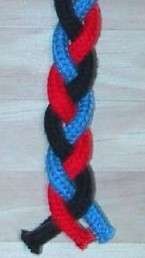
- A weave of three or more strands of fibers, ribbons, cords or hair often for decoration. [from 16thc.]
- A fancy; freak; caprice.
- (Can we find and add a quotation of R. Hyrde to this entry?)
Translations
|
|
Further reading
- braid in Webster’s Revised Unabridged Dictionary, G. & C. Merriam, 1913
- braid in The Century Dictionary, The Century Co., New York, 1911

Etymology 2
Adjective
braid (comparative more braid, superlative most braid)
- (obsolete) deceitful
- Shakespeare
- Since Frenchmen are so braid, / Marry that will, I live and die a maid.
- Shakespeare
Anagrams
Gothic
Romanization
braid
- Romanization of 𐌱𐍂𐌰𐌹𐌳
Irish
Noun
braid f
- (archaic, dialectal) dative singular of brad
Mutation
| Irish mutation | ||
|---|---|---|
| Radical | Lenition | Eclipsis |
| braid | bhraid | mbraid |
| Note: Some of these forms may be hypothetical. Not every possible mutated form of every word actually occurs. | ||