brood
English
Etymology
From Middle English brood, brod, from Old English brōd (“brood; foetus; breeding, hatching”), from Proto-Germanic *brōduz (“heat, breeding”), from Proto-Indo-European *bʰrē- (“breath, mist, vapour, steam”). Cognate with Scots brude, brod (“brood, child, offspring”), Dutch broed (“spawn”), Low German Broot (“spawn, breeding, incubation, brood”), German Brut (“breeding, progeny, incubation, brood”).
Pronunciation
- enPR: bro͞od, IPA(key): /bɹuːd/
Audio (US) (file) - Homophones: brewed
- Rhymes: -uːd
Noun
brood (plural broods)
- The young of certain animals, especially a group of young birds or fowl hatched at one time by the same mother.
- Bible, Luke xiii. 34
- As a hen doth gather her brood under her wings.
- Bible, Luke xiii. 34
- (uncountable) The young of any egg-laying creature, especially if produced at the same time.
- The eggs and larvae of social insects such as bees, ants and some wasps, especially when gathered together in special brood chambers or combs within the colony.
- The children in one family.
- That which is bred or produced; breed; species.
- 1598, George Chapman translation of Homer's Iliad, Book 2:
- ... flocks of the airy brood,
- Cranes, geese or long-neck'd swans, here, there, proud of their pinions fly ...
- 1609, William Shakespeare, Sonnet 19:
- Devouring Time, blunt thou the lion's paws,
- And make the earth devour her own sweet brood ...
- 1598, George Chapman translation of Homer's Iliad, Book 2:
- (mining) Heavy waste in tin and copper ores.
Derived terms
Derived terms
Translations
the young of certain animals
the young of any egg-laying creature
the children in one family
- The translations below need to be checked and inserted above into the appropriate translation tables, removing any numbers. Numbers do not necessarily match those in definitions. See instructions at Wiktionary:Entry layout#Translations.
See also
Verb
brood (third-person singular simple present broods, present participle brooding, simple past and past participle brooded)
- (transitive) To keep an egg warm to make it hatch.
- In some species of birds, both the mother and father brood the eggs.
- (transitive) To protect.
- Under the rock was a midshipman fish, brooding a mass of eggs.
- (intransitive) To dwell upon moodily and at length (with adpositions generally being either about or over)
- He sat brooding about the upcoming battle, fearing the outcome.
- Nathaniel Hawthorne
- Brooding over all these matters, the mother felt like one who has evoked a spirit.
- Tennyson
- when with downcast eyes we muse and brood
- 1925, F. Scott Fitzgerald, chapter IX, in The Great Gatsby, New York, N.Y.: Charles Scribner's Sons, OCLC 884653065; republished New York, N.Y.: Charles Scribner's Sons, 1953, →ISBN:
- And as I sat there brooding on the old, unknown world, I thought of Gatsby’s wonder when he first picked out the green light at the end of Daisy’s dock. He had come a long way to this blue lawn and his dream must have seemed so close that he could hardly fail to grasp it.
Translations
to keep an egg warm
to protect
to dwell upon moodily and at length
Further reading

Anagrams
Afrikaans
Etymology
Pronunciation
- IPA(key): /brʊət/
Noun
brood (plural brode)
Dutch
Etymology
From Middle Dutch brôot, from Old Dutch *brōd, from Proto-Germanic *braudą.
Pronunciation
- Rhymes: -oːt
- IPA(key): /broːt/
audio (file)
Noun
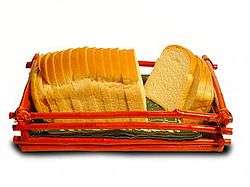
Gesneden wittebrood
Sliced white bread
Sliced white bread
brood n (plural broden, diminutive broodje n)
- bread
- (by extension) Similar bakery product or other baked dish
- (metonymically) livelihood, especially in expressions like dagelijks brood
Derived terms
Derived terms
|
|
|
|
Anagrams
Middle English
Alternative forms
Etymology
From Old English brād.
Adjective
brood
Descendants
This article is issued from
Wiktionary.
The text is licensed under Creative Commons - Attribution - Sharealike.
Additional terms may apply for the media files.