芙蓉
Chinese
| phonetic | |||
|---|---|---|---|
| simp. and trad. (芙蓉) |
芙 | 蓉 | |
| alt. forms | 夫容 | ||
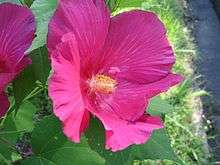
芙蓉 (1).
Etymology
Possibly derived from a word meaning “to blossom”; compare 敷榮/敷荣 (fūróng, “to blossom”) (Zhang and Shen, 2014).
Pronunciation 1
Noun
芙蓉
- cotton rose; hibiscus (Hibiscus mutabilis)
- 製芰荷以為衣兮,集芙蓉以為裳。 [Classical Chinese, trad.]
- From: The Verses of Chu, 4th century BCE – 2nd century CE
- Zhì jìhé yǐwéi yī xī, jí fúróng yǐwéi shāng. [Pinyin]
- I fashioned the flowers of the water-caltrops and lotus to adorn my upper garment; I collected those of the hibiscus for my lower one.
制芰荷以为衣兮,集芙蓉以为裳。 [Classical Chinese, simp.]
- Alternative name for 荷花 (héhuā, “lotus”).
Synonyms
Derived terms
Proper noun
芙蓉
- (~區) Furong District, Changsha, Hunan Province, China
- (~市) Seremban (Fu Yong), capital of Negeri Sembilan, Malaysia
Pronunciation 2
Proper noun
芙蓉
- Alternative name for 梅山 (“Meishan Town, Nan'an, Fujian”).
Descendants
This article is issued from
Wiktionary.
The text is licensed under Creative Commons - Attribution - Sharealike.
Additional terms may apply for the media files.