朝
| ||||||||
Translingual
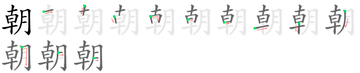
| Stroke order | |||
|---|---|---|---|
 | |||
Han character
朝 (radical 74, 月+8, 12 strokes, cangjie input 十十月 (JJB), four-corner 47420, composition ⿰龺月)
Derived characters
References
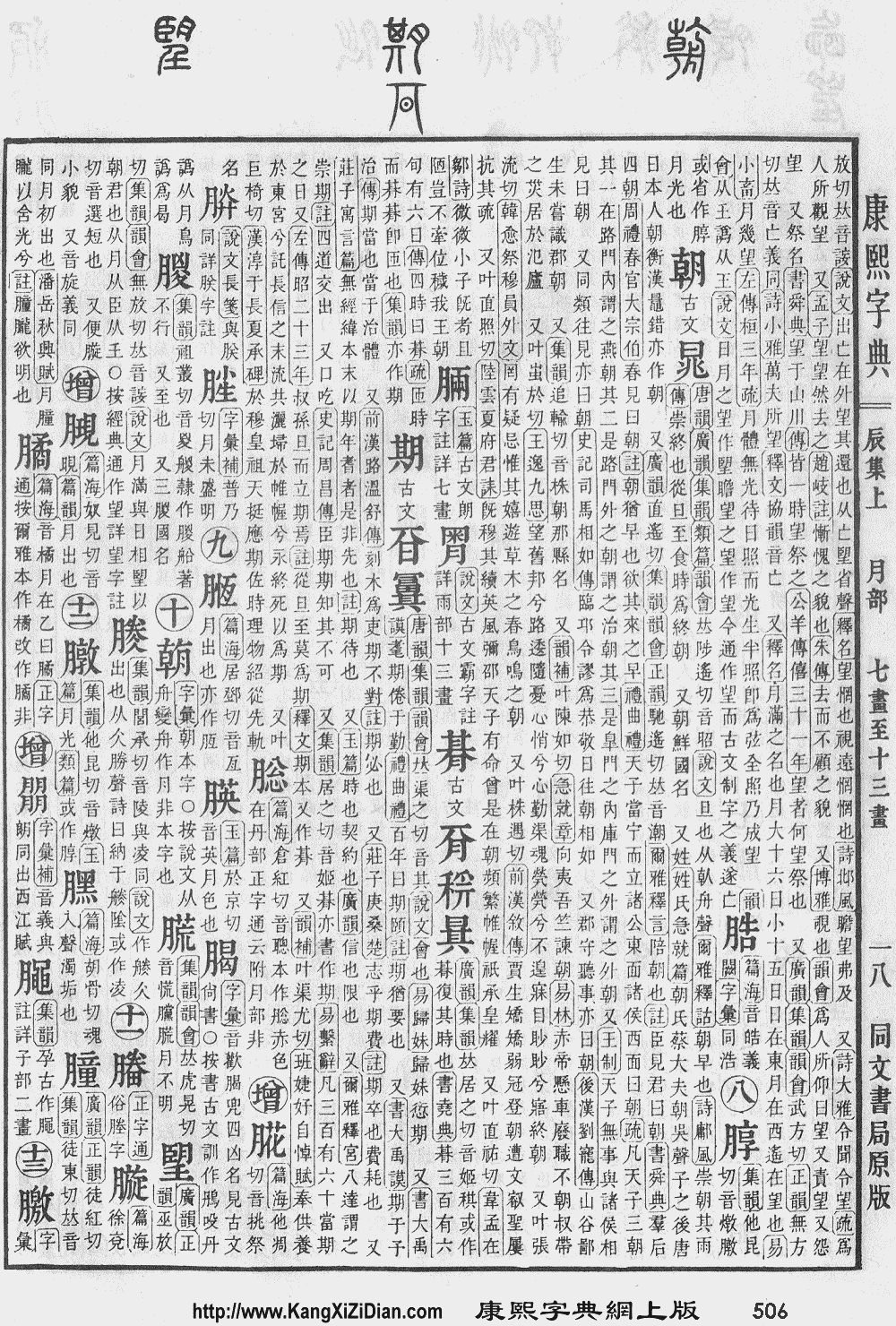
- KangXi: page 506, character 3
- Dai Kanwa Jiten: character 14374
- Dae Jaweon: page 885, character 7
- Hanyu Da Zidian: volume 3, page 2084, character 8
- Unihan data for U+671D
Chinese
| simp. and trad. |
朝 | |
|---|---|---|
Glyph origin
| Characters in the same phonetic series (朝) (Zhengzhang, 2003) | |
|---|---|
| Old Chinese | |
| 嘲 | *ʔr'eːw |
| 廟 | *mrews |
| 朝 | *ʔr'ew, *r'ew |
| 潮 | *r'ew |
Phono-semantic compound (形聲, OC *ʔr'ew, *r'ew) : phonetic 𠦝 + semantic 月.
The left side (𠦝) is a pictograph of the sunrise as seen through some trees. The right-side 月 is actually a graphical corruption of 川 (“river”).
Etymology
“Morning” > “perform the morning ceremony” > “to go/come to court; to have an audience”. Derivative: 潮 (OC *r'ew, “morning tide”).
Perhaps related to Thai เพรา (prao, “morning”) (Manomaivibool, 1975).
Pronunciation 1
Definitions
朝
Compounds
|
|
Pronunciation 2
Definitions
朝
- (historical) to wish elders or seniors good health; to visit (a senior person)
- (historical) to have an audience with the king or emperor; to perform the morning ceremony; to go to court
- to make a pilgrimage to; to pay homage to
- to assemble; to call; to gather
- imperial court
- dynasty (line of rulers)
- emperor's reign; period ruled by a particular emperor or king
- government; imperial government
- affairs of the state
- (historical) courtier class
- towards; to; on; facing
- Short for 朝鮮/朝鲜 (Cháoxiǎn, “North Korea; Korea”).
Compounds
|
|
|
Japanese
Kanji
Readings
Compounds
Etymology 1
| Kanji in this term |
|---|
| 朝 |
| あさ Grade: 2 |
| kun’yomi |
Historically a day was split into two halves:
- afternoon cycle: 朝 (asa), 昼 (hiru), 夕 (yū)
- evening cycle: 夕べ (yūbe), 宵 (yoi), 夜中 (yonaka), 暁 (akatsuki), 朝 (ashita)
While asa and ashita represent the same time period, asa was associated with beginning of the afternoon and ashita was associated with the end of the night. Both terms share an initial as- and are likely etymologically related.
Pronunciation
Noun
Etymology 2
| Kanji in this term |
|---|
| 朝 |
| あした Grade: 2 |
| kun’yomi |
Historically a day was split into two halves:
- afternoon cycle: 朝 (asa), 昼 (hiru), 夕 (yū)
- evening cycle: 夕べ (yūbe), 宵 (yoi), 夜中 (yonaka), 暁 (akatsuki), 朝 (ashita)
While asa and ashita represent the same time period, asa was associated with beginning of the afternoon and ashita was associated with the end of the night. Both terms share an initial as- and are likely etymologically related.
Pronunciation
Alternative forms
Noun
朝 (hiragana あした, rōmaji ashita)
Usage notes
The spelling 明日 is much more common in modern Japanese.
Etymology 3
Suffix
| Kanji in this term |
|---|
| 朝 |
| ちょう Grade: 2 |
| on’yomi |
- dynasty
- ブルボン朝
- the Bourbon Dynasty
References
Korean
Hanja
朝 • (jo) (hangeul 조, revised jo, McCune–Reischauer cho, Yale co)
Vietnamese
Han character
朝 (triều, chầu, chào, tràu, trều, triêu, chiều, giàu, giầu, trào)
- Non-Sino-Vietnamese reading of Chinese 朝 (“to meet; to meet a senior person; to attend the emperor's audience”; SV: triều).
- Related to chầu (“to attend an audience; to attend upon (in design)”). (Nguyễn Văn Khang. Từ ngoại lai trong tiếng Việt, 2007)
Readings
- Nôm: chào, chầu, chiều, chìu, dèo, giàu, trào, trèo, triêu, triều
References
- Thiều Chửu : Hán Việt Tự Điển Hà Nội 1942
- Trần Văn Chánh: Từ Điển Hán Việt NXB Trẻ, Ho Chi Minh Ville, 1999
- Vũ Văn Kính: Đại Tự Điển Chữ Nôm, NXB Văn Nghệ, Ho Chi Minh Ville