court
English
Etymology
Borrowed from Old French cort, curt, from Latin cortem (accusative of cors), ultimately from cohors. Doublet of cohort.

Pronunciation
- (Received Pronunciation) IPA(key): /kɔːt/
- (General American) IPA(key): /kɔɹt/
- (rhotic, without the horse–hoarse merger) IPA(key): /ko(ː)ɹt/
- (non-rhotic, without the horse–hoarse merger) IPA(key): /koət/
Audio (UK) (file) Audio (US) (file) - Homophone: caught (non-rhotic with the horse-hoarse merger)
- Rhymes: -ɔː(ɹ)t
Noun
court (plural courts)
- An enclosed space; a courtyard; an uncovered area shut in by the walls of a building, or by different building; also, a space opening from a street and nearly surrounded by houses; a blind alley.
- The girls were playing in the court.
- Alfred Tennyson (1809-1892)
- And round the cool green courts there ran a row / Of cloisters.
- Thomas Macaulay (1800-1859)
- Goldsmith took a garret in a miserable court.
- (US, Australia) A street with no outlet, a cul-de-sac.
- (social) Royal society.
- The residence of a sovereign, prince, nobleman, or ether dignitary; a palace.
- The noblemen visited the queen in her court.
- William Shakespeare (1564-1616)
- This our court, infected with their manners, / Shows like a riotous inn.
- The collective body of persons composing the retinue of a sovereign or person high in authority; all the surroundings of a sovereign in his regal state.
- The queen and her court traveled to the city to welcome back the soldiers.
- William Shakespeare (1564-1616)
- My lord, there is a nobleman of the court at door would speak with you.
- Sir Walter Scott (1771-1832)
- Love rules the court, the camp, the grove.
- Any formal assembling of the retinue of a sovereign.
- Thomas Macaulay (1800-1859)
- The princesses held their court within the fortress.
- Thomas Macaulay (1800-1859)
- The residence of a sovereign, prince, nobleman, or ether dignitary; a palace.
- Attention directed to a person in power; conduct or address designed to gain favor; courtliness of manners; civility; compliment; flattery.
- Edmund Spenser (c.1552–1599)
- No solace could her paramour entreat / Her once to show, ne court, nor dalliance.
- John Evelyn (1620-1706)
- I went to make my court to the Duke and Duchess of Newcastle.
- Edmund Spenser (c.1552–1599)
- (law) The administration of law.
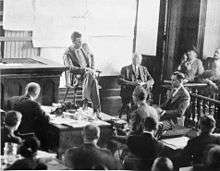
- The hall, chamber, or place, where justice is administered.
- Many famous criminals have been put on trial in this court.
- The persons officially assembled under authority of law, at the appropriate time and place, for the administration of justice; an official assembly, legally met together for the transaction of judicial business; a judge or judges sitting for the hearing or trial of cases.
- The court started proceedings at 11 o'clock.
- 2012 August 21, Pilkington, Ed, “Death penalty on trial: should Reggie Clemons live or die?”, in The Guardian:
- Next month, Clemons will be brought before a court presided over by a "special master", who will review the case one last time. The hearing will be unprecedented in its remit, but at its core will be a simple issue: should Reggie Clemons live or die?
- A tribunal established for the administration of justice.
- The judge or judges; as distinguished from the counsel or jury, or both.
- The session of a judicial assembly.
- The court is now in session.
- Any jurisdiction, civil, military, or ecclesiastical.
- The hall, chamber, or place, where justice is administered.
- (sports) A place arranged for playing the games of tennis, basketball, squash, badminton, volleyball and some other games; also, one of the divisions of a tennis court.
- The local sports club has six tennis courts and two squash courts.
- The shuttlecock landed outside the court.
- 1935, George Goodchild, chapter 5, in Death on the Centre Court:
- By one o'clock the place was choc-a-bloc. […] The restaurant was packed, and the promenade between the two main courts and the subsidiary courts was thronged with healthy-looking youngish people, drawn to the Mecca of tennis from all parts of the country.
Derived terms
|
Translations
|
|
|
|
|
|
|
|
- The translations below need to be checked and inserted above into the appropriate translation tables, removing any numbers. Numbers do not necessarily match those in definitions. See instructions at Wiktionary:Entry layout#Translations.
Verb
court (third-person singular simple present courts, present participle courting, simple past and past participle courted)
- (transitive) To seek to achieve or win.
- He was courting big new accounts that previous salesman had not attempted.
- Prescott
- They might almost seem to have courted the crown of martyrdom.
- De Quincey
- Guilt and misery […] court privacy and solitude.
- (transitive) To risk (a consequence, usually negative).
- He courted controversy with his frank speeches.
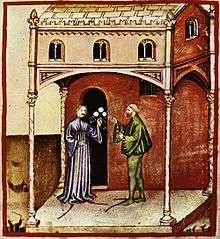
- (transitive) To try to win a commitment to marry from.
- Shakespeare
- If either of you both love Katharina […] / Leave shall you have to court her at your pleasure.
- Shakespeare
- (transitive) To engage in behavior leading to mating.
- The bird was courting by making an elaborate dance.
- (transitive) To attempt to attract.
- Macaulay
- By one person, hovever, Portland was still assiduously courted.
- Macaulay
- (transitive) To attempt to gain alliance with.
- (intransitive) To engage in activities intended to win someone's affections.
- She's had a few beaus come courting.
- (intransitive) To engage in courtship behavior.
- In this season, you can see many animals courting.
- (transitive) To invite by attractions; to allure; to attract.
- Tennyson
- A well-worn pathway courted us / To one green wicket in a privet hedge.
- Tennyson
Translations
|
|
Further reading

Anagrams
French
Pronunciation
Etymology 1
From Old French curt, from Latin curtus, ultimately from Proto-Indo-European *(s)ker-.
Adjective
court (feminine singular courte, masculine plural courts, feminine plural courtes)
Related terms
Etymology 2
See etymology on the main entry.
Verb
court
- third-person singular present indicative of courir
Etymology 3
Noun
court m (plural courts)
- (tennis) court
Further reading
- “court” in le Trésor de la langue française informatisé (The Digitized Treasury of the French Language).
Middle English
Etymology
Borrowed from Old French cort, curt.
Noun
court (plural courts)
- court (place, building)
Descendants
- English: court
Middle French
Etymology
From Old French cort, curt, etc.
Noun
court f (plural cours)
- court (of law)
- court (of a palace, etc.)
- 1488, Jean Dupré, Lancelot du Lac:
- quant il les eut faictes si les scella & les bailla a la damoiselle pour porter l'andemain a court
- when he had written them [the letters] he then sealed them and entrusted them to the lady to take them tomorrow to the court
- quant il les eut faictes si les scella & les bailla a la damoiselle pour porter l'andemain a court
-
Descendants
- French: cour
References
- Godefroy, Frédéric, Dictionnaire de l'ancienne langue française et de tous ses dialectes du IXe au XVe siècle (1881) (court, supplement)
Norman
Etymology
From Old French curt, from Latin curtus (“shortened, short”).
Adjective
court m
Derived terms
- courtément (adverb)
Walloon
Etymology
From Old French curt, from Latin curtus.
Adjective
court m (feminine singular courte, masculine plural courts, feminine plural courtes)