lime
English
Pronunciation
- IPA(key): /laɪm/
- Rhymes: -aɪm
Etymology 1
From Middle English lyme, lym, lime, from Old English līm, from Proto-Germanic *līmaz. Cognate with Danish lim (from Old Norse lím), Dutch lijm, German Leim; Latin limus (“mud”).
Noun
lime (countable and uncountable, plural limes)
- (chemistry) Any inorganic material containing calcium, usually calcium oxide (quicklime) or calcium hydroxide (slaked lime).
- 1952, L.F. Salzman, Building in England, page 149.
- Lime, which is the product of the burning of chalk or limestone, might be bought ready burnt, or it could be burnt in kilns specially constructed in the neighbourhood of the building operations.
- 1952, L.F. Salzman, Building in England, page 149.
- (poetic) Any gluey or adhesive substance; something which traps or captures someone; sometimes a synonym for birdlime.
- 1610, The Tempest, by William Shakespeare, act 4 scene 1
- Monster, come, put some lime upon your fingers, and away with the rest.
- (Can we date this quote?) Wordsworth
- Like the lime that foolish birds are caught with.
- 1610, The Tempest, by William Shakespeare, act 4 scene 1
Derived terms
- limewater
- limeworking
- quicklime
- slaked lime
- soda lime
- unslaked lime
- white lime
Translations
|
|
- The translations below need to be checked and inserted above into the appropriate translation tables, removing any numbers. Numbers do not necessarily match those in definitions. See instructions at Wiktionary:Entry layout#Translations.
|
|
See also
Verb
lime (third-person singular simple present limes, present participle liming, simple past and past participle limed)
- (transitive) To treat with calcium hydroxide or calcium oxide (lime).
- Rudyard Kipling, The Land
- If I were you, I'd lime.
- Rudyard Kipling, The Land
- (transitive) To smear with birdlime.
- (rare) To ensnare, catch, entrap.
- 1599, William Shakespeare, Much Ado About Nothing, Act 3 Scene 1
- URSULA. She's lim'd, I warrant you: we have caught her, madam.
- HERO. If it prove so, then loving goes by haps:
- Some Cupid kills with arrows, some with traps.
- 1599, William Shakespeare, Much Ado About Nothing, Act 3 Scene 1
- (rare) To ensnare, catch, entrap.
- (transitive) To apply limewash.
Translations
|
|
Etymology 2

An alteration of line, a variant form of lind.
Noun
lime (plural limes)
- A deciduous tree of the genus Tilia, especially Tilia × europaea; the linden tree, or its wood.
- 1871–72, George Eliot, Middlemarch, Chapter 3
- she looked before her, not consciously seeing, but absorbing into the intensity of her mood, the solemn glory of the afternoon with its long swathes of light between the far-off rows of limes, whose shadows touched each other.
- 1871–72, George Eliot, Middlemarch, Chapter 3
Usage notes
- Both this and the citrus are trees with fragrant flowers, but this is more temperate and the citrus is more tropical and subtropical. Outside of Europe and adjoining parts of Asia, the citrus sense is much more common
Related terms
Translations
Etymology 3
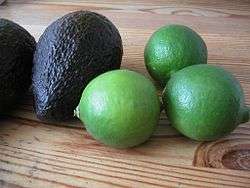
From French lime, from Spanish lima, from Arabic لِيمَة (līma), from Persian لیمو (līmū).
Noun
lime (plural limes)
- Any of several green citrus fruit, somewhat smaller and sharper-tasting than a lemon.
- Any of the trees that bear limes, especially key lime, Citrus aurantiifolia.
- A light, somewhat yellowish, green colour associated with the fruits of a lime tree.
- lime colour:
- web lime colour:
Usage notes
Both this and the linden are trees with fragrant flowers, but the linden is more temperate and this is more tropical and subtropical. Outside of Europe and adjoining parts of Asia, this sense is much more common.
Derived terms
|
|
|
Translations
|
|
|
|
|
- The translations below need to be checked and inserted above into the appropriate translation tables, removing any numbers. Numbers do not necessarily match those in definitions. See instructions at Wiktionary:Entry layout#Translations.
See also
| Colors in English · colors, colours (layout · text) | |||||
|---|---|---|---|---|---|
| white | gray, grey | black | brown | ||
| pink | red ; crimson | orange | yellow ; cream | ||
| lime | green | cyan ; teal | |||
| azure, sky blue | blue | violet ; indigo | magenta ; purple | ||
Adjective
lime (not comparable)
- Containing lime or lime juice.
- Having the aroma or flavor of lime.
- Lime-green.
Translations
Etymology 4
Back-formation from limer.
Verb
lime (third-person singular simple present limes, present participle liming, simple past and past participle limed)
Etymology 5
Noun
lime (plural limes)
- Alternative form of lyam (a leash)
Derived terms
Etymology 6
From lime (the fruit) as comparable to lemon (a more explicit rating in anime).
Noun
lime (plural limes)
- (anime) A fan fiction story that stops short of full, explicit descriptions of sexual activity, with the intimacy left to the reader's imagination.
Anagrams
Danish
Noun
lime c (singular definite limen, plural indefinite lime or limes)
- lime (fruit)
Inflection
Verb
lime (imperative lim, infinitive at lime, present tense limer, past tense limede, perfect tense har limet)
- to glue
Finnish
Pronunciation
- IPA(key): /ˈlime/
- Hyphenation: li‧me
Noun
lime
- lime (citrus tree and its fruit)
Usage notes
This word is now more common than limetti but still regarded as less correct by, for example, the Kielitoimiston sanakirja. Some inflected forms are indeed quite awkward to use.
Declension
| Inflection of lime (Kotus type 8/nalle, no gradation) | |||
|---|---|---|---|
| nominative | lime | limet | |
| genitive | limen | limejen | |
| partitive | limeä | limejä | |
| illative | limeen | limeihin | |
| singular | plural | ||
| nominative | lime | limet | |
| accusative | nom. | lime | limet |
| gen. | limen | ||
| genitive | limen | limejen limeinrare | |
| partitive | limeä | limejä | |
| inessive | limessä | limeissä | |
| elative | limestä | limeistä | |
| illative | limeen | limeihin | |
| adessive | limellä | limeillä | |
| ablative | limeltä | limeiltä | |
| allative | limelle | limeille | |
| essive | limenä | limeinä | |
| translative | limeksi | limeiksi | |
| instructive | — | limein | |
| abessive | limettä | limeittä | |
| comitative | — | limeineen | |
Synonyms
Anagrams
French
Pronunciation
- IPA(key): /lim/
audio (une lime) (file)
Etymology 1
Noun
lime f (plural limes)
- file (tool)
Derived terms
Etymology 2
From Spanish lima, from Arabic لِيمَة (līma).
Noun
lime f (plural limes)
- lime (fruit, tree)
Synonyms
- (fruit): limette
Anagrams
Further reading
- “lime” in le Trésor de la langue française informatisé (The Digitized Treasury of the French Language).
Galician
Verb
lime
- first-person singular present subjunctive of limar
- third-person singular present subjunctive of limar
Italian
Pronunciation
- IPA(key): /ˈli.me/
Etymology 1
Noun
lime f pl
- plural of lima
Etymology 2
Borrowed from English.
Noun
lime m (invariable)
- lime (citrus tree)
Anagrams
Latin
Pronunciation
- (Classical) IPA(key): /ˈliː.me/, [ˈliː.mɛ]
Noun
līme
- vocative singular of līmus
Middle English
Etymology 1
From Old English lim.
Noun
lime
- Alternative form of lyme (“limb”)
Etymology 2
From Old English līm.
Noun
lime
- Alternative form of lyme (“quicklime”)
Norwegian Bokmål
Etymology 1
From Persian لیمو (līmū), via Arabic لِيمَة (līma), Spanish lima, and English lime
Noun
lime m (definite singular limen, indefinite plural limer, definite plural limene)
- a lime (citrus fruit)
Etymology 2
Verb
lime (imperative lim, present tense limer, passive limes, simple past lima or limet or limte, past participle lima or limet or limt, present participle limende)
Related terms
- lim (noun)
References
- “lime” in The Bokmål Dictionary.
Norwegian Nynorsk
Etymology
From Persian لیمو (līmū), via Arabic لِيمَة (līma), Spanish lima, and English lime
Noun
lime m (definite singular limen, indefinite plural limar, definite plural limane)
- a lime (citrus fruit)
Synonyms
- limett
References
- “lime” in The Nynorsk Dictionary.
Portuguese
Verb
lime
- first-person singular (eu) present subjunctive of limar
- third-person singular (ele and ela, also used with você and others) present subjunctive of limar
- third-person singular (você) affirmative imperative of limar
- third-person singular (você) negative imperative of limar
Spanish
Pronunciation
- IPA(key): /ˈlime/
Verb
lime