paste
English
Etymology
Borrowed from Middle French paste (modern pâte), from Old French paste, from Late Latin pasta, from Ancient Greek πάστα (pásta). Doublet of pasta.
Pronunciation
- IPA(key): /peɪst/
Audio (US) (file) - Rhymes: -eɪst
- Homophone: paced
Noun
paste (countable and uncountable, plural pastes)
- A soft moist mixture, in particular:
- (physics) A substance that behaves as a solid until a sufficiently large load or stress is applied, at which point it flows like a fluid
- A hard lead-containing glass, or an artificial gemstone made from this glass.
- (obsolete) Pasta.
- Tobias George Smollett (1766) Travels through France and Italy: Containing observations on character, customs, religion, government, police, commerce, arts, and antiquities. With a particular description of the town, territory, and climate of Nice. To which is added, A register of the weather, kept during a residence of eighteen months in that city, Volume 2 (travel), page 35: “This is likewise the market for their oil, and the paste called macaroni, of which they make a good quantity.”
- Arnaud Berquin (1792) The childrens' companion: or, entertaining instructor for the youth of both sexes; designed, to excite attention and inculcate virtue. Selected from the works of Berquin, Genlis, Day, and others, page 75 of 346: “Vermicelli for soups, is paste from Italy; so called because it looks like worms. My macaroni, paste from Italy—My salop, a root ground to powder—the root of one kind of orchis.”
- (mineralogy) The mineral substance in which other minerals are embedded.
Translations
a soft mixture
soft mixture used in making pastry
soft mixture of pounded foods
an adhesive paste
Verb
paste (third-person singular simple present pastes, present participle pasting, simple past and past participle pasted)
- (transitive) To stick with paste; to cause to adhere by or as if by paste.
- (intransitive, computing) To insert a piece of media (e.g. text, picture, audio, video, movie container etc.) previously copied or cut from somewhere else.
- (transitive, informal) To strike or beat someone or something.
- 1943, William Saroyan, The Human Comedy, chapter 23,
- He got up and pasted Byfield in the mouth.
- 1943, William Saroyan, The Human Comedy, chapter 23,
- (transitive, informal) To defeat decisively or by a large margin.
Translations
to cause to stick, adhere
to insert a piece of text
Anagrams
Dutch
Pronunciation
Audio (file)
Verb
paste
- singular past indicative and subjunctive of passen
Italian
Noun
paste f pl
- plural of pasta
Anagrams
Latin
Participle
paste
- vocative masculine singular of pastus
Old French
Etymology
From Late Latin pasta, from Ancient Greek πάστα (pásta).
Noun
paste m (oblique plural pastes, nominative singular pastes, nominative plural paste)
Derived terms
Descendants
References
- paste on the Anglo-Norman On-Line Hub
Portuguese
Verb
paste
- first-person singular (eu) present subjunctive of pastar
- third-person singular (ele and ela, also used with você and others) present subjunctive of pastar
- third-person singular (você) affirmative imperative of pastar
- third-person singular (você) negative imperative of pastar
Spanish
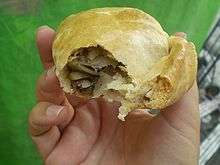
paste from Mexico City
Pronunciation
- IPA(key): /ˈpaste/, [ˈpast̪e]
Noun
paste m (plural pastes)
Alternative forms
- (loofah): paxte
Etymology 2
See etymology on the main entry.
Verb
paste
- Formal second-person singular (usted) imperative form of pastar.
- First-person singular (yo) present subjunctive form of pastar.
- Formal second-person singular (usted) present subjunctive form of pastar.
- Third-person singular (él, ella, also used with usted?) present subjunctive form of pastar.
Further reading
- “paste” in Diccionario de la lengua española, Vigésima tercera edición, Real Academia Española, 2014.
This article is issued from
Wiktionary.
The text is licensed under Creative Commons - Attribution - Sharealike.
Additional terms may apply for the media files.