大鹿
Chinese
big; great; huge; large; major; wide; deep; oldest; eldest; doctor |
deer | ||
|---|---|---|---|
| simp. and trad. (大鹿) |
大 | 鹿 | |
Pronunciation
Noun
大鹿
Japanese
Etymology 1
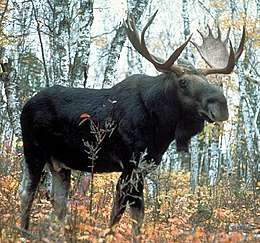
大鹿 (ōjika): a moose.
| Kanji in this term | |
|---|---|
| 大 | 鹿 |
| おお Grade: 1 |
しか > じか Grade: S |
| kun’yomi | |
From 大 (ō, “big”) + 鹿 (shika, “deer”).[1][2] The shika changes to jika as an instance of rendaku (連濁).
Alternative forms
Pronunciation
Noun
大鹿 (hiragana おおじか, katakana オオジカ, rōmaji ōjika, historical hiragana おほじか)
Usage notes
As with many terms that name organisms, this term is often spelled in katakana, especially in biological contexts, as オオジカ. Not to be confused with 牡鹿 (ojika, “stag; buck”).
Proper noun
大鹿 (hiragana おおじか, rōmaji Ōjika)
- a district in Itami, Hyōgo Prefecture
Etymology 2
| Kanji in this term | |
|---|---|
| 大 | 鹿 |
| おお Grade: 1 |
しか Grade: S |
| kun’yomi | |
Compound of 大 (ō, “big”) + 鹿 (shika, “deer”). Appears to be a variation on ōjika above.
Pronunciation
Proper noun
Etymology 3
| Kanji in this term | |
|---|---|
| 大 | 鹿 |
| だい Grade: 1 |
ろく Grade: S |
| on’yomi | |
Probably coined in Japan from Middle Chinese-derived components, as 大 (dai, “great”) + 鹿 (roku, “stag, male deer”).
Pronunciation
Noun
大鹿 (hiragana だいろく, rōmaji dairoku)
- (shogi) the great stag, a piece in taikyoku shogi
References
This article is issued from
Wiktionary.
The text is licensed under Creative Commons - Attribution - Sharealike.
Additional terms may apply for the media files.