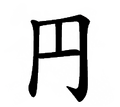
円
 | ||||||||
Translingual
| Japanese stroke order | |||
|---|---|---|---|
 | |||
| Traditional | 圓 |
|---|---|
| Shinjitai | 円 |
| Simplified | 圆 |
Etymology
Japanese simplification of 圓, via a simplified character similar to 𠮚.[1]
Han character
円 (radical 13, 冂+2, 4 strokes, cangjie input 月卜 (BY) or 月中一 (BLM), composition ⿵冂丄)
References
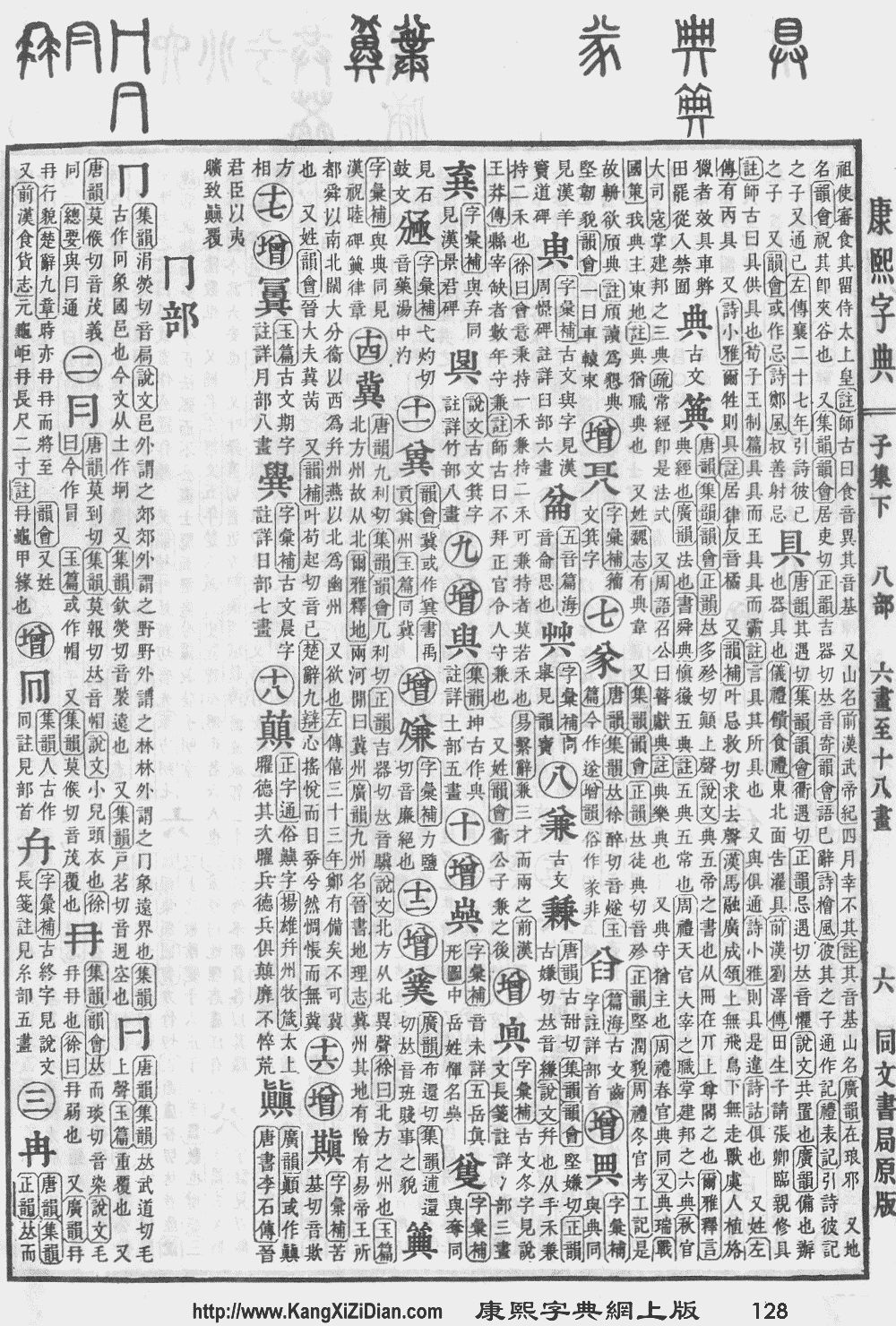
- KangXi: not present, would follow page 128, character 35
- Dai Kanwa Jiten: character 1513
- Dae Jaweon: page 289, character 17
- Hanyu Da Zidian: volume 1, page 96, character 18
- Unihan data for U+5186
Chinese
| For pronunciation and definitions of 円 – see 圓 (“circle; circular; round; etc.”). (This character, 円, is a variant form of 圓.) |
Usage notes
In contemporary usage, classifier for the Japanese yen.
Japanese
| 円 | |
| 圓 |
Kanji
(grade 1 “Kyōiku” kanji, shinjitai kanji, kyūjitai form 圓)
Readings
Compounds
- 円運動 (en undō, “circular motion”)
- 円蓋 (engai, “dome”)
- 円滑 (enkatsu)
- 円罐 (enkama)
- 円環 (enkan)
- 円規 (enki, “compass”, drawing tool)
- 円丘 (enkyū)
- 円鏡 (enkyō)
- 円形 (enkei)
- 円弧 (enko)
- 円光 (enkō)
- 円寂 (enjaku)
- 円周 (enshū, “circle”)
- 円熟 (enjuku)
- 円心 (enshin)
- 円陣 (enjin)
- 円錐 (ensui)
- 円窓 (ensō)
- 円卓 (entaku)
- 円柱 (enchū)
- 円虫類 (enchūrui)
- 円頂 (enchō)
- 円転 (enten)
- 円筒 (entō)
- 円盤 (enban)
- 円舞 (enbu)
- 円墳 (enpun)
- 円偏光 (en henkō)
- 円本 (Enpon)
- 円満 (enman)
- 円顱 (enro)
- 一円 (ichien)
- 団円 (dan'en)
- 楕円, 橢円 (daen), 長円 (chōen, “oval, ellipse”)
- 方円 (hōen)
- 遊動円木 (yūdōenboku)
- 卵円孔 (ran'enkō)
- 円居 (madoi)
Etymology 1
| Kanji in this term |
|---|
| 円 |
| えん Grade: 1 |
| on’yomi |
/wen/ → /eɴ/
From Middle Chinese 圓 (MC ziuᴇn, ɦˠiuᴇn), with the original sense of "circle, roundness".
The yen sense came much later in the Meiji period, a borrowing Mandarin 圓 (yuán), itself from 銀圓 (yínyuán, “round silver object(s), especially a piece of eight”). Compare Chinese 元 (yuán, “yuan”) and Korean 원 (won, “Korean won”).
The yen became the official currency of Japan in 1871, succeeding the 両 (ryō) and the 文 (mon).
Pronunciation
Noun
円 (shinjitai kanji, kyūjitai kanji 圓, hiragana えん, rōmaji en, historical hiragana ゑん)
- a round or circular object; a circle; roundness
- (mathematics) circle (set of all points in plane at a given distance and at a given point)
- Synonym: 円周 (enshū)
- yen: the official currency of Japan
- one yen is equal to 100 銭 (sen)
- Synonym: 円貨 (enka)
Derived terms
- (circle):
See also
Proper noun
円 (shinjitai kanji, kyūjitai kanji 圓, hiragana えん, rōmaji En, historical hiragana ゑん)
- a surname.
- a female given name.
Etymology 2
| Kanji in this term |
|---|
| 円 |
| まろ Grade: 1 |
| kun’yomi |
⟨maro2⟩ → /maro/
From Old Japanese.
Noun
円 (shinjitai kanji, kyūjitai kanji 圓, hiragana まろ, rōmaji maro)
Derived terms
Etymology 3
| Kanji in this term |
|---|
| 円 |
| まる Grade: 1 |
| kun’yomi |
/maro/ → /maru/
Sound shift from maro above.
Pronunciation
Noun
円 (shinjitai kanji, kyūjitai kanji 圓, hiragana まる, rōmaji maru)
Derived terms
Prefix
円 (shinjitai kanji, kyūjitai kanji 圓, hiragana まる, rōmaji maru-)
Proper noun
円 (shinjitai kanji, kyūjitai kanji 圓, hiragana まる, rōmaji Maru)
- a surname.
- a unisex given name.
Etymology 4
Various nanori readings.
Proper noun
円 (hiragana つぶら, rōmaji Tsubura)
- a surname.
- a female given name.
円 (hiragana のどか, rōmaji Nodoka)
- a female given name.
円 (shinjitai kanji, kyūjitai kanji 圓, hiragana まどか, rōmaji Madoka)
- a surname.
- a female given name.
円 (hiragana まろか, rōmaji Maroka)
- a female given name.
円 (hiragana まろし, rōmaji Maroshi)
- a unisex given name.
円 (hiragana みつ, rōmaji Mitsu)
- a female given name.
円 (hiragana めぐる, rōmaji Meguru)
- a female given name.
References
Korean
| Hanja in this term |
|---|
| 円 |
Hanja
円 • (en) (hangeul 엔)
Usage notes
This is the only character whose pronunciation is from modern Japanese, not from Classical Chinese.
References
Vietnamese
Han-Nom Character
円 = viên