kaleidoscope
See also: kaléidoscope
English
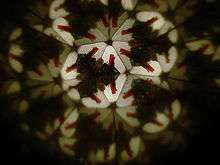
A design seen in the kaleidoscope
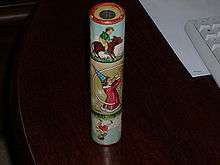
The tube of a kaleidoscope
Alternative forms
Etymology
From Ancient Greek καλός (kalós, “beautiful”) + εἶδος (eîdos, “shape”) (compare -oid) + -scope. Coined 1817, by David Brewster, its inventor.[1]
Figurative sense of “constantly changing pattern” attested 1819 by Lord Byron, who had received a kaleidoscope from his publisher.[1]
Noun
kaleidoscope (plural kaleidoscopes)
- A tube of mirrors containing loose coloured beads etc. that is rotated to produce a succession of symmetrical designs.
- A constantly changing set of colours, or other things.
Derived terms
Translations
tube of mirrors rotated to produce symmetrical designs
|
|
constantly changing set
|
|
Further reading
-

Verb
kaleidoscope (third-person singular simple present kaleidoscopes, present participle kaleidoscoping, simple past and past participle kaleidoscoped)
- (intransitive) To move in shifting patterns.
References
- 1 2 “kaleidoscope” in Douglas Harper, Online Etymology Dictionary, 2001–2018.
This article is issued from
Wiktionary.
The text is licensed under Creative Commons - Attribution - Sharealike.
Additional terms may apply for the media files.