upe
Guaraní
Pronoun
upe
Latgalian
Noun
upe f
Latvian
Etymology
In principle, from Proto-Baltic *apē-, from Proto-Indo-European *h₂ep-, *h₂op-, *h₂op (“(flowing) water, river”). Cognates include Lithuanian ùpė, dialectal ũpė, upìs, ùpis, Old Prussian ape (“river”), apus (“(water) well”), Sudovian upa (“river”), Hittite ẖap(a) (“river”), Sanskrit आपः (āpaḥ, “water (plural)”), Tocharian A, Tocharian B āp (“water”). The u in Latvian upe (and Lithuanian upė), instead of the expected a, as in the Old Prussian cognate, is difficult to explain. Some suggest that upe was influenced by other words (e.g., Old Prussian wupyan (“cloud”)), others that it is not cognate with Old Prussian ape, but rather a reflex of Proto-Indo-European *eup-, *ūp-, *up- (“to call, to cry, to yell”), or then a specific Eastern Baltic word without a Proto-Indo-European etymology.[1]
Noun
upe f (5th declension)
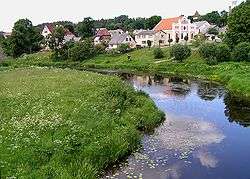
- (geography) river (permanent watercourse)
- strauja, lēna upe ― fast, slow river
- kalnu, līdzenumu upe ― mountain, lowland river
- upes gultne ― riverbed
- upes ieleja ― river valley
- upes baseins ― river basin
- upju sistēma ― river system
- upes pietekas ― river tributaries
- upes ieteka, grīva ― river estuary, mouth
- upes izteka ― river source, headwaters
- upes augštece, lejtece ― upriver, downriver
- upju transports ― fluvial transportation
- upju kuģniecība ― river lines
-
Declension
References
- ↑ Karulis, Konstantīns (1992), “upe”, in Latviešu Etimoloģijas Vārdnīca (in Latvian), Rīga: AVOTS, →ISBN
Lithuanian
Pronunciation
Noun
upè f
- instrumental singular form of upė.
Noun
ùpe f
Spanish
Verb
upe