arm
English
| Picture dictionary | ||
|---|---|---|
| ||
|


Pronunciation
Etymology 1
From Middle English arm, from Old English earm (“arm”), from Proto-Germanic *armaz (“arm”), from Proto-Indo-European *h₂(e)rmos (“a fitting, joint”), a suffixed form of *h₂er- (“to join, fit together”).
Akin to Dutch arm, German Arm, Yiddish אָרעם (orem), Norwegian and Swedish arm. Indo-European cognates include Latin armus (“the uppermost part of the arm, shoulder”), Armenian արմունկ (armunk, “elbow”), Ancient Greek ἁρμός (harmós, “joint, shoulder”) and ἅρμα (hárma, “wagon, chariot”), Avestan 𐬀𐬭𐬨𐬀 (arma), Old Persian [script needed] (arma).
Noun
arm (plural arms)
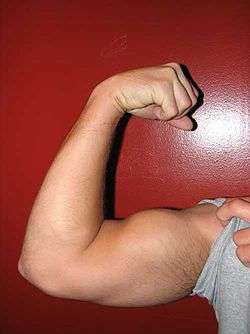
- The portion of the upper human appendage, from the shoulder to the wrist and sometimes including the hand.
- 1963, Margery Allingham, chapter 19, in The China Governess:
- When Timothy and Julia hurried up the staircase to the bedroom floor, where a considerable commotion was taking place, Tim took Barry Leach with him. He had him gripped firmly by the arm, since he felt it was not safe to let him loose, and he had no immediate idea what to do with him.
- She stood with her right arm extended and her palm forward to indicate “Stop!”
-
- (anatomy) The extended portion of the upper limb, from the shoulder to the elbow.
- The arm and forearm are parts of the upper limb in the human body.
- A limb, or locomotive or prehensile organ, of an invertebrate animal.
- the arms of an octopus
- A long, narrow, more or less rigid part of an object extending from the main part or centre of the object, such as the arm of an armchair, a crane, a pair of spectacles or a pair of compasses.
- The robot arm reached out and placed the part on the assembly line.
- (geography) A bay or inlet off a main body of water.
- Shelburne Bay is an arm of Lake Champlain.
- A branch of an organization.
- the cavalry arm of the military service
- (figuratively) Power; might; strength; support.
- the arm of the law
- the secular arm
- Bible, Isa. lii. 1
- To whom is the arm of the Lord revealed?
- (baseball, slang) A pitcher
- The team needs to sign another arm in the offseason.
- (genetics) One of the two parts of a chromosome.
- A group of patients in a medical trial.
Derived terms
|
|
Translations
|
|
|
Verb
arm (third-person singular simple present arms, present participle arming, simple past and past participle armed) (obsolete)
- To take by the arm; to take up in one's arms.
- Shakespeare
- And make him with our pikes and partisans / A grave: come, arm him.
- Two N. Kins
- Arm your prize; / I know you will not lose him.
- Shakespeare
- To supply with arms or limbs.
- Beaumont and Fletcher
- His shoulders broad and strong, / Armed long and round.
- Beaumont and Fletcher
Etymology 2
From Middle English arm (“poor, wretched”), from Old English earm (“poor, miserable, pitiful, wretched”), from Proto-Germanic *armaz (“poor”), from Proto-Indo-European *erm- (“poor, ill”).
Adjective
arm (comparative armer or more arm, superlative armest or most arm)
- (Britain dialectal, chiefly Scotland) Poor; lacking in riches or wealth.
- He's neither poor nor arm.
- (Britain dialectal, chiefly Scotland) To be pitied; pitiful; wretched.
References
Derived terms
Etymology 3
Back-formation from arms, from Middle English armes, from Old French armes, from Latin arma (“weapons”), from Proto-Indo-European *ar-mo-, a suffixed form of *h₂er- (“to fit together”), hence ultimately cognate with etymology 1.
Noun
arm (plural arms)
- (usually used in the plural) A weapon.
- 1883, Robert Louis Stevenson, Treasure Island
- The next thing I laid hold of was a brace of pistols, and as I already had a powder horn and bullets, I felt myself well supplied with arms.
- 1883, Robert Louis Stevenson, Treasure Island
- (in the plural) heraldic bearings or insignia
- The Duke's arms were a sable gryphon rampant on an argent field.
Usage notes
- Capitalized, the word is often used in the names of pubs, taverns and the like.
Synonyms
- See also Thesaurus:weapon
Derived terms
|
|
|
Translations
|
|
Verb
arm (third-person singular simple present arms, present participle arming, simple past and past participle armed)
- To supply with armour or (later especially) weapons.
- To prepare a tool or a weapon for action; to activate.
- Remember to arm an alarm system.
- To cover or furnish with a plate, or with whatever will add strength, force, security, or efficiency.
- to arm the hit of a sword; to arm a hook in angling
- (figuratively) To furnish with means of defence; to prepare for resistance; to fortify, in a moral sense.
- Bible, 1 Peter iv. 1
- Arm yourselves […] with the same mind.
- Bible, 1 Peter iv. 1
- To fit (a magnet) with an armature.
Synonyms
- (furnish with weapons): beweapon
Derived terms
Translations
|
|
Anagrams
Afrikaans
Etymology
Noun
arm (plural arms)
Cimbrian
Noun
arm m (plural èrme)
Adjective
arm
Derived terms
References
- “arm” in Umberto Martello Martalar, Alfonso Bellotto, Dizionario della lingua Cimbra dei Setti Communi vicentini, 1st edition, 1974.
Danish
Pronunciation
- IPA(key): /arm/, [ɑːˀm]
Etymology 1
From Old Norse armr (“arm”), from Proto-Germanic *armaz, from Proto-Indo-European *h₁ar-mo- (“arm”).
Noun
arm c (singular definite armen, plural indefinite arme)
Inflection
Etymology 2
From Old Norse armr (“arm, poor”), from Proto-Germanic *armaz (“poor”).
Adjective
arm
Inflection
| Inflection of arm | |||
|---|---|---|---|
| Positive | Comparative | Superlative | |
| Common singular | arm | — | —2 |
| Neuter singular | armt | — | —2 |
| Plural | arme | — | —2 |
| Definite attributive1 | arme | — | — |
| 1) When an adjective is applied predicatively to something definite, the corresponding "indefinite" form is used. 2) The "indefinite" superlatives may not be used attributively. | |||
Further reading

Dutch
| Picture dictionary | ||
|---|---|---|
| ||
|
Pronunciation
- IPA(key): /ɑrm/
Audio (file) - Rhymes: -ɑrm
Etymology 1
From Middle Dutch arm, from Old Dutch arm, from Proto-Germanic *armaz (“arm”), from Proto-Indo-European *h₂(e)rmos (“a fitting, joint”), a suffixed form of *h₂er- (“to join, fit together”). Cognate to Avestan 𐬀𐬭𐬨𐬀 (arma) and Old Persian [script needed] (arma).
Noun
arm m (plural armen, diminutive armpje n)
- arm
- Iemand kneep in mijn arm.
- Someone pinched my arm.
Derived terms
Etymology 2
From Middle Dutch arm, from Old Dutch arm, from Proto-Germanic *armaz, perhaps from Proto-Indo-European *h₂erH- (“to be sparse”).
Adjective
arm (comparative armer, superlative armst)
Inflection
| Inflection of arm | ||||
|---|---|---|---|---|
| uninflected | arm | |||
| inflected | arme | |||
| comparative | armer | |||
| positive | comparative | superlative | ||
| predicative/adverbial | arm | armer | het armst het armste | |
| indefinite | m./f. sing. | arme | armere | armste |
| n. sing. | arm | armer | armste | |
| plural | arme | armere | armste | |
| definite | arme | armere | armste | |
| partitive | arms | armers | — | |
Derived terms
|
Anagrams
Estonian
Etymology 1
From Proto-Finnic *arpi; arm is an irregular variant of the root; the expected arb can be seen in dialects.
Noun
arm (genitive armi, partitive armi)
Declension
| singular | plural | |
|---|---|---|
| nominative | arm | armid |
| genitive | armi | armide |
| partitive | armi | arme / armisid |
| illative | armi / armisse | armidesse |
| inessive | armis | armides |
| elative | armist | armidest |
| allative | armile | armidele |
| adessive | armil | armidel |
| ablative | armilt | armidelt |
| translative | armiks | armideks |
| terminative | armini | armideni |
| essive | armina | armidena |
| abessive | armita | armideta |
| comitative | armiga | armidega |
Etymology 2
Most likely derived from armas. Cognate to Votic armo (“grace, mercy”).
Noun
arm (genitive armu, partitive armu)
Declension
| singular | plural | |
|---|---|---|
| nominative | arm | armud |
| genitive | armu | armude |
| partitive | armu | arme / armusid |
| illative | armu / armusse | armudesse |
| inessive | armus | armudes |
| elative | armust | armudest |
| allative | armule | armudele |
| adessive | armul | armudel |
| ablative | armult | armudelt |
| translative | armuks | armudeks |
| terminative | armuni | armudeni |
| essive | armuna | armudena |
| abessive | armuta | armudeta |
| comitative | armuga | armudega |
German
Etymology
From Proto-Germanic *armaz, perhaps from Proto-Indo-European *h₂erH- (“to be sparse”).
Pronunciation
- IPA(key): [ʔaʁm]
Audio (Germany) (file) Audio (Austria) (file)
Adjective
arm (comparative ärmer, superlative am ärmsten)
- poor (having little money)
- poor (to be pitied)
- arm dran sein ― to have bad luck
- lieber arm dran als Arm ab ― better to have poor luck than to have no more arm (language game)
- low (having a small amount)
Declension
| number & gender | singular | plural | |||
|---|---|---|---|---|---|
| masculine | feminine | neuter | all genders | ||
| predicative | er ist arm | sie ist arm | es ist arm | sie sind arm | |
| strong declension (without article) |
nominative | armer | arme | armes | arme |
| genitive | armen | armer | armen | armer | |
| dative | armem | armer | armem | armen | |
| accusative | armen | arme | armes | arme | |
| weak declension (with definite article) |
nominative | der arme | die arme | das arme | die armen |
| genitive | des armen | der armen | des armen | der armen | |
| dative | dem armen | der armen | dem armen | den armen | |
| accusative | den armen | die arme | das arme | die armen | |
| mixed declension (with indefinite article) |
nominative | ein armer | eine arme | ein armes | (keine) armen |
| genitive | eines armen | einer armen | eines armen | (keiner) armen | |
| dative | einem armen | einer armen | einem armen | (keinen) armen | |
| accusative | einen armen | eine arme | ein armes | (keine) armen | |
| number & gender | singular | plural | |||
|---|---|---|---|---|---|
| masculine | feminine | neuter | all genders | ||
| predicative | er ist ärmer | sie ist ärmer | es ist ärmer | sie sind ärmer | |
| strong declension (without article) |
nominative | ärmerer | ärmere | ärmeres | ärmere |
| genitive | ärmeren | ärmerer | ärmeren | ärmerer | |
| dative | ärmerem | ärmerer | ärmerem | ärmeren | |
| accusative | ärmeren | ärmere | ärmeres | ärmere | |
| weak declension (with definite article) |
nominative | der ärmere | die ärmere | das ärmere | die ärmeren |
| genitive | des ärmeren | der ärmeren | des ärmeren | der ärmeren | |
| dative | dem ärmeren | der ärmeren | dem ärmeren | den ärmeren | |
| accusative | den ärmeren | die ärmere | das ärmere | die ärmeren | |
| mixed declension (with indefinite article) |
nominative | ein ärmerer | eine ärmere | ein ärmeres | (keine) ärmeren |
| genitive | eines ärmeren | einer ärmeren | eines ärmeren | (keiner) ärmeren | |
| dative | einem ärmeren | einer ärmeren | einem ärmeren | (keinen) ärmeren | |
| accusative | einen ärmeren | eine ärmere | ein ärmeres | (keine) ärmeren | |
| number & gender | singular | plural | |||
|---|---|---|---|---|---|
| masculine | feminine | neuter | all genders | ||
| predicative | er ist am ärmsten | sie ist am ärmsten | es ist am ärmsten | sie sind am ärmsten | |
| strong declension (without article) |
nominative | ärmster | ärmste | ärmstes | ärmste |
| genitive | ärmsten | ärmster | ärmsten | ärmster | |
| dative | ärmstem | ärmster | ärmstem | ärmsten | |
| accusative | ärmsten | ärmste | ärmstes | ärmste | |
| weak declension (with definite article) |
nominative | der ärmste | die ärmste | das ärmste | die ärmsten |
| genitive | des ärmsten | der ärmsten | des ärmsten | der ärmsten | |
| dative | dem ärmsten | der ärmsten | dem ärmsten | den ärmsten | |
| accusative | den ärmsten | die ärmste | das ärmste | die ärmsten | |
| mixed declension (with indefinite article) |
nominative | ein ärmster | eine ärmste | ein ärmstes | (keine) ärmsten |
| genitive | eines ärmsten | einer ärmsten | eines ärmsten | (keiner) ärmsten | |
| dative | einem ärmsten | einer ärmsten | einem ärmsten | (keinen) ärmsten | |
| accusative | einen ärmsten | eine ärmste | ein ärmstes | (keine) ärmsten | |
Antonyms
Derived terms
|
|
Related terms
Further reading
- arm in Duden online
Icelandic
Noun
arm
- indefinite accusative singular of armur
Irish
Etymology
From Old Irish arm n (“armour, battle-equipment, panoply; weapon; army”), from Latin arma.
Pronunciation
Noun
arm m (genitive singular airm, nominative plural airm)
Declension
First declension
|
Bare forms:
|
Forms with the definite article:
|
Derived terms
|
|
|
Mutation
| Irish mutation | |||
|---|---|---|---|
| Radical | Eclipsis | with h-prothesis | with t-prothesis |
| arm | n-arm | harm | not applicable |
| Note: Some of these forms may be hypothetical. Not every possible mutated form of every word actually occurs. | |||
Further reading
- "arm" in Foclóir Gaeilge-Béarla, An Gúm, 1977, by Niall Ó Dónaill.
- “arm” in Dictionary of the Irish Language, Royal Irish Academy, 1913–76.
- “arm” in Foclóir Gaeḋilge agus Béarla, Irish Texts Society, 1st ed., 1904, by Patrick S. Dinneen, page 40.
- Finck, F. N. (1899), Die araner mundart, Marburg: Elwert’sche Verlagsbuchhandlung, vol. II, p. 10.
- Entries containing “arm” in English-Irish Dictionary, An Gúm, 1959, by Tomás de Bhaldraithe.
- Entries containing “arm” in New English-Irish Dictionary by Foras na Gaeilge.
Jersey Dutch
Etymology
Adjective
arm
- poor
- 1912, Tijdschrift voor Nederlandsche taal— en letterkunde, volumes 31-32, page 309:
- Hai waz nît tevrêde täus en dârkîs tû râkni arm. […]
- He was not content at home and therefore he became poor. […]
- 1912, Tijdschrift voor Nederlandsche taal— en letterkunde, volumes 31-32, page 309:
Livonian
Etymology
Noun
arm
Manx
Etymology
From Old Irish arm n (“armour, battle-equipment, panoply; weapon; army”), from Latin arma.
Noun
arm m (genitive singular arm, plural armyn)
Verb
arm (verbal noun armal, past participle garmal)
References
- “arm” in Dictionary of the Irish Language, Royal Irish Academy, 1913–76.
Middle Dutch
Alternative forms
- arem, aerm
Pronunciation
- IPA(key): /arm/
Etymology 1
From Old Dutch arm, from Proto-Germanic *armaz.
Noun
arm m
Inflection
Descendants
Etymology 2
From Old Dutch arm, from Proto-Germanic *armaz.
Adjective
arm
- poor, having few possessions
- unfortunate, pitiable
Inflection
| Adjective | |||||
|---|---|---|---|---|---|
| Masculine | Feminine | Neuter | Plural | ||
| Nominative | Indefinite | arm | arme | arm | arme |
| Definite | arme | arme | |||
| Accusative | armen | arme | arme | arme | |
| Genitive | arms | armer | arms | armer | |
| Dative | armen | armer | armen | armen | |
Alternative forms
Descendants
Further reading
- “arm (I)”, in Vroegmiddelnederlands Woordenboek, 2000
- “arm (II)”, in Vroegmiddelnederlands Woordenboek, 2000
- “arm (I)”, in Middelnederlandsch Woordenboek, 1929
- “arm (II)”, in Middelnederlandsch Woordenboek, 1929
Middle English
Etymology 1
From Old English earm (“arm”), from Proto-Germanic *armaz (“arm”), from Proto-Indo-European *arəm- (“arm”).
Noun
arm (plural arms)
Descendants
- English: arm
Etymology 2
From Old English earm (“poor, wretched”), from Proto-Germanic *armaz (“poor”), from Proto-Indo-European *erm- (“poor, ill”).
Adjective
arm
Norwegian Bokmål
Etymology
Adjective
arm (neuter singular armt, definite singular and plural arme)
Noun
arm m (definite singular armen, indefinite plural armer, definite plural armene)
Derived terms
References
- “arm” in The Bokmål Dictionary.
Norwegian Nynorsk
Pronunciation
- IPA(key): /ɑrm/
Etymology 1
Adjective
arm (neuter singular armt, definite singular and plural arme)
Etymology 2
From Old Norse armr. Akin to English arm.
Noun
arm m (definite singular armen, indefinite plural armar, definite plural armane)
Derived terms
References
- “arm” in The Nynorsk Dictionary.
Old English
Alternative forms
Etymology
From Proto-Germanic *armaz (“arm”), whence also Old High German arm, Old Norse armr.
Noun
arm m
Old High German
Alternative forms
Pronunciation
- IPA(key): /arm/
Etymology 1
From Proto-Germanic *armaz, from Proto-Indo-European *h₂ermos, *h₂ŕ̥mos, whence also Old English arm, Old Norse armr.
Noun
arm m
Declension
Descendants
Etymology 2
From Proto-Germanic *armaz, whence also Old English earm, Old Norse armr.
Adjective
arm
Descendants
- German: arm
References
- Joseph Wright, An Old High German Primer
Old Saxon
Etymology 1
From Proto-Germanic *armaz, whence also Old English earm, Old Norse armr.
Noun
arm m
Declension
Descendants
Etymology 2
From Proto-Germanic *armaz, whence also Old English earm, Old Norse armr.
Adjective
arm (comparative armoro, superlative armost)
Declension
| Strong declension | ||||||
|---|---|---|---|---|---|---|
| gender | masculine | neuter | feminine | |||
| case | singular | plural | singular | plural | singular | plural |
| nominative | arm | arme | arm | arme | arm | armu |
| accusative | armana | arme | arm | arme | arma | armu |
| genitive | armes | armarō | armes | armarō | armaro | armarō |
| dative | armumu | armum | armumu | armum | armaro | armum |
| Weak declension | ||||||
| gender | masculine | neuter | feminine | |||
| case | singular | plural | singular | plural | singular | plural |
| nominative | armo | armu | arma | armu | arma | armu |
| accusative | armun | armun | arma | armun | armun | armun |
| genitive | armun | armonō | armun | armonō | armun | armonō |
| dative | armun | armum | armun | armum | armun | armum |
| gender | masculine | neuter | feminine | |||
|---|---|---|---|---|---|---|
| case | singular | plural | singular | plural | singular | plural |
| nominative | armoro | armoru | armora | armoru | armora | armoru |
| accusative | armorun | armorun | armora | armorun | armorun | armorun |
| genitive | armorun | armoronō | armorun | armoronō | armorun | armoronō |
| dative | armorun | armorum | armorun | armorum | armorun | armorum |
| Strong declension | ||||||
|---|---|---|---|---|---|---|
| gender | masculine | neuter | feminine | |||
| case | singular | plural | singular | plural | singular | plural |
| nominative | armost | armoste | armost | armoste | armost | armostu |
| accusative | armostana | armoste | armost | armoste | armosta | armostu |
| genitive | armostes | armostarō | armostes | armostarō | armostaro | armostarō |
| dative | armostumu | armostum | armostumu | armostum | armostaro | armostum |
| Weak declension | ||||||
| gender | masculine | neuter | feminine | |||
| case | singular | plural | singular | plural | singular | plural |
| nominative | armosto | armostu | armosta | armostu | armosta | armostu |
| accusative | armostun | armostun | armosta | armostun | armostun | armostun |
| genitive | armostun | armostonō | armostun | armostonō | armostun | armostonō |
| dative | armostun | armostum | armostun | armostum | armostun | armostum |
Descendants
Romanian
Etymology
From Latin armus, from Proto-Indo-European *h₂er- (“to join”).
Noun
arm n (plural armuri)
Related terms
See also
Scots
Etymology 1
From Middle English arm, from Old English earm (“arm”), from Proto-Germanic *armaz (“arm”), from Proto-Indo-European *arəm- (“arm”).
Alternative forms
Noun
arm (plural arms)
Etymology 2
From Middle English arm (“poor”), from Old English earm (“poor”), from Proto-Germanic *armaz (“poor”), from Proto-Indo-European *erm- (“poor, ill”).
Adjective
Verb
arm (third-person singular present arms, present participle armin, past armt, past participle armt)
- to crawl about miserably.
Etymology 3
From Middle English armen (“to arm”), from Old French armer (“to arm”), from Latin armō (“to arm”). More at arm.
Verb
arm (third-person singular present arms, present participle armin, past armt, past participle armt)
Etymology 4
From Old Norse armr (“wing of a body”).
Noun
arm (plural arms)
- the tail end of something, especially of fishing line
Scottish Gaelic
Etymology
From Old Irish arm n (“armour, battle-equipment, panoply; weapon; army”), from Latin arma.
Pronunciation
- IPA(key): /ˈaɾam/
Noun
arm m (genitive singular airm, plural airm)
Usage notes
- Arm is usually used to refer to the entire fighting force of a nation etc, while armailt usually refers to the an "army" involved in a particular battle etc:
- Arm Bhreatainn anns a' Chogadh Mhòr ― British Army in the First World War (the armed forces as a whole)
- armailt Bhreatannach ann an Afraga ― British Army in Africa
Derived terms
Related terms
Mutation
| Scottish Gaelic mutation | |||
|---|---|---|---|
| Radical | Eclipsis | with h-prothesis | with t-prothesis |
| arm | n-arm | h-arm | t-arm |
| Note: Some of these forms may be hypothetical. Not every possible mutated form of every word actually occurs. | |||
Further reading
- Faclair Gàidhlig Dwelly Air Loidhne, Dwelly, Edward (1911), Faclair Gàidhlig gu Beurla le Dealbhan/The Illustrated [Scottish] Gaelic-English Dictionary (10th ed.), Edinburgh: Birlinn Limited, →ISBN
- “arm” in Dictionary of the Irish Language, Royal Irish Academy, 1913–76.
Swedish
| Picture dictionary | ||
|---|---|---|
| ||
|
Pronunciation
audio (file)
Etymology 1
From Old Norse armr (“arm”), from Proto-Germanic *armaz, from Proto-Indo-European *h₂ermos, *h₂ŕ̥mos.
Noun
arm c
Declension
| Declension of arm | ||||
|---|---|---|---|---|
| Singular | Plural | |||
| Indefinite | Definite | Indefinite | Definite | |
| Nominative | arm | armen | armar | armarna |
| Genitive | arms | armens | armars | armarnas |
Derived terms
See also
Etymology 2
From Old Norse armr (“poor”), from Proto-Germanic *armaz, from Proto-Indo-European *h₂ermos, *h₂ŕ̥mos.
Adjective
arm
- (dated) poor; to be pitied
- (dated) poor; with no possessions or money
Declension
| Inflection of arm | |||
|---|---|---|---|
| Indefinite | Positive | Comparative | Superlative2 |
| Common singular | arm | armare | armast |
| Neuter singular | armt | armare | armast |
| Plural | arma | armare | armast |
| Definite | Positive | Comparative | Superlative |
| Masculine singular1 | arme | armare | armaste |
| All | arma | armare | armaste |
| 1) Only used, optionally, to refer to things whose natural gender is masculine. 2) The indefinite superlative forms are only used in the predicative. | |||
Derived terms
Anagrams
Yimas
Noun
arm
References
- The Papuan Languages of New Guinea (1986, →ISBN) (as arɨm)
- William A. Foley, The Yimas Language of New Guinea (1991, →ISBN), page 296:
- arm tark kantk-rm ima-na-tɨ-n
- water coldness with-water water S-DEF-becomes-PRES
- 'The water is getting cold.'