crane
English
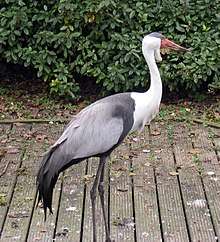
A crane (bird).
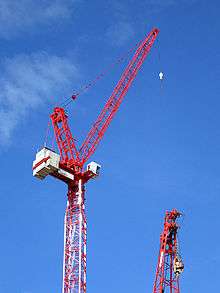
A crane (mechanical).
Etymology
From Middle English cran, from Old English cran (“crane”), from Proto-Germanic *kranô (“crane”), from Proto-Indo-European *gerh₂- (“to cry hoarsely”). Cognate with Scots cran (“crane”), Dutch kraan (“crane”), German Kran (“crane”).
Pronunciation
- IPA(key): /kɹeɪn/
Audio (US) (file) - Rhymes: -eɪn
Noun
crane (plural cranes)
- Any bird of the family Gruidae, large birds with long legs and a long neck which is extended during flight.
- 1876, "Burmah" in the Encyclopædia Britannica, 9th ed., Vol. IV, p. 552:
- Aquatic birds of various kinds are very numerous, such as geese, darters (Flotus melanogaster), scissor-bills (Rhynchops nigra), adjutants (Leptoptilos argala), pelicans, cormorants, cranes (Grus antigone, in Burmese gyoja), whimbrels, plovers, and ibises.
- 1876, "Burmah" in the Encyclopædia Britannica, 9th ed., Vol. IV, p. 552:
- (US, dialect) Ardea herodias, the great blue heron.
- A mechanical lifting machine or device, often used for lifting heavy loads for industrial or construction purposes.
- An iron arm with horizontal motion, attached to the side or back of a fireplace for supporting kettles etc. over the fire.
- A siphon, or bent pipe, for drawing liquors out of a cask.
- (nautical) A forked post or projecting bracket to support spars, etc.; generally used in pairs.
Hyponyms

Derived terms
Derived terms
|
|
|
|
Related terms
- cranberry, via Low German Kraan (“crane”)
Translations
bird
|
|
machinery
|
|
See also
Verb
crane (third-person singular simple present cranes, present participle craning, simple past and past participle craned)
- (transitive) To extend (one's neck).
- (Can we find and add a quotation of George Eliot to this entry?)
- (transitive) To raise or lower with, or as if with, a crane.
- Bates
- What engines, what instruments are used in craning up a soul, sunk below the centre, to the highest heavens.
- Massinger
- an upstart craned up to the height he has
- Bates
Translations
to extend (one's neck)
|
Anagrams
This article is issued from
Wiktionary.
The text is licensed under Creative Commons - Attribution - Sharealike.
Additional terms may apply for the media files.