等
| ||||||||
Translingual
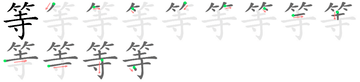
| Stroke order | |||
|---|---|---|---|
 | |||
Han character
等 (radical 118, 竹+6, 12 strokes, cangjie input 竹土木戈 (HGDI), four-corner 88341, composition ⿱⺮寺)
Derived characters
- 𠎬, 𬼑, 𠾡, 𫮨, 𢡩, 㩐, 𣛆, 𥢜, 𥪸, 𦅯, 𮖴, 𨅸, 𨬻, 𠟚, 𫂨, 𮆠, 𮆩
References
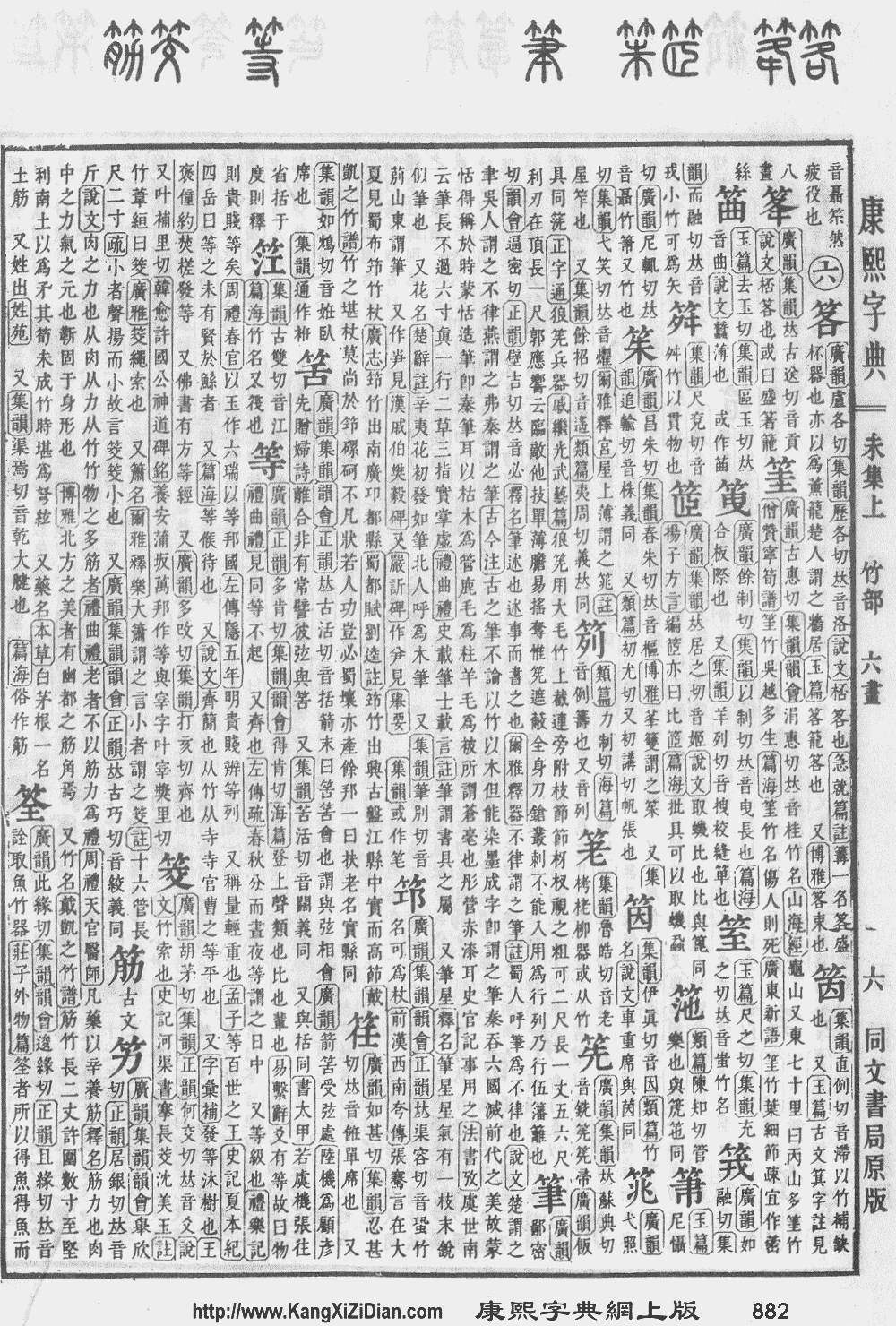
- KangXi: page 882, character 24
- Dai Kanwa Jiten: character 25992
- Dae Jaweon: page 1311, character 5
- Hanyu Da Zidian: volume 5, page 2962, character 1
- Unihan data for U+7B49
Chinese
| simp. and trad. |
等 | |
|---|---|---|
Glyph origin
| Characters in the same phonetic series (寺) (Zhengzhang, 2003) | |
|---|---|
| Old Chinese | |
| 等 | *tɯːʔ, *tɯːŋʔ |
| 待 | *dɯːʔ |
| 寺 | *ljɯs |
| 持 | *l'ɯ |
| 峙 | *dɯʔ |
| 痔 | *dɯʔ |
| 跱 | *dɯʔ |
| 歭 | *dɯʔ |
| 洔 | *dɯʔ, *tjɯʔ |
| 畤 | *dɯʔ, *tjɯʔ, *djɯʔ |
| 秲 | *dɯʔ, *djɯs |
| 庤 | *dɯʔ |
| 時 | *djɯ |
| 鰣 | *djɯ |
| 塒 | *djɯ |
| 蒔 | *djɯ, *djɯs |
| 榯 | *djɯ |
| 恃 | *djɯʔ |
| 侍 | *djɯs |
| 詩 | *hljɯ |
| 邿 | *hljɯ |
| 特 | *dɯːɡ |
Phono-semantic compound (形聲, OC *tɯːʔ, *tɯːŋʔ) : semantic 竹 (“bamboo”) + phonetic 寺 (OC *ljɯs).
竹 here refers to the bamboo strips used for writing (e.g. grading, classification) in ancient times. 寺 (OC *ljɯs) was originally used phonetically; the character was subsequently borrowed for another word with the same meaning, but with no phonetic resemblance to 寺.
Etymology
Pronunciation
Definitions
等
- † to arrange bamboo slips neatly
- rank; grade; class
- sort; kind; type
- to equate; to be equal
- and the like; and so on; etc.; et al.
- (literary or Hakka) Plural particle used after personal pronouns or nouns.
- to wait
- (Hakka) Progressive particle, used after verbs to indicate the continuation of an action or a state.
- A surname.
Compounds
|
|
|
Japanese
Kanji
Readings
Compounds
- 劣等 (rettō): inferior
Etymology 1
| Kanji in this term |
|---|
| 等 |
| とう Grade: 3 |
| on’yomi |
From Middle Chinese 等 (tongX, “step, grade”), extended to mean ... kind of thing.
Pronunciation
Adverb
Suffix
Usage notes
For the et cetera sense, the tō reading is somewhat more formal than the nado reading.
Etymology 2
| Kanji in this term |
|---|
| 等 |
| など Grade: 3 |
| kun’yomi |
From earlier なんど (nando, “etc., and so forth, and such like”), from earlier 何と (nani to, “etc., and so forth, and such like”, literally “and what”), itself a compound of 何 (nani, “what”) + と (to, “and”).[2][1][3]
Pronunciation
Adverb
- et cetera, that kind of thing, and so on
- 魚や肉等
- sakana ya niku nado
- things like fish or meat, fish and meat et cetera / and other such things
- 魚や肉等
Usage notes
For the et cetera sense, the tō reading is somewhat more formal than the nado reading.
Often spelled in hiragana, as など.
Etymology 3
| Kanji in this term |
|---|
| 等 |
| なんど Grade: 3 |
| kun’yomi |
From earlier 何と (nani to, “etc., and so forth, and such like”, literally “and what”), itself a compound of 何 (nani, “what”) + と (to, “and”).[2][1][3]
Pronunciation
Adverb
等 (hiragana なんど, rōmaji nando)
Usage notes
Largely superseded by the nado reading above.
May be spelled in hiragana, as なんど.
Etymology 4
| Kanji in this term |
|---|
| 等 |
| ら Grade: 3 |
| kun’yomi |
From Old Japanese.
Pronunciation
Suffix
- pluralizer
- 我、我等、これ、これ等
- ware, warera, kore, korera
- I, we, this, these
- 我、我等、これ、これ等
- qualifier, softener: around abouts
- 今日等、そこ等辺
- kyōra, sokora hen
- roughly today, that area around there
- 今日等、そこ等辺
Usage notes
Often spelled in hiragana, as ら.
References
Korean
Hanja
等 • (deung)
- This term needs a translation to English. Please help out and add a translation, then remove the text
{{rfdef}}.
Vietnamese
Han character
- This term needs a translation to English. Please help out and add a translation, then remove the text
{{rfdef}}.