star
English

Etymology
From Middle English sterre, from Old English steorra (“star”), from Proto-Germanic *sternô, *sternǭ (“star”), from Proto-Indo-European *h₂stḗr (“star”).
Cognate with Scots starn, North Frisian steer, West Frisian stjer, Saterland Frisian Stiern, Dutch ster, Luxembourgish Stär, German Stern, Yiddish שטערן (shtern), Vilamovian śtaom, Swedish stjärna, Norwegian stjerne, Icelandic stjarna, Gothic 𐍃𐍄𐌰𐌹𐍂𐌽𐍉 (stairnō), Spanish estrella, Portuguese estrela, Italian stella, Romanian stea, Occitan estela, Venetian stéła, Sicilian stidda, Sardinian isteddu, Mirandese streilha, Walloon sitoele, Romansch staila, Megleno-Romanian steau̯ă, Istriot stila, Istro-Romanian ste, Latin stēlla, Greek αστέρι (astéri), Ancient Greek ἀστήρ (astḗr), Old Armenian աստղ (astł), Persian ستاره (setâre), Tajik ситора (sitora), Pashto ستوری (storay), Mazanderani اساره (ëssâre), Northern Kurdish stêr, Central Kurdish ئەستێرە (estêre), Zazaki astare, Ossetian стъалы (st’aly), Hindi तारा (tārā), Urdu تارا (tārā), Punjabi ਤਾਰਾ (tārā), Gujarati તારો (tārō), Sanskrit तारा (tārā).
Pronunciation
Noun
star (plural stars)
- Any small luminous dot appearing in the cloudless portion of the night sky, especially with a fixed location relative to other such dots.
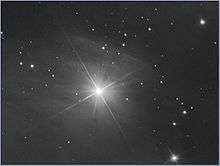
- (astronomy) A luminous celestial body, made up of plasma (particularly hydrogen and helium) and having a spherical shape. Depending on context the sun may or may not be included.
- (geometry) A concave polygon with regular, pointy protrusions and indentations, generally with five or six points.
- (acting) An actor in a leading role.
- Many Hollywood stars attended the launch party.
- An exceptionally talented or famous person, often in a specific field; a celebrity.
- His teacher tells us he is a star pupil.
- 1920, Mary Roberts Rinehart, Avery Hopwood, The Bat, chapterI:
- Star reporter, leg-man, cub, veteran gray in the trade—one and all they tried to pin the Bat like a caught butterfly to the front page of their respective journals—soon or late each gave up, beaten. He was news— […]—the brief, staccato recital of his career in the morgues of the great dailies grew longer and more incredible each day.
- (printing) An asterisk (*).
- A symbol used to rate hotels, films, etc. with a higher number of stars denoting better quality.
- A simple dance, or part of a dance, where a group of four dancers each put their right or left hand in the middle and turn around in a circle. You call them right-hand stars or left-hand stars, depending on the hand which is in the middle.
- (astrology) A planet supposed to influence one's destiny.
- What's in the stars for you today? Find out in our horoscope.
- William Shakespeare
- O malignant and ill-brooding stars.
- Joseph Addison
- Blesses his stars, and thinks it luxury.
- 1898, Winston Churchill, chapter 5, in The Celebrity:
- But Miss Thorn relieved the situation by laughing aloud, […] . By the time we reached the house we were thanking our stars she had come.
- A star-shaped ornament worn on the breast to indicate rank or honour.
- Alfred, Lord Tennyson
- On whom […] / Lavish Honour showered all her stars.
- Alfred, Lord Tennyson
- A composition of combustible matter used in the heading of rockets, in mines, etc., which, exploding in the air, presents a starlike appearance.
Synonyms
- (astronomy): * (abbreviation)
Hypernyms
- (astronomy): celestial body
Hyponyms
- Thesaurus:star
Derived terms
Descendants
- German: Star
Translations
|
|


|
|
|
|
|
|
- The translations below need to be checked and inserted above into the appropriate translation tables, removing any numbers. Numbers do not necessarily match those in definitions. See instructions at Wiktionary:Entry layout#Translations.
- The translations below need to be checked and inserted above into the appropriate translation tables, removing any numbers. Numbers do not necessarily match those in definitions. See instructions at Wiktionary:Entry layout#Translations.
|
|
- The translations below need to be checked and inserted above into the appropriate translation tables, removing any numbers. Numbers do not necessarily match those in definitions. See instructions at Wiktionary:Entry layout#Translations.
|
Verb
star (third-person singular simple present stars, present participle starring, simple past and past participle starred)
- (intransitive) To appear as a featured performer or headliner, especially in an entertainment program.
- (transitive) To feature a performer or a headliner, especially in a movie or an entertainment program.
- (transitive) To mark with a star or asterisk.
- (transitive) To set or adorn with stars, or bright, radiating bodies; to bespangle.
- Young
- A sable curtain starred with gold.
- Young
Translations
|
See also
Anagrams
Dutch
Etymology
From Middle Dutch star, from Old Dutch [Term?], from Proto-Germanic *staraz.
Pronunciation
Audio (file) - Rhymes: -ɑr
Adjective
star (comparative starder, superlative starst)
Inflection
| Inflection of star | ||||
|---|---|---|---|---|
| uninflected | star | |||
| inflected | starre | |||
| comparative | starder | |||
| positive | comparative | superlative | ||
| predicative/adverbial | star | starder | het starst het starste | |
| indefinite | m./f. sing. | starre | stardere | starste |
| n. sing. | star | starder | starste | |
| plural | starre | stardere | starste | |
| definite | starre | stardere | starste | |
| partitive | stars | starders | — | |
French
Etymology
From English.
Pronunciation
- IPA(key): /staʁ/
Audio (file)
Noun
star f (plural stars)
- star (celebrity)
- Elle est devenue star. - she's become a star.
Derived terms
Further reading
- “star” in le Trésor de la langue française informatisé (The Digitized Treasury of the French Language).
Anagrams
Italian
Etymology
Noun
star f (invariable)
- star (celebrity)
Mirandese
Etymology
Verb
star
- to be (indicates a temporary state)
See also
Norwegian Nynorsk
Noun
star m (definite singular staren, indefinite plural starar, definite plural starane)
- alternative form of stare
Serbo-Croatian
Etymology
From Proto-Slavic *starъ.
Pronunciation
- IPA(key): /stâr/
Adjective
stȁr (definite stȃrī, comparative stàrijī, Cyrillic spelling ста̏р)
Declension
| singular | masculine | feminine | neuter | |
|---|---|---|---|---|
| nominative | star | stara | staro | |
| genitive | stara | stare | stara | |
| dative | staru | staroj | staru | |
| accusative | inanimate animate |
star stara |
staru | staro |
| vocative | star | stara | staro | |
| locative | staru | staroj | staru | |
| instrumental | starim | starom | starim | |
| plural | masculine | feminine | neuter | |
| nominative | stari | stare | stara | |
| genitive | starih | starih | starih | |
| dative | starim(a) | starim(a) | starim(a) | |
| accusative | stare | stare | stara | |
| vocative | stari | stare | stara | |
| locative | starim(a) | starim(a) | starim(a) | |
| instrumental | starim(a) | starim(a) | starim(a) | |
| singular | masculine | feminine | neuter | |
|---|---|---|---|---|
| nominative | stari | stara | staro | |
| genitive | starog(a) | stare | starog(a) | |
| dative | starom(u/e) | staroj | starom(u/e) | |
| accusative | inanimate animate |
stari starog(a) |
staru | staro |
| vocative | stari | stara | staro | |
| locative | starom(e/u) | staroj | starom(e/u) | |
| instrumental | starim | starom | starim | |
| plural | masculine | feminine | neuter | |
| nominative | stari | stare | stara | |
| genitive | starih | starih | starih | |
| dative | starim(a) | starim(a) | starim(a) | |
| accusative | stare | stare | stara | |
| vocative | stari | stare | stara | |
| locative | starim(a) | starim(a) | starim(a) | |
| instrumental | starim(a) | starim(a) | starim(a) | |
| singular | masculine | feminine | neuter | |
|---|---|---|---|---|
| nominative | stariji | starija | starije | |
| genitive | starijeg(a) | starije | starijeg(a) | |
| dative | starijem(u) | starijoj | starijem(u) | |
| accusative | inanimate animate |
stariji starijeg(a) |
stariju | starije |
| vocative | stariji | starija | starije | |
| locative | starijem(u) | starijoj | starijem(u) | |
| instrumental | starijim | starijom | starijim | |
| plural | masculine | feminine | neuter | |
| nominative | stariji | starije | starija | |
| genitive | starijih | starijih | starijih | |
| dative | starijim(a) | starijim(a) | starijim(a) | |
| accusative | starije | starije | starija | |
| vocative | stariji | starije | starija | |
| locative | starijim(a) | starijim(a) | starijim(a) | |
| instrumental | starijim(a) | starijim(a) | starijim(a) | |
| singular | masculine | feminine | neuter | |
|---|---|---|---|---|
| nominative | najstariji | najstarija | najstarije | |
| genitive | najstarijeg(a) | najstarije | najstarijeg(a) | |
| dative | najstarijem(u) | najstarijoj | najstarijem(u) | |
| accusative | inanimate animate |
najstariji najstarijeg(a) |
najstariju | najstarije |
| vocative | najstariji | najstarija | najstarije | |
| locative | najstarijem(u) | najstarijoj | najstarijem(u) | |
| instrumental | najstarijim | najstarijom | najstarijim | |
| plural | masculine | feminine | neuter | |
| nominative | najstariji | najstarije | najstarija | |
| genitive | najstarijih | najstarijih | najstarijih | |
| dative | najstarijim(a) | najstarijim(a) | najstarijim(a) | |
| accusative | najstarije | najstarije | najstarija | |
| vocative | najstariji | najstarije | najstarija | |
| locative | najstarijim(a) | najstarijim(a) | najstarijim(a) | |
| instrumental | najstarijim(a) | najstarijim(a) | najstarijim(a) | |
Derived terms
Slovene
Etymology
From Proto-Slavic *starъ.
Pronunciation
- IPA(key): /ˈstár/
- Tonal orthography: stȁr
Adjective
stàr (comparative starêjši, superlative nàjstarêjši)
Declension
| singular | |||
|---|---|---|---|
| masculine | feminine | neuter | |
| nominative | stàr ind stári def |
stára | stáro |
| accusative | nominativeinan or genitiveanim | stáro | stáro |
| genitive | stárega | stáre | stárega |
| dative | stáremu | stári | stáremu |
| locative | stárem | stári | stárem |
| instrumental | stárim | stáro | stárim |
| dual | |||
| masculine | feminine | neuter | |
| nominative | stára | stári | stári |
| accusative | stára | stári | stári |
| genitive | stárih | stárih | stárih |
| dative | stárima | stárima | stárima |
| locative | stárih | stárih | stárih |
| instrumental | stárima | stárima | stárima |
| plural | |||
| masculine | feminine | neuter | |
| nominative | stári | stáre | stára |
| accusative | stáre | stáre | stára |
| genitive | stárih | stárih | stárih |
| dative | stárim | stárim | stárim |
| locative | stárih | stárih | stárih |
| instrumental | stárimi | stárimi | stárimi |
This adjective needs an inflection-table template.
Derived terms
Venetian
Etymology
From Latin stāre, present active infinitive of stō. Compare Italian stare
Verb
star
Conjugation
- Venetian conjugation varies from one region to another. Hence, the following conjugation should be considered as typical, not as exhaustive.
| infinitive | star | |||||
|---|---|---|---|---|---|---|
| auxiliary verb | èser | gerund | stando | |||
| past participle | stà | |||||
| person | singular | plural | ||||
| first | second | third | first | second | third | |
| indicative | mi | ti | eło / eła | noialtri / noialtre | voialtri / voialtre | łuri / łore |
| present | sto | (te) sti | (el/ła) sta | stémo, stòn | sté | (i/łe) sta |
| imperfect | stava | (te) stavi | (el/ła) stava | stàvimo | stavi | (i/łe) stava |
| future | starò | (te) starè | (el/ła) starà | starémo | starè | (i/łe) starà |
| conditional | mi | ti | eło / eła | noialtri / noialtre | voialtri / voialtre | łuri / łore |
| present | starìa | (te) starisi | (el/ła) starìa | starìsimo | starisi | (i/łe) starìa |
| subjunctive | che mi | che ti | che eło / eła | che noialtri / noialtre | che voialtri / voialtre | che łuri / łore |
| present | ste, sta | (te) sti | (el/ła) ste, (el/ła) sta | stémo, stone | sté | (i/łe) ste, (i/łe) sta |
| imperfect | stase | (te) stasi | (el/ła) stase | stàsimo | stasi | (i/łe) stase |
| imperative | — | ti | eło / eła | noialtri / noialtre | voialtri / voialtre | łuri / łore |
| — | (te) sta | (el/ła) sta, (el/ła) ste | stémo | sté | (i/łe) sta, (i/łe) ste | |